History, Science and Biography

Putin’s longterm aim: reverse America’s Cold War win


Russian President Vladimir Putin arrives to take his place with French President Emmanuel Macron, Brigitte Macron, German Chancellor Angela Merkel, President Donald Trump, and first lady Melania Trump at the Arc de Triomphe in Paris, France on November 11, 2018.


Russian President Vladimir Putin arrives to take his place with French President Emmanuel Macron, Brigitte Macron, German Chancellor Angela Merkel, President Donald Trump, and first lady Melania Trump at the Arc de Triomphe in Paris, France.


Republicans were once proud of claiming that Ronald Reagan won the Cold War. “Mr. Gorbachev, Tear down this wall” was the moment often cited as the key point of challenge in a war that threatened more than once to end life on the planet as it waxed and waned from 1946 to 1991. When the wall came down in 1989 and the USSR unraveled until it collapsed in 1991, Republicans stood as the party that took the firmest defense of America’s interests abroad. That stance of confronting any and all threats, both real and imagined, to the US backed global order continued throughout the Bush I and Bush II regimes. Republicans, including Trump, frequently attacked the Clinton and Obama administrations for their supposedly weak defense of American interests  abroad.

But when the Russians attacked us in the citadel of our democracy, our elections, Republicans actively cooperated with Russia to cover up and deny that attack, and even took money from organizations such as the NRA that appear to have been turned into laundromats for Russian money. Meanwhile, Republican Supreme Court nominees in the Citizens United decision threw the door open to dark money and ensured that this dark money would be untraceable.  In effect the Republican majority on the Supreme Court turned the Constitution, with its protections of fundamental rights and democratic processes, into a suicide pact in which dark money from whatever sources could be used to turn us against ourselves.

Now, Republicans defend a president who seems determined to aid former spy, current Russian dictator Vladmir Putin, to reverse that Cold War victory. Moscow Mitch may be an epithet, but it accurately reflects the core of compromise and accommodation that now characterizes what was once described as the party of Ronald Reagan, the man who won the Cold War. Now, Republicans stand firmly behind, and beside, and in front in defending Trump, a man who appears determined to leave the United States without allies, without alliances, and surrounded on all sides by enemies determined to redraw the maps of the post WWII/post Cold War world.

This is not an imagined fear. It is all too real, and very far along in its progress. Yet no Democratic debate yet has really probed this threat to our freedoms and even our existence as a nation. This must be recified in the coming debate. Make no mistake about it, as Bill Taylor’s 15 pages of opening testimony attests, NATO and the European Alliance are in deep peril. Russia has already and continues to use force to redraw the post Cold War European map. American allies in Ukraine and Syria are dying as a result of Trump’s treachery. Russia has the center of the NATO line already weakened. With Turkey’s connaivance, Russia has now weakened the southern flank. And Trump is doing all he can to wreck America’s Pacific alliances and the China Card Reagan played that was crucial in ending the Cold War.

I spent the final years of the Cold War between the USSR and USA living and working in Hong Kong, which was then described as the window on China and a hotbed of agents of all sides on the prowl for intel. Reagan was in his final two years as President. As China reformed and opened up during the 1980s, the peril and isolation of the USSR grew. This was readily discernible from Hong Kong, where I continued to live until late 2015, teaching in a department of government and international studies. When the West, in no uncertain terms, punished China for the mid-1989 Tiananmen Square massacre with sanctions and with effectively siphoning off many of the most promising Chinese students abroad, Soviet leaders knew that their shaky economy could not withstand a similar response. And this played a role in the hesitancy they exhibited as demonstrations grew throughout the Soviet bloc and eventually spread to the USSR “republics” themselves.

The unity of the West, led by the United States, and buttressed by our ringing affirmations of democracy and freedom in defensive alliances such as the UN and NATO, as well as in agencies of economic cooperation and freedom such as the World Bank and WTO (then the GATT), constrained and then collapsed the dictatorships that ruled the majority of humanity during the Cold War. The Ukraine, as a result, broke free.

Russia has never accepted Ukraine’s independence and it appears it still covets its lost global influence. Putin appears determined to resurrect Russian global power and simultaneously destroy America’s.

This Cold War victory is thus in very real danger of being reversed. If Putin can break up the EU and NATO, the United States loses access and assistance from what is currently the largest economic bloc on the planet. Technically, the US and EU together command about 40% of the global economy. With the Asian alliance with Japan and our strong relations with China, well over half the global economy was strongly influenced by the United States as of 2016. But America alone is about 16-18% of the global economy, and shrinking. In purchasing power parity terms, China is already larger economically than the US according to the World Bank. A Russia-China bloc would have immense global influence without a US-EU-Japan and other allies block to counter it. If the US is weakend enough, you can be certain China will move to secure its hold over the entire South China Sea and over Taiwan. Japan, alone, would have no choice but to secure its vital trade routes through the South China Sea by alliance with China instead of the US. Other Pacific allies such as Australia and NZ, much of South America and Central Asia would shift orbit from the US to China.

Without our global alliances, the United States would be isolated in a world very much increasingly imperiled by global threats such as climate change and the rampant spread of nuclear weaponry. Even a “small” nuclear war between Pakistan and India would, as recent studies show, kill hundreds of millions globally. The Bulletin of Atomic Scientists recently noted the world is in as much or even more danger of nuclear war now than during the Cold War.

The global threats are growing. Our alliances and influence are weakening. This is a recipe for disaster, both to the US and our planet.

In attacking our democratic system and rule of law, Putin is attacking the very core of the global security and trade system that reflects and protects those values. There is no question Trump shares that hatred of democracy and rule of law with his master, Putin. With Trump disrupting and neglecting the UN, NATO, and the WTO—attacking all those agencies that globalized American democratic and legal values and systems, he proves himself a positive, present danger to the American Republic. His actions are wholly traitorous.

Yes, all these agencies need to better reflect our democratic values and better protect us as human beings, but they cannot be made better if they are destroyed. We cannot advance the global cooperation needed to address climate change and nuclear weapons without them. We cannot defend ourselves, our climate, our values, or our trade and hence prosperity alone. But Trump and Republicans today appear determined to strip us defenseless and to render us impotent.

Trump must be impeached and removed from office. And all those who defend this traitor must similarly be investigated for any criminality that may be found and/or voted from office. That includes Moscow Mitch, who may actually be a witting agent of Beijing, not Moscow, or perhaps of both. Assuredly, he is no patriot. Further, the “good behavior” of US Supreme Court justices who opened the door for Russian intervention and the destruction of our democracy must be fully, carefully investigated by Congress. If questionable associations (Deutschebank and a particular former justice come to mind) led to the majority forming this disastrous decision, the decision itself must be reconsidered. And if the “majority” do not reverse the decision, steps must be taken to impeach and remove justices who insist on forcing the United States to commit suicide. It cannot be considered “good behavior” to actively assist those who aim to destroy the nation.

As was said long ago, Now is the time for all good men and women to come to the aid of their country. We are clearly under attack from foes both foreign and domestic. Remember your oaths. Read the many diaries laying out how to assist in the coming election, and do your part, and do your part now in supporting our Congressional representatives who are standing up for us and our nation against those who want nothing less than to become rich by assisting the dismantling of this country.

Multiple actors in the United States, Russia, and Ukraine have been promoting the idea of investigating Ukraine’s alleged election meddling, as well as the inquiry about the Bidens. The calls for such measures have been promoted especially by Ukrainian lawmakers known for their pro-Russian views, including Yuri Boyko, the co-chairman of Ukraine’s biggest pro-Russian party.

“Russia’s influence over its largest European neighbor can be restored only by undermining the American involvement.”

According to the English-language Ukrainian newspaper Kyiv Post, three other Ukrainian lawmakers—Oleg Voloshyn, Valentyn Nalyvaichenko, and Andriy Derkach—are also “doing Trump’s dirty work” to try to prompt the investigations he demanded from the Ukrainian president.

The Kyiv Post pointed out the lawmakers’ links to the oligarch Dmytro Firtash, discredited former Prosecutor General Yuriy Lutsenko, and President Trump’s former campaign chief Paul Manafort.

Voloshyn, who calls Manafort his friend, authored a flattering opinion piece about him in December 2017. At the time, Robert Mueller’s prosecutors argued that Manafort violated a gag order by heavily editing Voloshyn’s op-ed that attempted to whitewash Manafort’s work in Ukraine.

The politically motivated investigations of the Bidens and Ukraine’s alleged interference in the U.S. elections would play right into President Vladimir Putin’s hands by jeopardizing bipartisan U.S. support for Kyiv. The Kremlin, which seized and annexed the Crimean Peninsula in 2014, sees Ukraine as the highly coveted jewel of the post-Soviet region. But Russia’s influence over its largest European neighbor can be restored only by undermining the American involvement. Putin personally pitched in to paint a negative picture of Ukraine, when President Trump inexplicably sought his “guidance” on how to deal with President Volodymyr Zelensky.

The Kremlin has strived continually to drive a wedge between the United States and Ukraine in order to get the country back firmly into Russia’s sphere of influence. Russian state media repeatedly urge the Ukrainian government to go along with Trump’s demands, no matter how humiliating, or else lose any hope of continued U.S. support.

The host of Russian news talk show 60 Minutes, Evgeny Popov, warned: “If Trump gets re-elected, and you don’t investigate Biden… [Ukraine] won’t get anything from America. Not a thing.” The co-host of 60 Minutes, Olga Skabeeva, scoffed: “With respect to mutual American-Ukrainian love, as we know, nothing lasts forever,” adding, “Trump could spit on Ukraine.”

The leader of a pro-Russian group of Ukrainians, Yuriy Kot, picked up that refrain: “Trump could spit on Ukraine!” Kot added that if Trump is re-elected, Ukraine can expect “four more years of hell from the United States of America. You don’t even understand the horror that is coming your way.” Skabeeva summed up: “For Ukraine, this is a catastrophe… Americans are directly telling you they’re sick of you. Nobody needs you.”

“Trump could spit on Ukraine.”
— Olga Skabeeva, co-hose of Russia’s “60 Minutes”

Such demoralizing drivel from Russian state media is, of course, designed to push the fledgling democracy away from the U.S. and back into Russia’s orbit.

Trump, for his part, has been in the “blame Ukraine” camp for years as a way to diminish or discredit the consensus of the U.S. intelligence community and many of its Western allies that, as Fiona Hill pointed out, Putin had waged a systematic effort to undermine U.S. democracy, with support for Trump a part of that strategy.

Putin and Trump reportedly have discussed allegations of Ukrainian interference in U.S. elections. In a 2017 Oval Office meeting, Trump told Russian Foreign Minister Sergei Lavrov and Russian Ambassador Sergey Kislyak that he was unconcerned about Moscow’s election interference. At the G20 in June of this year, Trump grinned and playfully wagged his finger as he told Putin: “Don’t meddle in the election.”

One month later, during Trump’s now infamous July 25 call with Ukraine’s Zelensky, Trump urged him to investigate Ukraine’s alleged meddling in the U.S. elections—and the lesson drawn from all this by Putin?  Appearing at the economic forum Russia Calling, he smirked: “Thank God no one is accusing us of interfering in the U.S. elections anymore. Now they’re accusing Ukraine.”

But here’s the fact of the matter. Russia’s unprecedented interference in the 2016 U.S. presidential election has been described, with reason, as “the most successful influence campaign in history, one that will be studied globally for decades,” and it is far from over.

Instead of counteracting Russia’s malign influence, American foreign policy under Trump is seemingly being guided by it and leaders of the Republican Party are doing their best to aid and abet that program.

The wave of Kremlin disinformation started with faceless workers at the St. Petersburg “troll factory” banging away at their keyboards, striving to reach everyday not-very-well-informed Americans who would in turn misinform others within their sphere of influence.

The operation surpassed Putin’s wildest dreams when ripples of disinformation surged into a tsunami as Candidate Trump and then President Trump started openly to recite Russia’s fictive talking points. The range of dissemination was then magnified by Trump’s Republican supporters, along with his 67 million Twitter followers, and media outlets hanging on to every word uttered by the leader of the mightiest country in the world.

In sum, there’s no question the presidency of Donald J. Trump has proved to be enormously beneficial for the Kremlin, and supporters of the Russian president are openly rooting for Trump’s re-election.

Russian state television channel Rossiya-1 has dispatched its reporter Denis Davydov to broadcast directly from the impeachment hearings and, probably this should not be a surprise, Russian state-media coverage sounded eerily like much of  Fox News, echoing the disingenuous claims by Trump supporters that there was no pressure against Ukraine and no “quid pro quo.”

For the first time in modern history, in the era of Trump, Russian state television is more than happy to support the Republicans—and for a good reason.

Categories: History, Science and Biography | Leave a comment

ASYLUM CLAIMS REJECTED


nazi-deportationWhat actually happened to Otto Richter and his wife? They were reported to have been seen in Cuba several years later. Good thing too, since Belgium later fell to Nazi Germany, its Jewish inhabitants paying the price. 

According to the stock photograph repository Alamy, the picture was taken on 12 June 1936 and credited to the German newspaper Süddeutsche Zeitung and featured a man named Otto Richter and his wife protesting at Ellis Island. A 24 December 1937 report in Seattle’s The Jewish Transcript provides a full accounting of Richter’s remarkable story, which ended with his deportation to Belgium (as opposed to Nazi Germany) after significant pressure from U.S. based-advocacy groups:

In November, 1933, a young German seaman jumped ship In the harbor of Seattle. He was in the truest sense of the word a political refugee, seeking the right of asylum from a regime of tyranny and dictatorship. This young man’s name was Otto Richter; born in Bremen, Germany, he was a worker and an active anti-Nazi. On the night of the burning of the Reichstag, storm troopers apprehended him and, though he had not the slightest connection with that event, beat and tortured him. The next four and a half months he spent hiding from Hitler’s secret police. [He] managed to enlist as a seaman and sail on German boat which was to call at ports in the United States. During the voyage his identity became known and officers of the ship, after abusing him, threatened to turn him over to the police on their return to Nazi Germany. These were the circumstances underlying Richter’s attempted escape from Nazi tyranny to American freedom.

What has happened since? In July, 1934, during the San Francisco general strike, a vigilante raid was made on the Workers Center, and there Otto Richter was found engaged in what the Department of Labor evidently regarded as the heinous offense of helping to feed striking marine workers. He was seized and ordered deported to Nazi Germany on the technical charge that he had remained in the United States illegally. Since that time a long legal battle has been fought by the American Committee for Protection of Foreign Born to save him from deportation. And only the tremendous counterpressure of mass sentiment has secured for Otto Richter the dubious privilege of being deported to a country of his choice -— Belgium -— instead of to Hitler’s sadistocracy.

 
Categories: History, Science and Biography | Leave a comment

GOODBYE ALASKA?


alaska-return-to-russia-plaque

RUSSIANS have demanded the return of Alaska from the US in a fiery new memorial.Images of the stone engraving in the Crimean town of Yevpatoria have emergedin the region recently annexed from the Ukraine by Vladimir Putin.Russia has flexed its muscles in Crimea since seizing the region from neighbour Ukraine in 2014.

Carrying an image of Crimea and Alaska, an inscription on the marble slab reads: “We have returned Crimea, you are to return Alaska!”

Has Vladimir Putin set his sights on ALASKA after war-mongering Russians demanded the US state is returned to Moscow’s rule?

United States bought the icy state from Russia for just £6million back in 1876, or $7.2 million dollars. Though an enormous sum just after the Civil War, Russians in 2016 are quick to point out that our government paid with a “rubber check”, since the Senate of the day refused to back the check with actual money. This is the basis of the claim by many that the U.S. acquired Alaska through fraud.

Years passed until the Russian Ambassador summoned a number of Senators, including Daniel Webster, to a sumptuous dinner during which he provided Senators present with a “gift” of $10,000 (the equivalent of millions today) each. Soon afterward, the Senate backed the check mentioned above with actual funds.

BY DANNY COLLINS, staff writer for the London SUN newspaper

27th October 2016, 2:57 pm

It is just the latest in a series of coded warnings from newly-resurgent Moscow that it is eyeing up its former territory.

How Russia once ruled a North American empire all the way down to California

Russia first established colonies in North America back in 1733.

Eastern pioneers first established settlements in Alaska, Canada, and then later in California.

Russia also held two ports on the Pacific islands of Hawaii.

Voyages were first made across the narrows of the Bering Strait in the hunt for valuable sea otter pelts.

By the mid 19th-century, intrepid explorers had established Fort Ross in California, for the purpose of growing food for its Alaskan colony.

But Moscow was forced to abandon its American adventure by 1867, citing the high cost of war with Britain–at the time considering annexing (by force) Russian territory adjoining its own North American lands, now known as Canada. An additional problem was that the sea otter harvest had resulted in depleting the resource, very nearly rendering the species extinct.

The Russian and US mainland are separated by barely 55 miles across the Bering Strait.

Each country possesses one of the Diomede Islands, which are only two miles apart.

It means two of the world’s superpowers are barely a few thousand metres (yards, in English measure) apart at their closest point.

The USA’s largest state was later found to contain reserves of natural gas and oil.That fact has not gone unnoticed in Russia, which lies only 55 miles away from Alaska across the Bering Strait.

.On one of Vladimir Putin’s carefully monitored “call-in” programs, a caller asked whether he would like to see his country seize America’s 49th state. Yet Vlad brushed off the question, dismissing the region as a cold outpost of no interest to Moscow.

He replied: “My dear caller, why do you need Alaska?”

“Although we sold Alaska to the United States for a song, we are the northern country. “

“Seventy percent of our territory today is located in regions of the North and Far North.”

“Alaska is not in the Southern hemisphere. It is also cold there.”

“Let’s not be hot-tempered.”

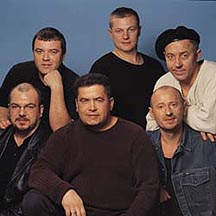
lyube-russian-band-favored-by-putin      RUSSIA’S CUDDLY MUSIC MAKERS–“LYUBE”

Lead singer of the band “ Lyube”,  Nikolai Rastorguyev had sung about the need for Russia to reclaim its territories in Alaska. V. Putin is a fan of this musical group. “Mixed signals” are hallmarks of Putin’s style. Below is an example:

“Do Not Fool with Us, America!The Tsars were wrong! Russia and Alaska are two banks of the same river!”

“Give back our dear land, dear Alaska, give it back to us!”

“We should have reclaimed Alaska a long time ago!”

Only last year an inflammatory TV documentary was aired with the name “When Will Alaska become Ours?” No doubt the script was a production of the Putin homeland propaganda machine. Nothing gets on Russian TV without approval.

Categories: History, Science and Biography | Tags: , , , , | Leave a comment

Teapot Dome, second edition


It seems clear that the incoming Trump Administration has already figured out how to make the country “great again”. Key to its strategy is the sale or “gift” of public assets to private interests, mainly “friends” of Trump and his pals.

Certainly whatever token amount can be worked out for this fire sale of the heritage of our country will temporarily boost revenues, but in the long term (too late, of course) we will learn the consequences of the election of 2016.

The other part of this festival of greed will be what are called “usage charges” for literally everything essential to life and sustenance,  essentially the conversion of freely traveled highways to toll roads, escalating fees for privately owned frequency spectrum and both surface and subsurface water.

Actually we will see a replay of the scandals of the Harding Administration of the 1920s, such as the Teapot Dome bribery case involving the only Cabinet Officer (so far!) convicted of a crime in office, a character well known in New Mexico (and reviled by history!), Albert B. Fall.

Complicit in the Harding greed-fest was Republican lock on Congress, lasting from 1919 to 1930, during which the slide toward Depression and war was launched—another similarity to today.

Sadly, responsibility for this election result belongs with all the eligible voters who, by their indifference, failed to exercise their responsibilities by voting in the 2016 election (final total, 53.1% voted, 46.9 % stayed home). I hope they’re happy.

Categories: History, Science and Biography | Leave a comment

Questioning and Curiosity


“Today, we can’t afford to become adults”

Thoughts on change, questioning, and childlike wonder from MIT’s Joichi Ito

Joichi_ItoIn recent weeks, I’ve been sharing some of the fuller versions of interviews conducted while I was researching and writing A More Beautiful Question. Here are some quotes from my talk with Joichi Ito (@Joi), one of the world’s most respected technologists and the current director of that hothouse of innovation known as the MIT Media Lab.

Ito on why questioning is becoming more important than ever

“There are two important differences in the world now. First, it’s a time of exponential change, so things are different every day. The old model of learning—that you do a lot of it when you’re young and then become an adult who doesn’t learn as much—that just doesn’t work as a productive way of living now. You have to learn new things all the time. And you learn by being curious and by questioning

“The other important difference: in addition to increasing change, you’ve got increasing speed and complexity. In a world that’s complex and fast, things aren’t as predictable as they were before. You must be much more resilient—to change, to failure, to the unexpected. Now you must maintain some of that childlike wonder and that ability to keep questioning and learning through doing.”

On questioning and learning

“If the learner is doing the questioning, it’s very different from when an examiner (or teacher) is doing the questioning. When you have the examiner doing the questioning, you’re in what I would call education mode. I think education is something other people do to you, whereas learning is what you do to yourself. You don’t learn unless you question—but we often don’t teach our kids to question; we teach them to answer our questions, forcing them to learn facts and skills. But since we may not know what facts or skills that kid’s going to need in the future, what you really want is to empower them to be able to find their own answers when they need them.

“Through questioning, we can also find more than answers—knowing how to ask the right questions can help you to pull support from a network of people or communities as you need it. You pull from the network by querying it, but you need to understand how to frame the questions. So it may be a matter of, how do you formulate the query to Google, or to an online community, to get the support or resources or answers you need. And if you have that skill, you may not need to know anything, other than people; it’s more about understanding the context of the network and how to traverse it.”

Diversity and questioning

“If a group is asking a question or challenging itself to come up with an answer for something, there’s a great body of work that shows diversity is extremely important. Everybody has different frameworks or models to ask the question; and it turns out that having a large number of very smart people that are similar is not nearly as useful as having maybe less smart people but with diversity of background.

“Then the issue becomes, how do you have a constructive conversation when everyone’s frameworks and backgrounds are different? At the Media Lab, we do what I call practice over theory. So, if an artist and a mechanical engineer are working together, it might be difficult for them to write a rigorous academic paper together, but they can build something together… and it either works or doesn’t. Often, academics create theories and test them and if it doesn’t work they start questioning the reality, the data. We’re the opposite; we build a robot and if it doesn’t work, it doesn’t work. And if it works but we don’t understand it, we can study it. Being able to “build the robot” is a really essential in this kind of environment where you’re searching and trying to discover things.

“At the Media Lab, we try to discover answers to questions we don’t know to ask yet. And that’s actually a harder kind of questioning because what you’re doing is asking, What is the question? That’s a harder thing but it’s where you get the really disruptive changes and discoveries. Some people would say we’re a pile of answers looking for questions.”

Joi-Ito

Why companies need to experiment more

“At the Lab, usually the costs of trying to figure out whether or not we should try something is more than just going ahead and letting people try it. For most things, the costs of experimenting, of building and trying things, have gone down. If you look at the people who started Facebook and Google, none of these guys asked permission, they just tried things out—because it didn’t cost them much to do it. And in companies today, I think people really need to think about that. Because in many companies, it’s still very difficult to do things without permission—and the permission-getting process can be slow. It’s important to lower the friction on innovation by allowing people to explore.”

On “neoteny”

“I was introduced to the term by Timothy Leary when he and I were writing a book together, and I kind of fell in love with it. Neoteny is about the retention of childlike attributes in adulthood; curiosity, playfulness, imagination, joy, wonder. This brings us back to the point that today, we can’t afford to become adults—meaning, we can’t afford to fall into that trap of being in repetition mode. Those childlike attributes, somehow you need to keep them. There are some people in our society who are allowed to remain creative, but for the most part, creativity isn’t considered an adult thing—you’re not supposed to fingerpaint. Neoteny is a word that gives you permission to keep that childlike creativity as an adult. To encourage neoteny, I think what’s needed is a culture that encourages playfulness and experimentation. That’s the culture we have here at the Media Lab.” (More on this site about neoteny.)

 On getting better at questioning

“To question, I think you have to have courage and confidence. A lot of times, if you’re sitting there and you think about something in the bathtub, you might say, “Oh, I’m sure somebody’s already thought of it”—and then you stop thinking about it. But the world is changing so fast and so much, every day, that things that weren’t true in the past are true now—so you should assume that what you’re thinking may actually be an original idea and pursue it. Have the energy and the courage and creativity to think through these ideas and try them out. And even if you fail you’ll have learned a lot more than if you just gave up.”


Categories: History, Science and Biography | Leave a comment

Alcohol fuel for the New Mexico Spaceport


Your opinions (printed March 18, Las Cruces Sun-News)

                                     NEW SPACEPORT BAR LIKE OLD BOOZE SHIPS

A burst of creativity from the crew piloting New Mexico’s ill-starred spaceport resulted in a need to obtain a liquor license, authorization for which was signed into law by Gov. Susana Martinez. (Senate Bill 147) This “need” has a basis in history. In the 1920s, during Prohibition, grand ocean liners such as the Ile-de-France, Windsor Castle and Bremen kept their on-board bars open while docked at New York piers, as the liners stocked and fueled for the return voyage across the Atlantic to Europe.

Through a quirk in the law, well-heeled visitors to shipboard bars were not technically on the soil of the United States, and thus were free to imbibe in unlimited quantities the premium booze (far superior to the mob-produced bootleg gin available on land) before staggering down the gangway to a waiting limo or cab.

So impaired these bar patrons were, that many could have been convinced they had traveled across the ocean and returned during their boozy episode.

In the same way, fogged-up patrons of the spaceport’s bar could be led to believe, with a little creative stage-craft, that they had launched into space and returned as their glasses were speedily refilled one after another. All such patrons, when suitably pickled, (no doubt enhancing the bottom line of the spaceport in the process) would be loaded into a stretch limo for the trek home to make sure none got near the wheel of a car until thoroughly sobered up.

The genius of this plan is that no longer do we have to bother with the empty promises of Sir Richard or his fellow space-venture hype artists or the technical issues of an actual orbital passenger rocket ship to provide a revenue stream for the spaceport.

— Dan Townsend, Las Cruces

Categories: History, Science and Biography | Leave a comment

Success in school explained


Starting at the school door is not soon enough

Recently I read an open letter from Michael Hays to Senator Lee Cotter concerning how to fix the 79% deficit in student reading performance in the fourth grade. As I see it, Hays believes the fix for NM is to upgrade colleges of education as opposed to Cotter’s support of widespread third grade retentions. Both are ideas for serious discussion but they don’t address the single factor that has been found to be the most important for student success.

Let’s step back and put the whole situation in perspective. Five years of life experiences have gone by before a child gets to school. Brain development in the first few years are the foundation for all learning that follows. What happens at home during this time has more influence on future success than anything that comes later.

Think of something you learned to do well. Maybe you are a great cook, play on a baseball team, or consider music an important pleasure in your life?

What is your very first memory of that experience? Quite likely, you can remember back to when you were three years old.

Now think of your best subjects in school. Is there a connection between your earliest memories and your school experiences? If you never touched a ball, how did you do in P.E? If your family didn’t dance or sing, how was your aptitude for music class?

For the first five years of life, every child’s first teachers are their caregivers. During the time when the brain is growing fastest and making crucial neural connections, a child is attaching emotionally, emulating, and trying to please the primary caregiver in the family.

Yes, educational excellence is of paramount importance and colleges of education are charged with the responsibility to train and produce the very best Reading teachers. Of course, public schools need to be accountable to standards, and milestones must be met to insure that learning is provided in a developmentally appropriate sequence for most of the children. I won’t argue with any of this. But, when looking for solutions, starting at the school door is not soon enough.

What happens at home between birth and the first day of kindergarten has much more to do with academic achievement than the number of years spent in third grade.

If a child grows up in a home where family games are played around the kitchen table and in the park, where throwing a ball, watching and talking sports is a favorite pastime, if music permeates the air, that child will enter school ready to excel at recess, PE, Music and even Math. Add books and shared family reading time to that mix and now our theoretical little kid is on a level playing field for Reading which opens the rest of the curriculum as well.

Lots of talking, naming, explaining, telling stories, and reading books together for pleasure, along with opportunities to ask and answer questions are fundamental learning skills. Starting school with these experiences make it much more likely that the curriculum in each grade will be developmentally appropriate and the transition from one grade to the next will be seamless.

Parents need to know that Kindergarten is changing to keep up with a fast paced world:

Children are expected to come to school able to recognize their own names as well as the names and sounds of letters and be able to print many of them in both upper and lowercase, count to 20 and see the one to one correspondence of numbers to objects, retell a story they have heard, and draw a picture to tell about an experience. They need to be able to concentrate on a task for five minutes, participate politely in group activity, and be flexible enough to adjust to new people and situations.

If 79% of our community’s children are not reading at grade level, there are lots of things that need to be done, including teacher training and school reform, but first parents need to be informed of what society’s expectations are and how easily they can be addressed at home in the earliest years. Finding out after school starts is entirely too late.


Categories: History, Science and Biography | Leave a comment

Sayonara 2015


(printed in the Las Cruces Sun-News, December 31, 2015)

Good riddance 2015, hopes for better 2016

If I could, I’d give 2015 a swift kick in the pants as it made way for 2016. Consider what went on during the year now ending: a mother who gave her six-month-old child a bottle, then suited up and joined her husband on a killing spree at a holiday party; a group of thugs in the Middle East who “inspire” others, (not themselves, oddly enough), to blow themselves up in various parts of the world expecting to get to paradise before anyone else; “low information voters” who become low information candidates for president of the U.S. — along with assorted sneerers and overstuffed billionaires. You couldn’t make this stuff up if you tried.

How about the “smart money” guys of 2015 who pride themselves on sending young people out on international soccer and (U.S.) football fields to beat their brains out to generate bribes, payoffs and lucrative TV contracts for their handlers. Or the characters who buy up drug companies to enrich themselves on the pain and suffering of others — not to mention congressmen enjoying the best medical care in the world seeking to deny health care to the working poor.

How about the makers and marketers of the guns spewing ammunition out of car windows; within classrooms, clinics, hospitals and churches; into playmates from other playmates; and, at close range, into the bodies of tortured souls afflicted with suicidal impulses.

Finally, 2015 saw another bump in the profits of predatory loan stores now on street corners around poor neighborhoods and military bases — so much for military preparedness.

Hope springs eternal, goes the expression. Will 2016 give hope a chance?

Dan Townsend,

Las Cruces

Categories: History, Science and Biography | Leave a comment

The Consequences of Denial


April 25, 2010

Suppose that an airline pilot, doing his pre-flight checks at Denver’s International Airport, got a printout of weather data which reflected not metropolitan Denver 2010, but  the  same area as it was in 1800.  The occasional native American cooking fire would have been the only contribution of man to the area temperature in 1800. Metropolitan Denver, like all 21st century urban areas, contributes by means of the well-known “heat island” effect, several degrees (as much as 22 degrees F.), depending on the season/time of day, etc., to its area temperature.  This is in addition to global climate change and other factors.

Factoring the spurious data he was supplied into the “density altitude” calculation critical to successful take-off, the unfortunate pilot and his passengers risked  winding up being mixed with fiery wreckage just across the freeway marking the end of the runway—another tragedy based on faulty data.

Another example: the trainee helmsman on duty as the Exxon Valdez wallowed  fully loaded  through Prince William Sound Alaska one night in 1989,  failed to realize that the fully loaded vessel handled very sluggishly to its controls compared to its handling, empty, on the trip to Alaska.  Pushed by cost-cutting management to shave time from the voyage by charting a course near Bligh Reef, the unfamiliar feel to the controls drew the vessel onto the reef, and on to front pages around the world.

In 1964, my wife and I visited the beaches along New Jersey’s Atlantic Shore. Wondering why so few were present on a beautiful summer afternoon, we soon discovered tar balls and oily goo along the water’s edge. The locals told us that an upwelling of the sea  had brought up oil from the bottom placed there as Nazi submarines, organized into “Wolf Packs” sank hundreds of merchant ships, many of them oil tankers, during the early years of WWII, many within sight of shore (wreckage and bodies were a regular sight along our Atlantic beaches at that time. The massive effort to stop this carnage was a well-kept secret during the war). The  waters of Gulf of Mexico are presently unwilling recipients of enough oil from the Deepwater Horizon oil platform blowout, underway as this piece is written,  to fill each of the sunken tankers of the WWII era in a few minutes. Leadership of the communities  which came to depend on revenue from the undersea oil resource are already in denial, for the usual political reasons.

Natural systems are a lot like the fully loaded Exxon Valdez.  As a helmsman on various ships on several occasions, I am well aware of the need to anticipate the reaction of a vessel to its controls as currents, winds and cargo loading mix with steering commands to produce the vessel’s actual course. Reductions  in, for example, CO2 contributions by man, will not be fully felt in terms of global warming, for decades. Does this mean that we should deny that Bligh Reef, or its climatic equivalent, exist?

Obviously waiting until the Exxon Valdez is within a few feet of the reef to correct its course would be disastrous, as history shows. When do Global Climate Change skeptics plan to take corrective action, should the extremely complex variables at play in man-caused climate change finally produce a definitive result with which all could agree?

The good part is that I am unaware of any global climate change skeptics piloting commercial aircraft or ocean-going ships. We can all be thankful on that score.

Dan Townsend

(Re: the above article: I was a resident of Alaska for 35 years, during the “Pipeline era” and the Exxon Valdez tragedy and its aftermath. At different times I was a helmsman on three ocean-going vessels: the MV Stevonia {Ellerman Wilson Lines, UK}; and  the fully rigged sailing vessels “Western Union” and “Wolf” home port, Key West Florida. I was also, among other duties, a “cockpit observer” for the Federal Aviation Administration.)

Categories: History, Science and Biography | Leave a comment

Guns


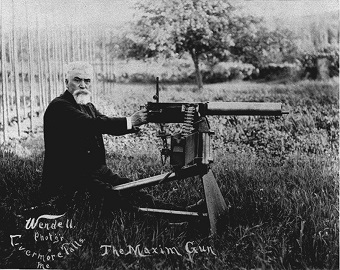
hiram_with_gun2

Las Cruces Sun News 08/09/2015, Page C05

Your opinions 

The Devil’s Paintbrush is still doing damage

The human weakness for mayhem and murder has been a consistent source for profit through the ages, a fact well known to the arms industry behind today’s National Rifle Association.

Armories of Germany, Britain, France, Belgium, Russia and the United States at the end of the 19th century produced versions of the “Maxim Gun,” referred to as the “Devil’s Paintbrush” due to its use in conflict since the original 1883 patent by its inventor, Hiram Maxim: “In 1882 I was in Vienna, where I met an American whom I had known in the States. He said, ‘Hang your chemistry and electricity! If you want to make a pile of money, invent something that will enable these Europeans to cut each others’ throats with greater facility.’” Ninety percent of those felled in the battlefields of WWI from bullet-related injuries died from Maxims and clones employed in that war. Similar numbers succumbed in WWII and subsequent wars from land and airlaunched ordnance fired at a rate of 600 rounds per minute and higher.

Sprayed ordnance at up to 1,200 rounds per minute is available from the muzzle of the Glock 18, a 2-pound gun that occupies the space within a lady’s handbag.

Trust the NRA, its network of craven politicians and infotainment jockeys to make such toys available to whomever wants one — presently available only to our increasingly militarized police forces — but stay tuned!

Imagine the result of a suspected attack inside a darkened theater answered by vigilantes in the audience with fire, the walls echoing from all directions and lit cell phone screens confused with muzzle flashes — enough body bags for the outcome?

Back to the NRA and its sponsors — Sir Basil Zaharoff, the most notorious arms dealer of all time, was known as the “Merchant of Death.” I’m sure he wouldn’t mind sharing the honor.

Dan Townsend, Las Cruces 

Categories: History, Science and Biography | Tags: , , , , | Leave a comment

Blog at WordPress.com.