Posts Tagged With: travel

GODS ARE ONLY USEFUL IF THEIR SIDE IS WINNING


Classical Wisdom

Classical Wisdom

Dear Classical Wisdom Reader,

What do you get when you mix divine rivalry, civic pride, and a splash of olive oil? Athens, apparently.

According to legend, the city’s name was decided in what can only be described as the ancient world’s version of X-factor. Poseidon shows up with his mighty trident, smashes the earth, and proudly unveils a saltwater spring. Athena, meanwhile, plants an olive tree and wins the crowd. Athens is hers, and Poseidon presumably storms off to sulk in the sea.

But Athena didn’t just give Athens its name. She became its symbol, its protector, and, perhaps most importantly, its brand. Her image crowned the Parthenon, her festivals filled the streets, and her colossal golden statue towered over the city like a divine reminder that Athens wasn’t just any city; it was the city. Culture, power, philosophy, democracy… all under her watchful gaze.

Of course, symbols are tricky things. When Athens rose, Athena gleamed. When Athens fell, battered, beaten, and stripped of its walls by Sparta, that same statue became a little… awkward. It’s a bit like putting up a “World Champions Forever” banner the year before your team spectacularly loses. Even gods, it turns out, can become embarrassing.

But that’s why Athena’s story is so interesting. Beneath the myths and marble is something deeply human. We still pour our hopes into symbols, still tell ourselves grand stories, still cling to ideas that define who we are… until, suddenly, they don’t.

Athens’ devotion to Athena reveals a truth: identity is fragile, power is fleeting, and sometimes even divine protection has an expiration date…

All the best,

Anya Leonard

Founder and Director

Classical Wisdom

Wisdom doesn’t have an expiration date. Become a Classical Wisdom Member and let the ancients guide you:

The Athenian Athena

By Ben Potter

Anyone with an interest in the classical Greek world may well have been intrigued, possibly confused, by the relationship between the goddess Athena and the ancient centre of democracy, philosophy and theatre, Athens.

As Walter Burkett said in his excellent book, Greek Religion: “whether the goddess is named after the city or the city after the goddess is an ancient dispute”. One, unfortunately, which is impossible to resolve.

However, an ancient tourist would have needed to look no further than the pediments of the mighty Parthenon to see evidence of Athena’s importance to the city.

The East pediment shows her motherless birth, straight from the head of Zeus. The myth goes that the King of the Gods, complaining of a headache, had his skull cracked open by Hephaistos‘ mighty hammer and out popped Athena, fully grown and clad in armor.
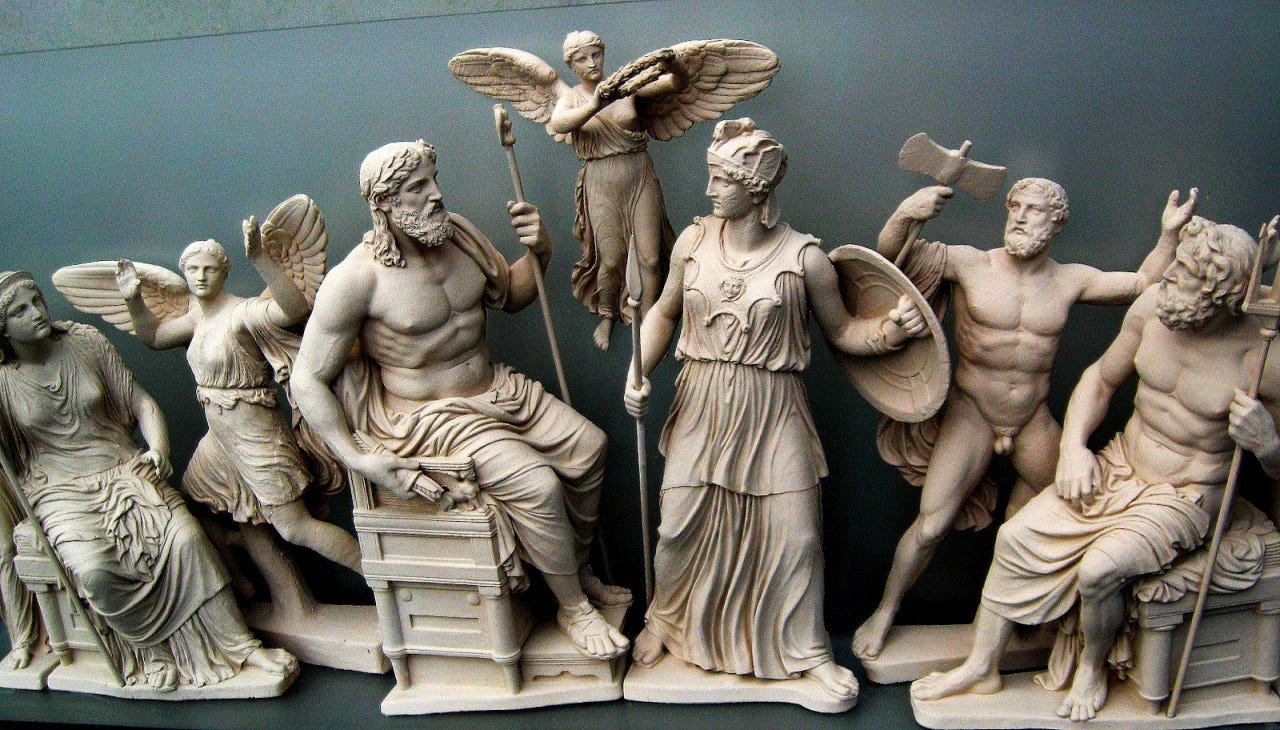
The West pediment depicts an early edition of Athens’ Got Talent (or whatever the devil the young people watch) with a competition between Athena and the sea-god Poseidon to win the honor of becoming the city’s patron deity by performing a beneficial miracle.
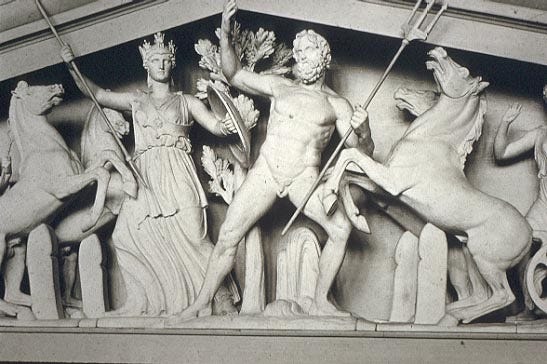
Poseidon created a salt water spring after striking his trident into the ground, to which Athena responded by producing an olive tree that is still visible on the Acropolis today.

Another myth explains that Athena triumphed over Poseidon because all the women, who made up a majority, voted for her and all the men for the sea-god. From this point on men decided women were not allowed to take part in elections. This fanciful, if amusing, tale of sour-grapes and misogyny is thought to have been a later introduction (i.e. during the democracy).

As well as her role as the patron deity, Athena also contributed to the ancient lineage of the city.

Share


She was said to have been pursued by skull-cracker Hephaistos who, with the trademark chivalry of the ancient gods, attempted to rape her of her virginity. However he spilt his seed on the ground and from it Erecthonius, the mythological ancient king of Athens was born. Athena then became foster mother to the baby and brought him up on the Acropolis.

Whilst such stories may seem whimsical, sometimes fay, to us, the power of the physical imagery of Athena cannot be underestimated.

It was one of the key factors by which Peisistratus became tyrant c.557/6 BC. According to Terry Buckley:

“He dressed up a stunningly beautiful six-foot woman in full armor; it was then claimed through messengers that she was Athena…and that she herself in her chariot was delivering Peisistratus to her own Acropolis to take over the rule of Athens’.

Although it is highly unlikely that the people of Athens truly believed Athena had come to Earth and was standing next to a politician in a chariot, the symbolism of the stunt and the association to the goddess seemed to endear Peisistratus to many.

Thus, ‘I am driven with a mission from God’ is as timelessly effective as it is unoriginal.

The most significant role Athena played as the patron deity was her contribution in the Panathenaia, a huge, annual festival of religious devotion and national pride; a Christmas Day and 4th of July rolled into one.

Falling on Athena’s birthday (28th day of Hekatombaion), the vast scale of the festival is recorded on the 175-yard long frieze of the Parthenon and includes animals for sacrifice, metics (resident foreigners), musicians, infantry, cavalry, craftsmen, priests and ordinary Athenians marching by deme (parish).

Athletic competition was also a part of the festivities and, here again, we see the influence of Athena. The special olive oil that was given to the victors was presented in a vessel that had the goddess on one side and the chosen discipline of the victorious athlete on the other.

Over 1400 amphorae (or type of container/vase) of this sort were produced every year in time for the Panathenaia.

The celebration took place on a much larger scale every fourth year. As part of the Grand Panathenaia, a huge peplos (tunic) was placed on the 39 foot statue of Athena Parthenos, situated inside the Parthenon. Outside the temple, this elegance was starkly contrasted as Athena’s birth was re-enacted in a grisly ritual where a bull’s head was smashed open, though presumably without an armored cow jumping out.

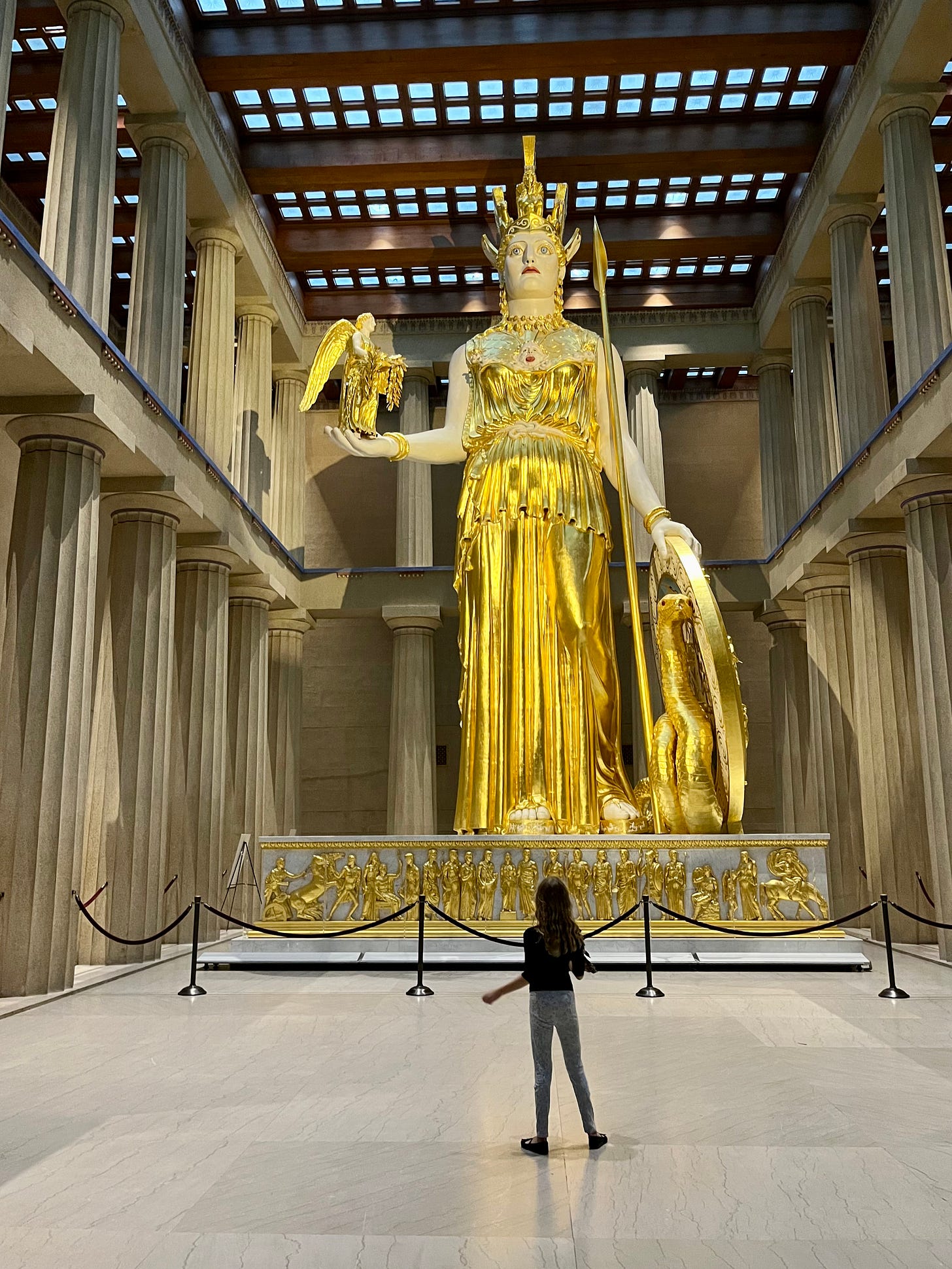
This huge chryselephantine (gold and ivory) statue of Athena Parthenos is worth further comment. Containing 2400 lbs of gold, it was built between 447 and 438 BC, at a time when the Greeks had just resisted invasion against the mighty Persian army.
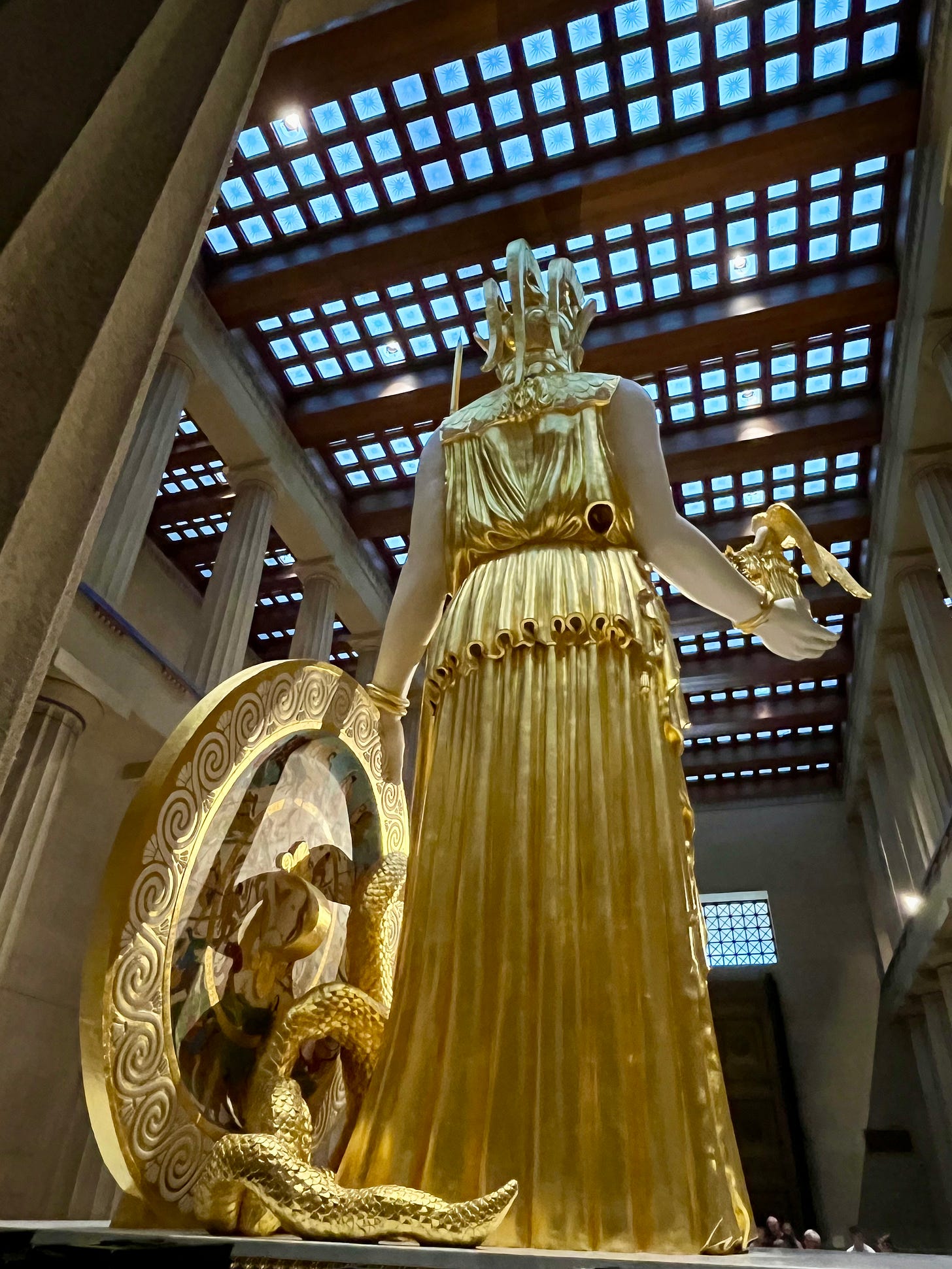
Thus, Athens was leading the world not only in terms of power, but also in culture; the finest thinkers, playwrights and scientists were either emerging from Athens or making an intellectual pilgrimage there. The grandeur and pomp of the Athena Parthenos was fitting, not only for the time, but for the thanks the citizens owed their patron protectress.

However, when the tables turned, it would have looked at best foolish and embarrassing, and at worst mocking and damning.

Don’t Turn Your Back on the Ancients… Become a Classical Wisdom Member and Learn from them instead:

During the latter part of the 5th century, Athens suffered a humiliating defeat in the Peloponnesian War against Sparta, not only sustaining huge casualties, but being transformed from the leaders of progressive thought and democracy to a second-rate power. The victorious Spartans even forced the Athenians to suffer the emasculating humiliation of having their protective city walls taken down.

As often happens when people feel god has abandoned them, they abandon god. However, in this instance, it seems Athenians abandoned the over-sized, suddenly incongruous sculpture, rather than the goddess herself.

The statue still remained a great work of art and a massive tourist attraction (there were at least 300 ancient replicas), but, as Andrew Stewart commented: “it swiftly lost its religious significance to all but a tiny minority… after 404 BC the Athena Parthenos became a museum piece”.

Astoundingly, there is a full-size replica of the mighty effigy in Nashville, Tennessee which boasts extraordinary attention to detail. The main difference being there is no documented evidence the original was made of gypsum and fiberglass.
Despite her elevated status as patron, Athena was not totally dominant in religious worship in Athens. The Eleusinian mysteries were (rather ironically) among the best known of all the Athenian cults and primarily paid homage to Demeter.

Also, the erection over the Agora of the Hephaisteion in the 440s BC gives great and towering status to the would-be assailant of Athena. What may have been doubly galling to Athena fans is that this building was made to honor the blacksmiths for their role in the Persian Wars, despite Athena being sacred to metal-workers.

Some say Socrates (executed for impiety) and men like him were bringing into question the very existence or importance of the gods. Whilst of all the extant Athenian tragedies, only The Ajax of Sophocles casts Athena in a role of any importance.

Who was Ajax? And why was his tale so tragic?

Despite these aberrations, there seems little doubt that Athena was ever-present in the psyche of the Athenians and there was certainly enough good-will in the bank to maintain for her a place of prominence within the polis.

Although she had many sub-roles within society: being sacred to maidens, weavers, carpenters, oil manufacturers, and blacksmiths, combined with her reverential position as the goddess of eyesight, wisdom and warfare, it is the historical, nationalistic and social links that make her such an important figure as patron.

Certainly being responsible for the year’s biggest knees-up is something that would cause even the staunchest unbeliever to rejoice in her worship.

After all, piety is all well and good, but a party is usually better.

Discussion about this post

I find it very interesting how this article shows that Athena was much more than a goddess: she was the personification of Athens’ identity, a kind of collective brand that brought together religion, politics, and culture. What strikes me most is how her image could inspire both pride and embarrassment, depending on the historical moment. Do you think that, just like with Athena, today we also idealize collective symbols that over time can become uncomfortable or lose their meaning?

Reply
Share

“After all, piety is all well and good, but a party is usually better.” I would call it a sign of bad times, the modern times. Look where mere “partying” has brought us. Are modern people proud, happy and democratic, like they were in Athena’s heyday? We’re not even an iota, compared to those times. Democracy was invented and was forming a deep foundation. Now democracy is being uprooted and smeared. No comparison!

My question to you, sir, is: which side are you on? It seems you admire classical wisdom. Is your effort merely rhetoric, merely a talking point with no seriousness attached to it? Do you have any regrets or a feeling of sorrow for what we’ve become?

What is the purpose of your trade, your writing? You just describe Athen’s classic wisdom. You don’t say that we should be guided by it or we should emulate it and advance it.

What is the purpose of creating deities and myths? It is to guide us towards practical development, a paragon to live by. I think you’ve missed the whole point. Sorry!

Reply
Share

3 more comments…

Categories: History, Science and Biography | Tags: , , , , | Leave a comment

THE “GREAT DYING” IN THE AMERICAS AFTER 1492, AND ITS EARTH SYSTEM IMPACTS.


The “germs” part of GUNS, GERMS AND STEEL (the PBS series and book by Professor Jared Diamond)

4 December 2018


Alexander Koch a, *, Chris Brierley a, Mark M. Maslin a, Simon L. Lewis a, b

a Geography, University College London, London, WC1E6BT, United Kingdom
b School of Geography, University of Leeds, Leeds, LS29JT, United Kingdom

Abs t r a c t
Human impacts prior to the Industrial Revolution are not well constrained. We investigate whether the
decline in global atmospheric CO2 concentration by 7e10 ppm in the late 1500s and early 1600s which
globally lowered surface air temperatures by 0.15+C, were generated by natural forcing or were a result of
the large-scale depopulation of the Americas after European arrival, subsequent land use change and
secondary succession. We quantitatively review the evidence for (i) the pre-Columbian population size,
(ii) their per capita land use, (iii) the post-1492 population loss, (iv) the resulting carbon uptake of the
abandoned anthropogenic landscapes, and then compare these to potential natural drivers of global
carbon declines of 7e10 ppm. From 119 published regional population estimates we calculate a

           pre-1492 CE population of 60.5 million

(interquartile range, IQR 44.8e78.2 million), utilizing 1.04 ha land per
capita (IQR 0.98e1.11).

European epidemics removed 90% (IQR 87e92%) of the indigenous population over the next century.

This resulted in secondary succession of 55.8 Mha (IQR 39.0e78.4 Mha) of
abandoned land, sequestering 7.4 Pg C (IQR 4.9e10.8 Pg C), equivalent to a decline in atmospheric CO2 of
3.5 ppm (IQR 2.3e5.1 ppm CO2). Accounting for carbon cycle feedbacks plus LUC outside the Americas
gives a total 5 ppm CO2 additional uptake into the land surface in the 1500s compared to the 1400s, 47
e67% of the atmospheric CO2 decline. Furthermore, we show that the global carbon budget of the 1500s
cannot be balanced until large-scale vegetation regeneration in the Americas is included.

Global climate change graph

YELLOW BOX IS THE “GREAT DYING” TIMESPAN, BLACK IS “CARBON UPTAKE” due to reforestation, BLUE and GREY are ice cores showing atmospheric CO2 levels


THE GREAT DYING OF THE INDIGENOUS PEOPLES OF THE AMERICAS RESULTED IN A HUMAN-DRIVEN GLOBAL IMPACT ON THE EARTH SYSTEM IN THE TWO CENTURIES PRIOR TO THE INDUSTRIAL REVOLUTION.


Amerindians in North America

Once, North America was full of Amerindian nations, populations of people ancestrally indigenous to the continent. Researchers estimate population numbers in the millions prior to the arrival of Europeans, but today Amerindians make up only about 1% of the total population. So, what happened? Well, the arrival of Europeans introduced many new things to North America. Some of those things were invisible bacteria and viruses that caused pandemic-level outbreaks amongst Amerindian populations. Now, off the bat it should be acknowledged that diseases did not single-handedly destroy Amerindian civilizations. However, when coupled with slavery, oppression and forced dietary/social changes that came from colonialism, these diseases did have an absolutely lethal impact. One of the most notorious of these diseases was smallpox, a vicious virus that even today cannot be treated except to manage its symptoms and prevent its spread. Of all the colonial empires to touch Amerindian nations, smallpox may have been the most aggressive.

Introduction of Smallpox

Smallpox found its way into the Americas basically in tandem with the first major colonial expeditions. The Spanish started setting up colonies in the Caribbean in the late 15th century, and by the first decade of the 16th century the region was already experiencing widespread mortality amongst Amerindian populations. Now, the obvious question here is why smallpox affected Amerindians so harshly. Smallpox as a disease first transferred to humans around 10,000 BCE. It appeared first in agricultural societies as humans were exposed to diseases carried by animals, and spread across Africa and Europe. But, over thousands of years they built up immunities. This doesn’t mean they were completely safe; a smallpox outbreak in Rome is believed to have killed roughly 7 million people in 108 CE. However, when smallpox appeared in the Caribbean, it encountered a people with absolutely no previous exposure, and therefore no genetic immunities to the disease.


Europeans landing in the Caribbean unknowingly introduced new diseases
Columbus

The people of the Caribbean, called the Taíno, were the first to really have to deal with smallpox, and they were entirely wiped out. When Europeans first arrived in the Caribbean, they often enslaved the Taíno and forced them into hard labor. Exhaustion and starvation weakened their immune systems, reducing the little ability they had to fight off new diseases like smallpox. Of the many populations to be decimated by smallpox, the Taíno are amongst the only ones considered to have experienced nearly a 100% mortality rate. In fact, it was because the Taíno had all succumbed to the disease that Europeans started importing new slaves from Africa. This actually made the smallpox problem worse, as African slaves unknowingly carried new strains of the disease.

Impact on European Colonialism

Smallpox ended up being one of the most dramatic factors in the colonial wars that would emerge between Amerindians and European empires across the next several centuries. When Hernán Cortés and the Spanish Conquistadores took on the Aztec Empire, many parts of that empire had already been ravaged by smallpox. Since the virus passes from person-to-person and can hide within a host for almost two weeks before that person shows any symptoms, smallpox worked its way into the continental Americas long before the Europeans got there. In fact, the Aztec capital of Tenochtitlán was ravaged by smallpox while the Spanish weren’t in the city, and the Aztec emperor himself was killed.

The disease likely reached Tenochtitlan when Cortés returned from the coast in June 1520, and by September it had killed perhaps half of the city’s 250,000 residents, including Montezuma’s successor, Cuitláhuac.

The loss of warriors and political disunity caused by the disease was part of the reasons the Aztec Empire fell.


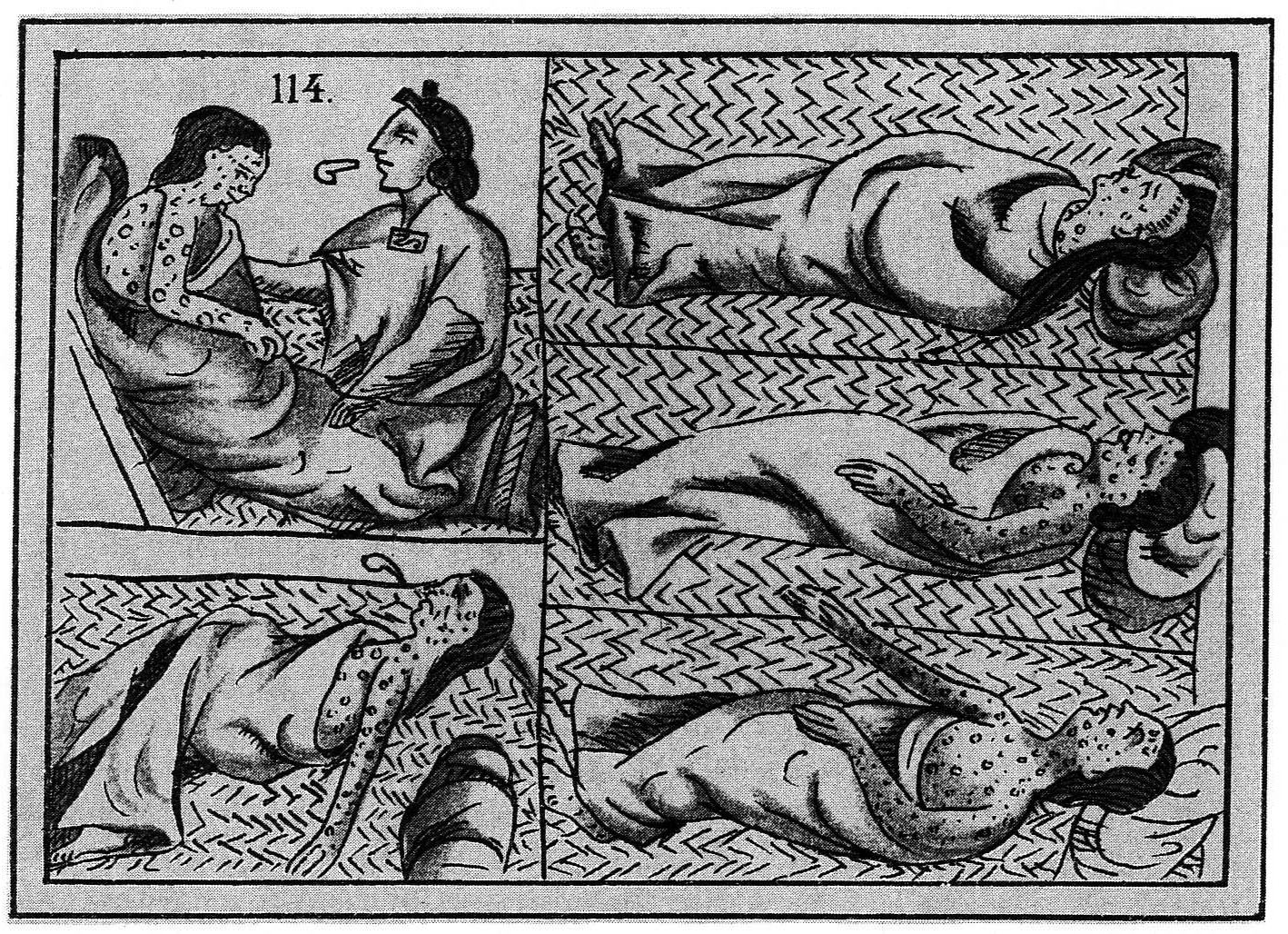
Smallpox depicted in Aztec illustrations
Aztec smallpox art

This trend would continue across the Americas. When European traders first made it to what is now Oregon and Washington, they noted that there were already members of the tribal nations there who were sick with smallpox. Researchers estimate that a smallpox outbreak in a community who has never seen the disease before can impact their population for 100 to 150 years. Those who survive are still carriers of the disease, and with each generation the virus can reappear, wreaking havoc.

In 1517 the Spanish conquistadors, led by Hernán Cortés, arrived in Tenochtitlan, the capital of the Aztec Empire. The ruler of the Aztecs, Montezuma II, made the Spanish welcome and things were initially friendly (but obviously wary) between the Spanish and the Aztecs initially.


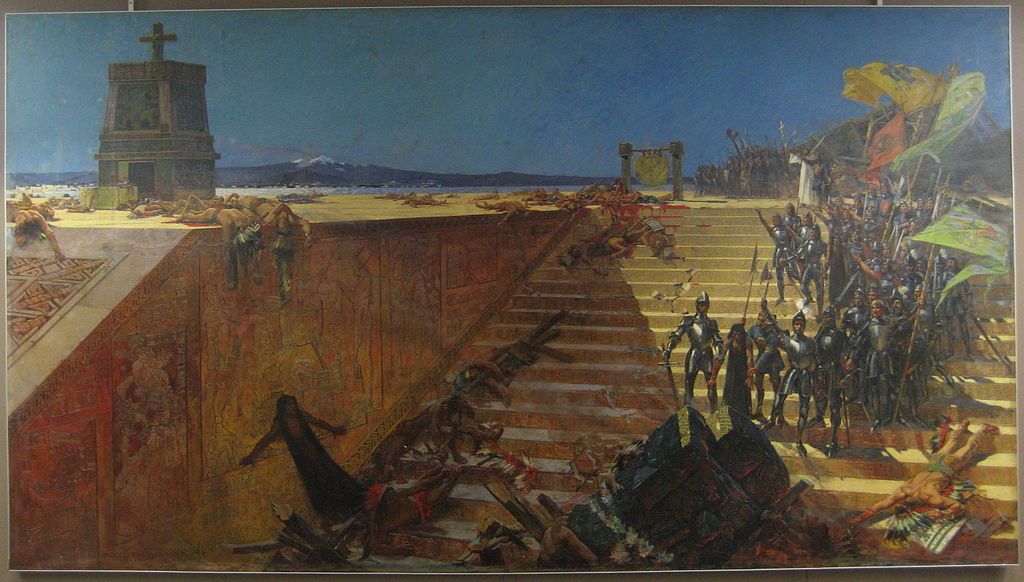
Tenochtitlan before Cortes–250,000 people, compulsory public education for all

1024px-LastDaysofTenochtitlanB

CORTES’ SOLDIERS ENCOUNTERING THE SMALLPOX VICTIMS OF TENOCHTITLAN

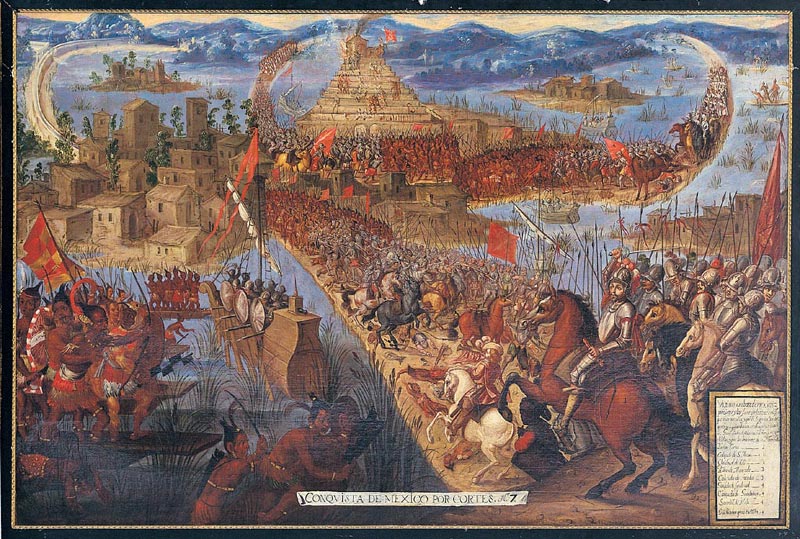
Notice the sophisticated boats based on Cortez’ imaginative reports to Spain, though Cortez burned his ships because he knew that his band would be unable to fashion boats to desert him. Armoured soldiers in the water would drown immediately, along with their panicked mounts.

Two years later the conquistadors began their conquest of Mexico, and by August 1521 Tenochtitlan had been destroyed. The Spanish colony of New Spain was established and the Aztec Empire had ended. The reasons for this rapid and dramatic destruction of such a mighty Empire were multi-factorial. The superior weaponry and more sophisticated military tactics of the Spanish, the religious beliefs of the Aztecs, and the long history of ritual sacrifice and persecution of the other peoples living in Mexico all played essential roles. There are a large number of detailed resources available on this subject, and I highly recommend the History on Fire podcast series by Daniele Bolleli if you are interested in the topic.

Primary Source Reading: Aztec Accounts of the Conquest

Introduction to the Source

In 1517  Hernan Cortés sailed from Cuba, landed in Mexico and made his way to the Aztec capital. Miguel Leon Portilla, a Mexican anthropologist, gathered accounts by the Aztecs, some of which were written shortly after the conquest. Note that references to the “Sun” refers to Aztec beliefs regarding the commandment of their Sun god to honor a future light-skinned visitor, a representative of the Sun god. Armored uniforms, shining in the sun, and the European light skin of Cortez’ entourage, reinforced this perception. Hostilities erupted when Spanish soldiers, with no translators among them (Malinche, Cortez’ concubine and translator, accompanied Cortez in his trek to the Veracruz to deal with soldiers sent to arrest him for defying the orders of the Spanish Governor in Cuba.)

   These soldiers perceived the celebration as somehow threatening to them because of their ignorance of Aztec language and custom, and commenced slaughter of celebrants and eventually much of Aztec leadership. Cortez returned to find a war between the Spanish and Aztecs already in progress.

Speeches of Motecuhzoma and Cortés

When Motecuhzoma [Montezuma] had given necklaces to each one, Cortés asked him: “Are you Motecuhzoma? Are you the king? Is it true that you are the king Motecuhzoma?”

And the king said: “Yes, I am Motecuhzoma.” Then he stood up to welcome Cortés; he came forward, bowed his head low and addressed him in these words: “Our lord, you are weary. The journey has tired you, but now you have arrived on the earth. You have come to your city, Mexico. You have come here to sit on your throne, to sit under its canopy.

“The kings who have gone before, your representatives, guarded it and preserved it for your coming. The kings Itzcoatl, Motecuhzoma the Elder, Axayacatl, Tizoc and Ahuitzol ruled for you in the City of Mexico. The people were protected by their swords and sheltered by their shields.

“Do the kings know the destiny of those they left behind, their posterity? If only they are watching! If only they can see what I see!
No, it is not a dream. I am not walking in my sleep. I am not seeing you in my dreams…. I have seen you at last! I have met you face to face! I was in agony for five days, for ten days, with my eyes fixed on the Region of the Mystery. And now you have come out of the clouds and mists to sit on your throne again.
This was foretold by the kings who governed your city, and now it has taken place. You have come back to us; you have come down from the sky. Rest now, and take possession of your royal houses. Welcome to your land, my lords!”

When Motecuhzoma had finished, La Malinche translated his address into Spanish so that the Captain could understand it. Cortés replied in his strange and savage tongue, speaking first to La Malinche: “Tell Motecuhzoma that we are his friends. There is nothing to fear. We have wanted to see him for a long time, and now we have seen his face and heard his words. Tell him that we love him well and that our hearts are contented.”

Then he said to Motecuhzoma: “We have come to your house in Mexico as friends. There is nothing to fear.”

La Malinche translated this speech and the Spaniards grasped Motecuhzoma’s hands and patted his back to show their affection for him….

Massacre in the Main Temple

During this time, the people asked Motecuhzoma how they should celebrate their god’s fiesta. He said: “Dress him in all his finery, in all his sacred ornaments.”

During this same time, The Sun commanded that Motecuhzoma and Itzcohuatzin, the military chief of Tlatelolco, be made prisoners. The Spaniards hanged a chief from Acolhuacan named Nezahualquentzin. They also murdered the king of Nauhtla, Cohualpopocatzin, by wounding him with arrows and then burning him alive.

For this reason, our warriors were on guard at the Eagle Gate. The sentries from Tenochtitlan stood at one side of the gate, and the sentries from Tlatelolco at the other. But messengers came to tell them to dress the figure of Huitzilopochtli. They left their posts and went to dress him in his sacred finery: his ornaments and his paper clothing.

When this had been done, the celebrants began to sing their songs. That is how they celebrated the first day of the fiesta. On the second day they began to sing again, but without warning they were all put to death. The dancers and singers were completely unarmed. They brought only their embroidered cloaks, their turquoises, their lip plugs, their necklaces, their clusters of heron feathers, their trinkets made of deer hooves. Those who played the drums, the old men, had brought their gourds of snuff and their timbrels.

The Spaniards attacked the musicians first, slashing at their hands and faces until they had killed all of them. The singers-and even the spectators- were also killed. This slaughter in the Sacred Patio went on for three hours. Then the Spaniards burst into the rooms of the temple to kill the others: those who were carrying water, or bringing fodder for the horses, or grinding meal, or sweeping, or standing watch over this work.

The king Motecuhzoma, who was accompanied by Itzcohuatzin and by those who had brought food for the Spaniards, protested: “Our lords, that is enough! What are you doing? These people are not carrying shields or macanas. Our lords, they are completely unarmed!”

The Sun had treacherously murdered our people on the twentieth day after the captain left for the coast. We allowed the Captain to return to the city in peace. But on the following day we attacked him with all our might, and that was the beginning of the war.


In addition to these factors, smallpox undoubtedly played a huge part in the fall of the Aztec Empire. When Cortés and his army began their campaign against the Aztecs in 1519, over 30 million people were living in Mexico. One hundred years later, after a series of smallpox epidemics had decimated the local population, it is estimated only around 1.5-3 million natives had survived.

Native Americans Helped the Europeans when they Suffered Disease

Updated on May 9, 2013

Native Americans became exposed to many new diseases when the Europeans arrived in North America. Native American communities were isolated from disease until the arrival of the Europeans. The Europeans had built up immunity to many diseases while living in the Old World. Native Americans had never been exposed to these diseases before and their traditional cures did not work. The transmission of the diseases caused more devastation in the New World than the Black Death had done in Europe. Hundreds of thousands of Natives died from these diseases. Well established trade routes helped spread the diseases very quickly. Diseases that the Europeans brought over were smallpox, measles, malaria, yellow fever, influenza, chicken pox, and many others. Diseases that were spread to the Europeans from the Natives were syphilis, polio, hepatitis, and encephalitis.

Christopher Columbus

Christopher Columbus and his crew landed in Hispaniola, an island in the Caribbean Sea, in the year 1492, and by the year 1600 most of the Natives were dead from disease. The reason they died so quickly is because the Europeans brought over livestock with them. The Natives were hunters and gatherers. The Europeans lived in tight settlements with their livestock, which helped diseases spread faster. Cattle pass measles, tuberculosis, and smallpox to people. Pigs pass influenza and pertussis to people. Chickens pass malaria to people. The Natives did not have these animals until the Europeans arrived, and did not have the antibodies to fight the diseases as well as the Europeans had. Trading with one another helped spread the diseases quickly. Alfred Crosby writes about some of these diseases in his article The Columbian Exchange, Smallpox was the worst and the most spectacular of the infectious diseases mowing down the Native Americans. The first recorded pandemic of that disease in British North America detonated among the Algonquin of Massachusetts in the early 1630s: William Bradford of Plymouth Plantation wrote that the victims “fell down so generally of this disease as they were in the end not able to help one another, no not to make a fire nor fetch a little water to drink, nor any to bury the dead.” European explorers encountered distinctively American illnesses such as Chagas Disease, but these did not have much effect on Old World populations. Venereal syphilis has also been called American, but that accusation is far from proven. Even if we add all the Old World deaths blamed on American diseases together, including those ascribed to syphilis, the total is insignificant compared to Native American losses to smallpox alone.”

Syphilis

The Europeans not only brought disease to the New World, but also brought disease with them back to the Old World. European sailors on their way back to Europe brought syphilis with them. “The origin of venereal syphilis is referred to as the “Columbian hypothesis”, it asserts that the disease causing agent Treponema pallidum originated in the New World and was spread in 1493 by Christopher Columbus and his crew, who acquired it from the Natives of Hispaniola through sexual contact. Upon return to Spain, some of these men joined the military campaign of Charles VIII of France and laid siege to Naples in 1495. Encamped soldiers exposed the local populations of prostitutes, which amplified disease transmission. Infected and disbanding mercenaries then spread the disease throughout Europe when they returned home. Within five years of its arrival, the disease was an epidemic in Europe. Syphilis reached Hungary and Russia by 1497; Africa, the Middle East and India by 1498; China by 1505; Australia by 1515; and Japan by 1569.” The most common remedies for syphilis were mercury and guaiacum.

Native Americans

The Native Americans did help the Europeans when they suffered disease. One example is when the French explorer Jacques Cartier and his crew were trapped in the St. Lawrence River near Montreal. The ships were frozen in the ice from November to March during the winter of 1535 to 1536. As a result, disease broke out on the ships and twenty-five men died. (The disease is what we now call scurvy.) The local Natives saw the Frenchmen’s plight and showed them how to take bark and leaves of a certain tree (either white pine or hemlock) boil them down and drink it every other day. Native American healers, many of them women, knew where to find natural plant remedies. Europeans would have rather received natural healing then the alternative European healing, such as purging and bleeding. Natives would treat wounds with crushed bark of Chionanthus; use Spirea as a purgative like ipecac; apply the pulverized roots and leaves of Dracontium (skunk or polecat-weed) after attacks of asthma; use a decoction of Aralia spinosa to treat rheumatic pains; apply the bark of witch hazel to tumors and inflammations and make a poultice from the inside bark as a remedy for burning eyes; relieve coughs with a decoction of Adiantum; and use the resin from the buds of the tacamahac tree for various illnesses. They also used bayberry roots for toothaches and petroleum to relieve rheumatism and aches and pains.

Europeans

The Europeans also helped the Native Americans when they were suffering. Traditional Native healing practices, such as fasting, taking sweat baths, and plunging into an icy river, did not help them fight the diseases, but made it worse. The Europeans had sought the aid of the Natives for cures for snakebites and other ailments, now the Natives were seeking help from the Europeans. The Huron Natives accepted Baptism from Jesuit priests in hopes that they would be healed. The Europeans had some medical knowledge and supplies and helped them the best they could. Alvar Nunez Cabeza de Vaca writes in Relacions how he helped cure Natives of illnesses. “We remained with the Avavares Indians for eight months, according to our reckoning of the moons. During that time they came for us from many places and said that verily we were children of the sun. Until then Dorantes and the negro had not made any cures, but we found ourselves so pressed by the Indians coming from all sides, that all of us had to become medicine men. I was the most daring and reckless of all in undertaking cures. We never treated anyone that did not afterwards say he was well, and they had such confidence in our skill as to believe that none of them would die as long as we were among them.” In his writings, Cabeza de Vaca tells that the only thing that they did for the Indians was to pray for them. “Every one of the patients offered him his bow and arrows, which he accepted, and by sunset he made the sign of the cross over each of the sick, recommending them to God, Our Lord, and we all prayed to Him as well as we could to restore them to health.”

IMBALANCE IN THE SPIRIT WORLD

Native American cultures saw illness as a sign of imbalance in the spirit world. They did not believe that disease was spread person to person. Staying in harmony with others through rituals was very important for a good mind in the natural and spirit world. Illnesses could be caused by violated taboos, witchcraft, or unfulfilled dreams, but could be cured by rituals. Some tribes believe that there are three kinds of diseases. Some are natural and can be cured with natural remedies. Some are caused by the soul of the sick person and are cured by giving what the soul desires. And then some are caused by a spell that a sorcerer has cast upon the person and is cured by drawing out the spell that is making the person sick.

Interestingly, the Europeans thought that the illnesses that were killing the Native Americans were a divine act of God. “According to John Winthrop, God was killing Indians and their supporters to ensure “our title to this place.” And as the “instruments of Providence, divinely appointed to claim the New World from its ‘godless’ peoples,” the colonists felt it was their duty to destroy the “godless savage.” In the words of Captain John Underhill, “We had sufficient light from the word of God for our proceedings” — he refers to the massacre of five hundred Pequot men, women, and children at a village along the Mystic River.”

Helped Modern Medicine

The diseases that affected early American people are very extensive. The treatments varied depending on what part of the country and what culture lived there. As you can see in my research, there are many differences on who helped who and what treatment they received. The Native Americans were natural healers and the Europeans used advanced medical technology. The two groups did not always get along and work together, but when they did it was very advantageous for all involved. The Natives specialized in ways that the Europeans did not, and vice versa. The diseases helped modern medicine and doctors gain more knowledge as time went on.


THE “LITTLE ICE AGE”

Hence, the carbon uptake that is thought to have occurred
following the arrival of epidemics in the Americas may have
reduced atmospheric CO2 levels and led to a decline in radiative
forcing that may then have contributed to the coldest part of the
Little Ice Age

Though scientists don’t agree on what caused the Little Ice Age, most agree the climate cooled from the 15th century to the middle of the 19th century, with the greatest intensity between 1550 and 1700. Some scientists peg the coldest period even more narrowly, between 1645 and 1715. During that period the average winter temperatures in North America fell two degrees Celsius.

The NASA Earth Observatory blames diminished solar activity for the Little Ice Age, though scientists offer competing theories.

Historians, on the other hand, agree that the Little Ice Age altered the course of history. It froze rivers and canals in Northern Europe, wiped out cereal production in Iceland and caused famine in France, Norway and Sweden. Colder winters meant denser wood, which contributed to the superior tone of the Stradivarius violin.

little-ice-age-great-snowThe Little Ice Age brought cool summers and bitterly cold winters to New England.  During the Great Snow of 1717, for example, a series of snowstorms buried houses and got search parties lost looking for them.

The Cold Friday of 1810 also belonged to the Little Ice Age. People died in their homes when the temperature suddenly plummeted more than 60 degrees in less than a day. Years later, Henry David Thoreau’s mother remembered how dishes froze as fast as they were washed – right next to the fire

In conclusion, a pre-industrial event such as the “Great Dying”, which was thought to trigger both the reduction in CO2 and increase in carboniferous plant residues captured in ice cores inverts the usual understanding of global climate change due to human activities which, when you think about it, provides unique confirmation of the hypothesis.


Categories: History, Science and Biography | Tags: , , , , | Leave a comment

Blog at WordPress.com.