Posts Tagged With: europe

GODS ARE ONLY USEFUL IF THEIR SIDE IS WINNING


Classical Wisdom

Classical Wisdom

Dear Classical Wisdom Reader,

What do you get when you mix divine rivalry, civic pride, and a splash of olive oil? Athens, apparently.

According to legend, the city’s name was decided in what can only be described as the ancient world’s version of X-factor. Poseidon shows up with his mighty trident, smashes the earth, and proudly unveils a saltwater spring. Athena, meanwhile, plants an olive tree and wins the crowd. Athens is hers, and Poseidon presumably storms off to sulk in the sea.

But Athena didn’t just give Athens its name. She became its symbol, its protector, and, perhaps most importantly, its brand. Her image crowned the Parthenon, her festivals filled the streets, and her colossal golden statue towered over the city like a divine reminder that Athens wasn’t just any city; it was the city. Culture, power, philosophy, democracy… all under her watchful gaze.

Of course, symbols are tricky things. When Athens rose, Athena gleamed. When Athens fell, battered, beaten, and stripped of its walls by Sparta, that same statue became a little… awkward. It’s a bit like putting up a “World Champions Forever” banner the year before your team spectacularly loses. Even gods, it turns out, can become embarrassing.

But that’s why Athena’s story is so interesting. Beneath the myths and marble is something deeply human. We still pour our hopes into symbols, still tell ourselves grand stories, still cling to ideas that define who we are… until, suddenly, they don’t.

Athens’ devotion to Athena reveals a truth: identity is fragile, power is fleeting, and sometimes even divine protection has an expiration date…

All the best,

Anya Leonard

Founder and Director

Classical Wisdom

Wisdom doesn’t have an expiration date. Become a Classical Wisdom Member and let the ancients guide you:

The Athenian Athena

By Ben Potter

Anyone with an interest in the classical Greek world may well have been intrigued, possibly confused, by the relationship between the goddess Athena and the ancient centre of democracy, philosophy and theatre, Athens.

As Walter Burkett said in his excellent book, Greek Religion: “whether the goddess is named after the city or the city after the goddess is an ancient dispute”. One, unfortunately, which is impossible to resolve.

However, an ancient tourist would have needed to look no further than the pediments of the mighty Parthenon to see evidence of Athena’s importance to the city.

The East pediment shows her motherless birth, straight from the head of Zeus. The myth goes that the King of the Gods, complaining of a headache, had his skull cracked open by Hephaistos‘ mighty hammer and out popped Athena, fully grown and clad in armor.
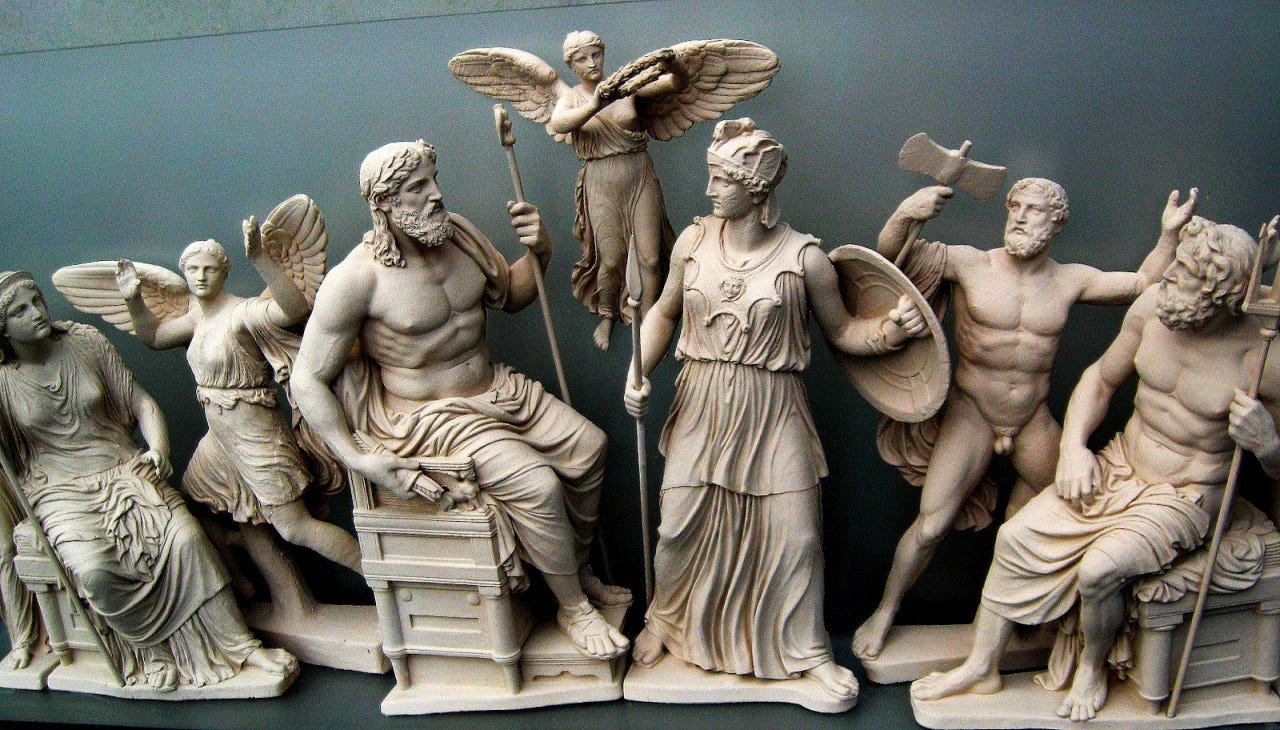
The West pediment depicts an early edition of Athens’ Got Talent (or whatever the devil the young people watch) with a competition between Athena and the sea-god Poseidon to win the honor of becoming the city’s patron deity by performing a beneficial miracle.
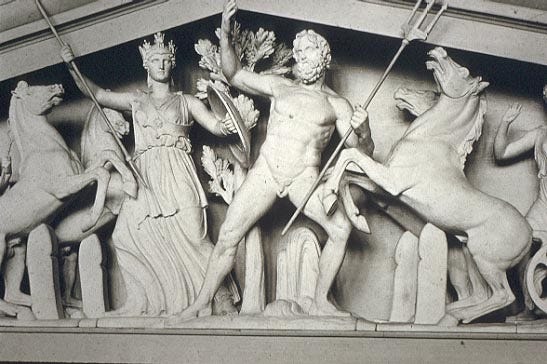
Poseidon created a salt water spring after striking his trident into the ground, to which Athena responded by producing an olive tree that is still visible on the Acropolis today.

Another myth explains that Athena triumphed over Poseidon because all the women, who made up a majority, voted for her and all the men for the sea-god. From this point on men decided women were not allowed to take part in elections. This fanciful, if amusing, tale of sour-grapes and misogyny is thought to have been a later introduction (i.e. during the democracy).

As well as her role as the patron deity, Athena also contributed to the ancient lineage of the city.

Share


She was said to have been pursued by skull-cracker Hephaistos who, with the trademark chivalry of the ancient gods, attempted to rape her of her virginity. However he spilt his seed on the ground and from it Erecthonius, the mythological ancient king of Athens was born. Athena then became foster mother to the baby and brought him up on the Acropolis.

Whilst such stories may seem whimsical, sometimes fay, to us, the power of the physical imagery of Athena cannot be underestimated.

It was one of the key factors by which Peisistratus became tyrant c.557/6 BC. According to Terry Buckley:

“He dressed up a stunningly beautiful six-foot woman in full armor; it was then claimed through messengers that she was Athena…and that she herself in her chariot was delivering Peisistratus to her own Acropolis to take over the rule of Athens’.

Although it is highly unlikely that the people of Athens truly believed Athena had come to Earth and was standing next to a politician in a chariot, the symbolism of the stunt and the association to the goddess seemed to endear Peisistratus to many.

Thus, ‘I am driven with a mission from God’ is as timelessly effective as it is unoriginal.

The most significant role Athena played as the patron deity was her contribution in the Panathenaia, a huge, annual festival of religious devotion and national pride; a Christmas Day and 4th of July rolled into one.

Falling on Athena’s birthday (28th day of Hekatombaion), the vast scale of the festival is recorded on the 175-yard long frieze of the Parthenon and includes animals for sacrifice, metics (resident foreigners), musicians, infantry, cavalry, craftsmen, priests and ordinary Athenians marching by deme (parish).

Athletic competition was also a part of the festivities and, here again, we see the influence of Athena. The special olive oil that was given to the victors was presented in a vessel that had the goddess on one side and the chosen discipline of the victorious athlete on the other.

Over 1400 amphorae (or type of container/vase) of this sort were produced every year in time for the Panathenaia.

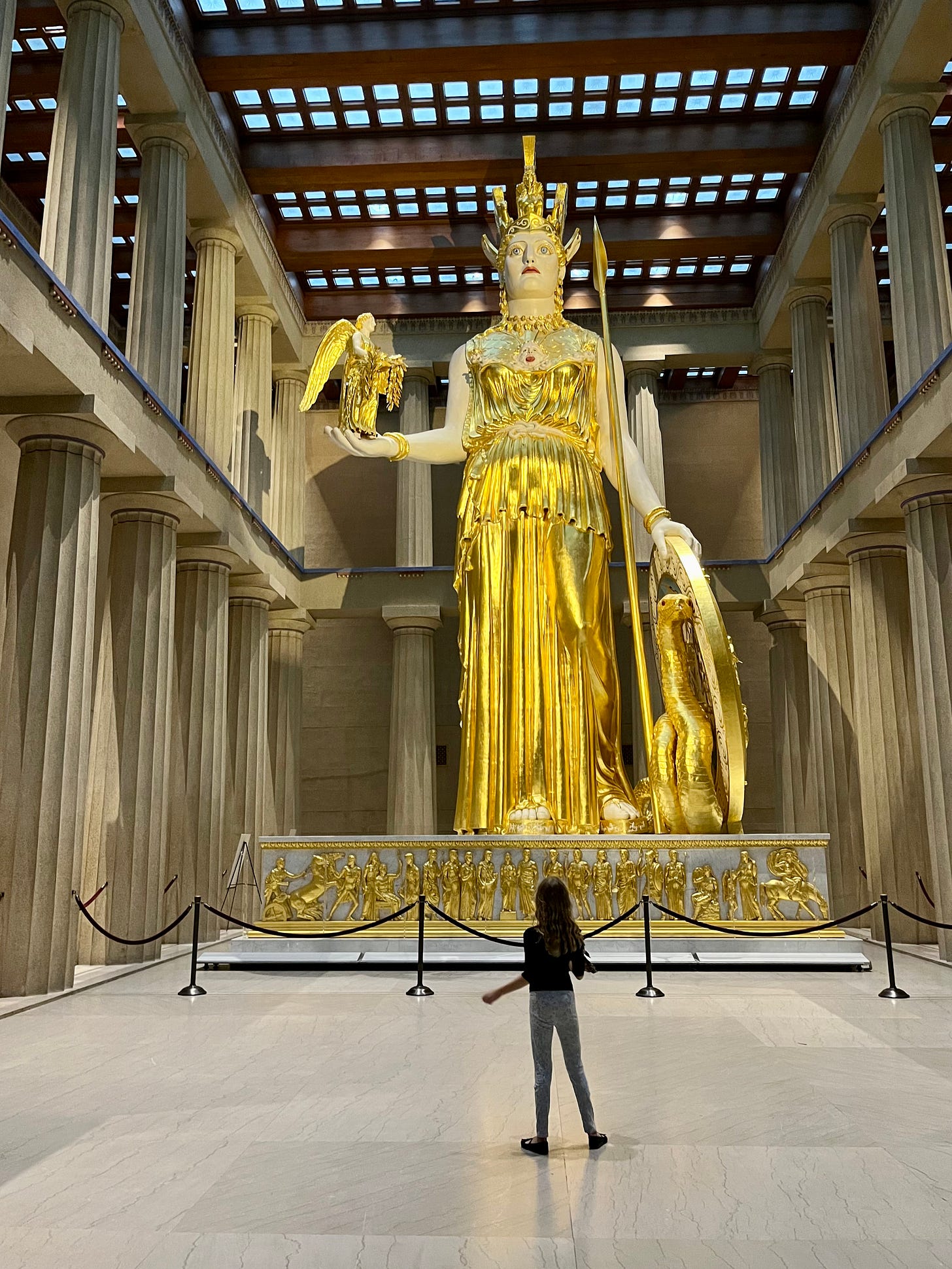
The celebration took place on a much larger scale every fourth year. As part of the Grand Panathenaia, a huge peplos (tunic) was placed on the 39 foot statue of Athena Parthenos, situated inside the Parthenon. Outside the temple, this elegance was starkly contrasted as Athena’s birth was re-enacted in a grisly ritual where a bull’s head was smashed open, though presumably without an armored cow jumping out.

This huge chryselephantine (gold and ivory) statue of Athena Parthenos is worth further comment. Containing 2400 lbs of gold, it was built between 447 and 438 BC, at a time when the Greeks had just resisted invasion against the mighty Persian army.
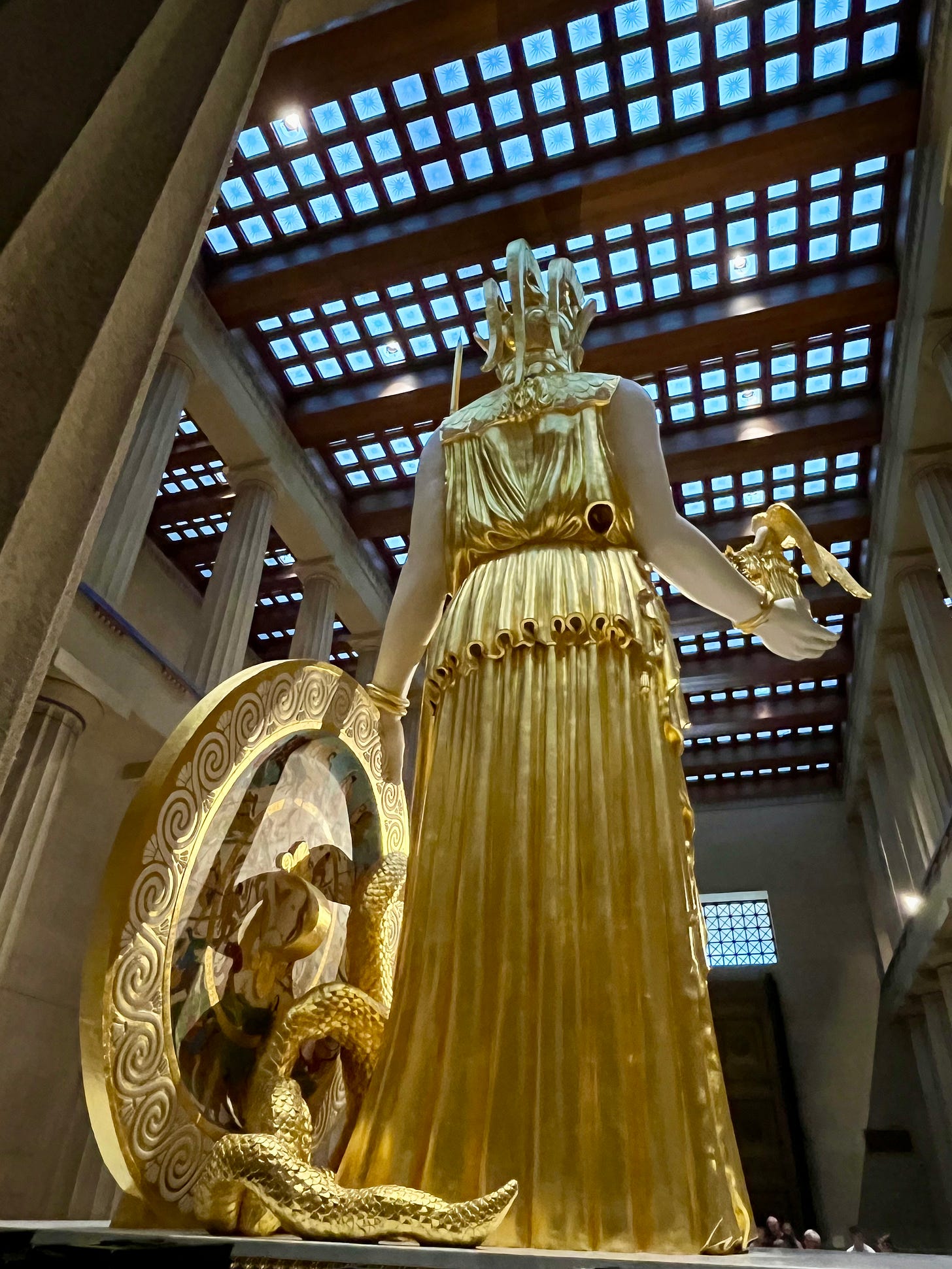
Thus, Athens was leading the world not only in terms of power, but also in culture; the finest thinkers, playwrights and scientists were either emerging from Athens or making an intellectual pilgrimage there. The grandeur and pomp of the Athena Parthenos was fitting, not only for the time, but for the thanks the citizens owed their patron protectress.

However, when the tables turned, it would have looked at best foolish and embarrassing, and at worst mocking and damning.

Don’t Turn Your Back on the Ancients… Become a Classical Wisdom Member and Learn from them instead:

During the latter part of the 5th century, Athens suffered a humiliating defeat in the Peloponnesian War against Sparta, not only sustaining huge casualties, but being transformed from the leaders of progressive thought and democracy to a second-rate power. The victorious Spartans even forced the Athenians to suffer the emasculating humiliation of having their protective city walls taken down.

As often happens when people feel god has abandoned them, they abandon god. However, in this instance, it seems Athenians abandoned the over-sized, suddenly incongruous sculpture, rather than the goddess herself.

The statue still remained a great work of art and a massive tourist attraction (there were at least 300 ancient replicas), but, as Andrew Stewart commented: “it swiftly lost its religious significance to all but a tiny minority… after 404 BC the Athena Parthenos became a museum piece”.

Astoundingly, there is a full-size replica of the mighty effigy in Nashville, Tennessee which boasts extraordinary attention to detail. The main difference being there is no documented evidence the original was made of gypsum and fiberglass.
Despite her elevated status as patron, Athena was not totally dominant in religious worship in Athens. The Eleusinian mysteries were (rather ironically) among the best known of all the Athenian cults and primarily paid homage to Demeter.

Also, the erection over the Agora of the Hephaisteion in the 440s BC gives great and towering status to the would-be assailant of Athena. What may have been doubly galling to Athena fans is that this building was made to honor the blacksmiths for their role in the Persian Wars, despite Athena being sacred to metal-workers.

Some say Socrates (executed for impiety) and men like him were bringing into question the very existence or importance of the gods. Whilst of all the extant Athenian tragedies, only The Ajax of Sophocles casts Athena in a role of any importance.

Who was Ajax? And why was his tale so tragic?

Despite these aberrations, there seems little doubt that Athena was ever-present in the psyche of the Athenians and there was certainly enough good-will in the bank to maintain for her a place of prominence within the polis.

Although she had many sub-roles within society: being sacred to maidens, weavers, carpenters, oil manufacturers, and blacksmiths, combined with her reverential position as the goddess of eyesight, wisdom and warfare, it is the historical, nationalistic and social links that make her such an important figure as patron.

Certainly being responsible for the year’s biggest knees-up is something that would cause even the staunchest unbeliever to rejoice in her worship.

After all, piety is all well and good, but a party is usually better.

Discussion about this post

I find it very interesting how this article shows that Athena was much more than a goddess: she was the personification of Athens’ identity, a kind of collective brand that brought together religion, politics, and culture. What strikes me most is how her image could inspire both pride and embarrassment, depending on the historical moment. Do you think that, just like with Athena, today we also idealize collective symbols that over time can become uncomfortable or lose their meaning?

Reply
Share

“After all, piety is all well and good, but a party is usually better.” I would call it a sign of bad times, the modern times. Look where mere “partying” has brought us. Are modern people proud, happy and democratic, like they were in Athena’s heyday? We’re not even an iota, compared to those times. Democracy was invented and was forming a deep foundation. Now democracy is being uprooted and smeared. No comparison!

My question to you, sir, is: which side are you on? It seems you admire classical wisdom. Is your effort merely rhetoric, merely a talking point with no seriousness attached to it? Do you have any regrets or a feeling of sorrow for what we’ve become?

What is the purpose of your trade, your writing? You just describe Athen’s classic wisdom. You don’t say that we should be guided by it or we should emulate it and advance it.

What is the purpose of creating deities and myths? It is to guide us towards practical development, a paragon to live by. I think you’ve missed the whole point. Sorry!

Reply
Share

3 more comments…

Categories: History, Science and Biography | Tags: , , , , | Leave a comment

GOD BLESSES PUTIN’S WAR?


08 FEBRUARY 2024, THE TABLET

Putin’s holy war

by Martin Sixsmith

Soviet politics and the Russian Orthodox Church

Patriarch Kirill of Moscow is a staunch critic of a Western-induced ‘cultural miasma’. Records have shown his links to the KGB and to Vladimir Putin.

The patriarch and the president reinforce each other’s conviction that the two-year-old war in Ukraine is necessary to prevent a decadent West imposing its depraved liberal values on Russia.

Patriarch Kirill criticised by MPs for links to Putin ahead of historic visit to UK

In April 1242, with the Russian lands in danger of being overrun by the advancing forces of the Teutonic Knights, Prince Alexander Nevsky of Novgorod needed a miracle. And, as his outnumbered forces rode out to confront the invaders on the frozen waters of Lake Peipus, he got one. “In fierce battle came the crash of breaking lances and the ringing of sword on sword, until the ice turned red with the blood of men,” wrote the official chronicler of the Novgorodian princedom, “until in the sky appeared God’s hosts of heavenly troops, aiding our Prince to victory … I know this is true, for an eyewitness hath told me so.”

The chronicler’s reassurance that God must be on our side because “an eyewitness hath told me so” is a curlicue embellishment on a time-honoured theme. Princes and presidents throughout history have claimed the endorsement of Heaven to shore up their authority. Vladimir Putin is no exception.

The Russian Orthodox Church (ROC) has generally been an ally – oftentimes, a servant – of the Russian state since the establishment of the Patriarchate of Moscow and All Rus’ in 1589. Under the ultra-conservative, antisemitic Konstantin Pobedonostsev, who served as procurator of the Holy Synod between 1880 and 1905, the ROC became part of the campaign to fight foreign influence and return Russia to its own “God-appointed” path, opposing western ideas of individualism, democracy and freedom of thought – desiderata that would be voiced again with gusto in the second half of Putin’s reign.

Despite the Bolshevik persecution of the Church, in 1927 Patriarch Sergius pledged the ROC’s loyalty to the Soviet state, triggering a schism and the declaration of a rival seat of Russian Orthodox power, the Russian Orthodox Church Outside Russia. Under Boris Yeltsin, the ROC was kept largely on the margins of power. Putin made a bigger effort. He spoke of his lifelong Orthodox faith and used it to his advantage. At his first meeting with George W. Bush, he showed him a metal cross that he said had been a gift from his mother on the occasion of his secret baptism in the 1950s. Although he didn’t wear it during his time in the KGB, Putin said he had had the cross blessed on a trip to Jerusalem in the mid 1990s at his mother’s behest and it had later miracu­lously survived a fire at the family dacha. Since then, Putin said, “I have never taken it off.” Putin returned much of the property confiscated from the Church by the Bolsheviks and showered its leaders with praise and money. In 2007, he attended the ceremony in Moscow’s Cathedral of Christ the Saviour that ended the 80-year-old schism within Russian Orthodoxy. “The restoration of church unity is an important condition for rediscovering the lost unity of the Russian people,” he declared.

When Putin announced in 2012 that he would return to the presidency after serving a term as prime minister, Patriarch Kirill, who had been elected in 2009, was his most vocal champion. The reign of Vladimir Putin, he assured the faithful, was “God’s miracle”. Kirill endorsed Putin’s description of the 1990s as a new Time of Troubles and blamed Russia’s “moral collapse” on western influences, ­including the excessive individualism that accompanied the liberalisation of politics and the economy. He gave thanks that the Church had remained a bastion of integrity, holding Russian society together in those difficult years, preserving the nation’s true values and ready now to aid President Putin in his crusade to put Russia back on its feet.

The leader of the Russian Orthodox Church and the president of the Russian Federation were soulmates, dedicated to the same “eternal principles” of conservatism, stability and strong rule from the top. When the KGB archives were opened briefly in the 1990s, a free-thinking Orthodox priest, Fr Gleb Yakunin, trawled through the classified documents and came away convinced that the Moscow Patriarchate was “practically a subsidiary, a sister company of the KGB”. Yakunin listed all the agents within the Church who m­ade regular reports to the security services. He revealed that “agent Mikhailov”, who travelled regularly to Switzerland, was none other than “a certain Archimandrite Kirill, working in the Church’s department of external relations”.

When members of the feminist art collective Pussy Riot were arrested and charged with “hooliganism motivated by religious hatred” after staging a performance of their “Punk Prayer: Mother of God, Drive Putin Away” in Moscow’s Cathedral of Christ the Saviour, Kirill made the most of it. Russia and Orthodoxy were once more under threat, he warned, for the moment by “blasphemy and outrage”, but physical violence might not be far behind. “Those who would invite us all to mock our shrines, reject our faith and, if possible, destroy our churches are testing the people’s ability to protect their holy places.” For Kirill, the “holy places” that require protection extend beyond the borders of the Russian Federation: the “canonical territory” of the ROC is considered to encompass all places where Orthodox Christians follow the Russian rite, just as canon law shall be applied to Russian citizens wherever they abide. His own title, Kirill is fond of reminding people, is Patriarch of Moscow and All Rus’.

Kirill’s assertion of Moscow’s authority abroad paralleled the state’s Russkiy Mir doctrine, entitling the motherland to intervene in the fate of Russians beyond its boundaries. Putin, in turn, cited Kirill’s devotion to “God’s intentions regarding [his] land and [his] people” as legitimising his own mission to reunite the Russian lands. Patriarch and president both declared themselves in favour of Russian pride and Russian patriotism; and both stated their intention to defend “trad­itional values” in the face of the “cultural miasma” seeping into Russia from the West.

Following the protests of 2011–12, Putin increasingly adopted the sort of conservative language that Kirill had long favoured, with the apparent aim of shoring up his support among traditional Orthodox believers, some of whom had taken to the streets to demonstrate against him. Kirill’s favourite themes – that Russia’s “spiritual sovereignty” was being assailed by “liberal trends emanating from the Protestant societies in the West” – appeared with regularity in Putin’s speeches. He told the Russian parliament that the West had sunk into a morass of depravity and was now trying to inflict it on Russia. “The Anglican Church is planning to consider the idea of a gender-neutral God. What can you say! Millions of people in the West understand that they are being led to spiritual destruction. The [western] elites are going crazy and this cannot be cured, it seems. But our duty is to protect our children. And we will do this. We will protect our children from degradation.”

The annexation of Crimea in 2014 presented Kirill with a dilemma. After the fall of the Soviet Union, the Orthodox Church in Ukraine had split, with some priests no longer accepting the authority of the Patriarch of Moscow. When masked soldiers of the Russian Federation – Putin’s “Little Green Men” – appeared in Crimea, priests of the Moscow-affiliated Ukrainian Orthodox Church (UOC-MP) had rushed to their side, blessing their holy mission and helping to negotiate the surrender of Ukrainian troops. Fr Dimitry Vasilenkov, a priest who would receive the Kremlin’s Order of Friendship by presidential decree for “providing care in Crimea”, saw the Church’s role as the fulfilment of divine will. “What can this be, if not God’s miracle? The Lord did not allow for any bloodshed. [After all], polite people need polite chaplains.” The invading forces were invited to use religious premises as barracks and for stockpiling weapons, while Orthodox priests loyal to Ukraine who refused to help were chased out of their churches. One them, Fr Ivan Katkalo, said the clergy were acting on direct orders from Moscow. “[Their] priests carried out assignments that were set at the very top levels […] When priests allow military people carrying weapons into their church, this stops being a church and starts being an organisation that answers to the state.”

Other participants in the “Crimean Spring” also had connections to the ROC, including the banker Konstantin Malofeyev, the so-called “Orthodox oligarch” whose charitable foundation had spent tens of millions of dollars supporting the Russian Orthodox Church. In February 2014, he had warned Putin that Western Europe was on the verge of “absorbing” Ukraine “element by element”. He demanded the immediate annexation of Crimea, to be followed by the fomenting of discontent in eastern Ukraine to create “political legitimacy and moral justification” for a Russian takeover. In Malofeyev’s plan, the pro-Russian message and the call to rebellion would be disseminated by ROC priests in sermons to parishioners across Russian-speaking Ukraine. Within a matter of weeks, Crimea had been annexed and Malofeyev’s former head of PR, Alexander Borodai, was named Prime Minister of the Donetsk People’s Republic. Malofeyev subsequently spent large sums of money financing Igor Girkin’s Sloviansk Brigade and promoting the “historic” duty of Russians to volunteer to fight to protect their Orthodox brothers abroad (the most famous literary example of this is Anna Karenina’s lover Vronsky setting off to defend the Serbs from the Ottomans in the 1870s). A unit calling itself the Russian Orthodox Army was also commanded by Girkin and financed by Malofeyev. It was, said Borodai, a “public-private partnership” with the Russian state.

Far from condemning Russian military aggression, Patriarch Kirill seemed to condone it. As early as 2011, he had commended the willingness of the “[Russian] Christian believer to sacrifice his life more easily than the non-believer, as he knows that his exist­ence is not going to end with the end of this life”, and declared that the Church had always blessed those who fought in a “just war”. Christians, he said, had an obligation to defend their homeland and, given that the Russian Orthodox lands encompassed the entire territory of Holy Rus’, it was right and proper to continue the fight for Russia’s “spiritual sovereignty” in Ukraine. When hostilities escalated in Donbas in 2014, Kirill claimed that “the conflict has an unambiguous religious underpinning”. “Catholics and schismatics”, he said, were moving from “preaching hatred for the Orthodox Church [to] carrying out direct aggression … under the guise of an anti-terrorist operation”. He instructed priests to bless the Russian troops departing for battle, as well as the tanks, rockets and shells that would be used to kill the Christians over the border. The head of the Church’s department for cooperation with the army, Bishop Stefan of Klin, explained that “our armed forces have sacred help from above, from God and from the heavenly saints”.

When Putin launched his full-scale invasion of Ukraine in 2022, Patriarch Kirill supported his contention that it had been made necessary by the actions of “groups who view Russia as a thorn in their flesh [and] wish to wipe Orthodox Rus’ from the face of the earth”. In a sermon at the Cathedral of Cyril and Methodius in Kaliningrad, he assured the congregation that the war was the fault of the West: “Our Fatherland has committed no crime. People are against us not because we are bad, but because we are different.”

When in September 2022 Putin announced the mobilisation of young Russians to fight in Ukraine, Kirill assured them it was their Orthodox duty to go. In a speech that could have been made by Islamist jihadis, he promised eternal joy to those willing to sacrifice themselves in the cause of holy war. An international group of Orthodox scholars and clergy made the case for expelling the Russian Orthodox Church from the World Council of Churches. “Just as Russia has invaded Ukraine,” they declared, “so too the Moscow Patriarchate of Patriarch Kirill has invaded the Orthodox Church.”

Instead of bringing the faithful back to the Russian fold, Kirill has seen millions of them depart. Fr Nicolay Pluzhnik, a Russophone priest in the Kharkiv region, had previously been loyal to Moscow, but could not accept the patriarch’s authority. “When I hear them say they are protecting us and fighting some ‘Holy War’, I think they are either blind, or they are not serving God but the devil. We were living peacefully until they came. But far from protecting us, they bombed and tortured and killed. Before the war, parishioners were completely free to choose what church they went to […] For many of them it was not even a significant difference to go to a church that followed Moscow or not, they just wanted to pray to God. Now all of that has changed.”

Some formerly pro-Moscow priests joined the autocephalous Ukrainian Orthodox Church; others, including the monks of the historic Pecherskaya Lavra in central Kyiv, faced searches and evictions as the Kyiv authorities became convinced they were sheltering Russian personnel and equipment. According to a 2023 Royal United Services Institute report, “the one body of ideologically committed agents supporting the invasion was the Russian Orthodox Church. Beyond its efforts to support Russian information operations, its priests were widely recruited and run by the Russian special services and their monasteries and churches used as safe houses […] The use of religion as cover is not only a widely established method of the Russian special services but also creates its own protection mechanism because of the political sensitivities of state targeting of religious institutions.”

When the desired rapid victory in Ukraine did not materialise, religion provided another useful prop. Putin’s long-time adviser and sabre rattler, Sergey Karaganov, declared it was time to go nuclear, with a pre-emptive strike on a Nato city such as Poznan. It would be a hard choice, Karaganov admitted, but – just as he did with Prince Alexander Nevsky and the Teutonic Knights – God would support Russia’s cause. “The creation of nuclear weapons was the result of divine intervention. God handed a weapon of Armageddon to humanity to remind those who have lost the fear of hell that it exists,” he said. “We will use God’s weapon, thus dooming ourselves to grave losses. But if we do not do this, Russia will die and most likely the whole of human civilisation will cease to exist.” By using God’s nukes, Russia “will not only save ourselves and finally free the world from the five-century-long western yoke, but we will also save humanity”, Karaganov declared. “In the end, the winners are not judged. And the saviours are thanked.”

Martin Sixsmith is an author, television and radio presenter and journalist. Adapted from Putin and the Return of History: How the Kremlin Rekindled the Cold War by Martin Sixsmith with Daniel Sixsmith (Bloomsbury Continuum, £25; Tablet price £22.50).

Categories: History, Science and Biography | Tags: , , , , , , | Leave a comment

Blog at WordPress.com.