Questioning and Curiosity


“Today, we can’t afford to become adults”

Thoughts on change, questioning, and childlike wonder from MIT’s Joichi Ito

Joichi_ItoIn recent weeks, I’ve been sharing some of the fuller versions of interviews conducted while I was researching and writing A More Beautiful Question. Here are some quotes from my talk with Joichi Ito (@Joi), one of the world’s most respected technologists and the current director of that hothouse of innovation known as the MIT Media Lab.

Ito on why questioning is becoming more important than ever

“There are two important differences in the world now. First, it’s a time of exponential change, so things are different every day. The old model of learning—that you do a lot of it when you’re young and then become an adult who doesn’t learn as much—that just doesn’t work as a productive way of living now. You have to learn new things all the time. And you learn by being curious and by questioning

“The other important difference: in addition to increasing change, you’ve got increasing speed and complexity. In a world that’s complex and fast, things aren’t as predictable as they were before. You must be much more resilient—to change, to failure, to the unexpected. Now you must maintain some of that childlike wonder and that ability to keep questioning and learning through doing.”

On questioning and learning

“If the learner is doing the questioning, it’s very different from when an examiner (or teacher) is doing the questioning. When you have the examiner doing the questioning, you’re in what I would call education mode. I think education is something other people do to you, whereas learning is what you do to yourself. You don’t learn unless you question—but we often don’t teach our kids to question; we teach them to answer our questions, forcing them to learn facts and skills. But since we may not know what facts or skills that kid’s going to need in the future, what you really want is to empower them to be able to find their own answers when they need them.

“Through questioning, we can also find more than answers—knowing how to ask the right questions can help you to pull support from a network of people or communities as you need it. You pull from the network by querying it, but you need to understand how to frame the questions. So it may be a matter of, how do you formulate the query to Google, or to an online community, to get the support or resources or answers you need. And if you have that skill, you may not need to know anything, other than people; it’s more about understanding the context of the network and how to traverse it.”

Diversity and questioning

“If a group is asking a question or challenging itself to come up with an answer for something, there’s a great body of work that shows diversity is extremely important. Everybody has different frameworks or models to ask the question; and it turns out that having a large number of very smart people that are similar is not nearly as useful as having maybe less smart people but with diversity of background.

“Then the issue becomes, how do you have a constructive conversation when everyone’s frameworks and backgrounds are different? At the Media Lab, we do what I call practice over theory. So, if an artist and a mechanical engineer are working together, it might be difficult for them to write a rigorous academic paper together, but they can build something together… and it either works or doesn’t. Often, academics create theories and test them and if it doesn’t work they start questioning the reality, the data. We’re the opposite; we build a robot and if it doesn’t work, it doesn’t work. And if it works but we don’t understand it, we can study it. Being able to “build the robot” is a really essential in this kind of environment where you’re searching and trying to discover things.

“At the Media Lab, we try to discover answers to questions we don’t know to ask yet. And that’s actually a harder kind of questioning because what you’re doing is asking, What is the question? That’s a harder thing but it’s where you get the really disruptive changes and discoveries. Some people would say we’re a pile of answers looking for questions.”

Joi-Ito

Why companies need to experiment more

“At the Lab, usually the costs of trying to figure out whether or not we should try something is more than just going ahead and letting people try it. For most things, the costs of experimenting, of building and trying things, have gone down. If you look at the people who started Facebook and Google, none of these guys asked permission, they just tried things out—because it didn’t cost them much to do it. And in companies today, I think people really need to think about that. Because in many companies, it’s still very difficult to do things without permission—and the permission-getting process can be slow. It’s important to lower the friction on innovation by allowing people to explore.”

On “neoteny”

“I was introduced to the term by Timothy Leary when he and I were writing a book together, and I kind of fell in love with it. Neoteny is about the retention of childlike attributes in adulthood; curiosity, playfulness, imagination, joy, wonder. This brings us back to the point that today, we can’t afford to become adults—meaning, we can’t afford to fall into that trap of being in repetition mode. Those childlike attributes, somehow you need to keep them. There are some people in our society who are allowed to remain creative, but for the most part, creativity isn’t considered an adult thing—you’re not supposed to fingerpaint. Neoteny is a word that gives you permission to keep that childlike creativity as an adult. To encourage neoteny, I think what’s needed is a culture that encourages playfulness and experimentation. That’s the culture we have here at the Media Lab.” (More on this site about neoteny.)

 On getting better at questioning

“To question, I think you have to have courage and confidence. A lot of times, if you’re sitting there and you think about something in the bathtub, you might say, “Oh, I’m sure somebody’s already thought of it”—and then you stop thinking about it. But the world is changing so fast and so much, every day, that things that weren’t true in the past are true now—so you should assume that what you’re thinking may actually be an original idea and pursue it. Have the energy and the courage and creativity to think through these ideas and try them out. And even if you fail you’ll have learned a lot more than if you just gave up.”


Categories: History, Science and Biography | Leave a comment

Alcohol fuel for the New Mexico Spaceport


Your opinions (printed March 18, Las Cruces Sun-News)

                                     NEW SPACEPORT BAR LIKE OLD BOOZE SHIPS

A burst of creativity from the crew piloting New Mexico’s ill-starred spaceport resulted in a need to obtain a liquor license, authorization for which was signed into law by Gov. Susana Martinez. (Senate Bill 147) This “need” has a basis in history. In the 1920s, during Prohibition, grand ocean liners such as the Ile-de-France, Windsor Castle and Bremen kept their on-board bars open while docked at New York piers, as the liners stocked and fueled for the return voyage across the Atlantic to Europe.

Through a quirk in the law, well-heeled visitors to shipboard bars were not technically on the soil of the United States, and thus were free to imbibe in unlimited quantities the premium booze (far superior to the mob-produced bootleg gin available on land) before staggering down the gangway to a waiting limo or cab.

So impaired these bar patrons were, that many could have been convinced they had traveled across the ocean and returned during their boozy episode.

In the same way, fogged-up patrons of the spaceport’s bar could be led to believe, with a little creative stage-craft, that they had launched into space and returned as their glasses were speedily refilled one after another. All such patrons, when suitably pickled, (no doubt enhancing the bottom line of the spaceport in the process) would be loaded into a stretch limo for the trek home to make sure none got near the wheel of a car until thoroughly sobered up.

The genius of this plan is that no longer do we have to bother with the empty promises of Sir Richard or his fellow space-venture hype artists or the technical issues of an actual orbital passenger rocket ship to provide a revenue stream for the spaceport.

— Dan Townsend, Las Cruces

Categories: History, Science and Biography | Leave a comment

Success in school explained


Starting at the school door is not soon enough

Recently I read an open letter from Michael Hays to Senator Lee Cotter concerning how to fix the 79% deficit in student reading performance in the fourth grade. As I see it, Hays believes the fix for NM is to upgrade colleges of education as opposed to Cotter’s support of widespread third grade retentions. Both are ideas for serious discussion but they don’t address the single factor that has been found to be the most important for student success.

Let’s step back and put the whole situation in perspective. Five years of life experiences have gone by before a child gets to school. Brain development in the first few years are the foundation for all learning that follows. What happens at home during this time has more influence on future success than anything that comes later.

Think of something you learned to do well. Maybe you are a great cook, play on a baseball team, or consider music an important pleasure in your life?

What is your very first memory of that experience? Quite likely, you can remember back to when you were three years old.

Now think of your best subjects in school. Is there a connection between your earliest memories and your school experiences? If you never touched a ball, how did you do in P.E? If your family didn’t dance or sing, how was your aptitude for music class?

For the first five years of life, every child’s first teachers are their caregivers. During the time when the brain is growing fastest and making crucial neural connections, a child is attaching emotionally, emulating, and trying to please the primary caregiver in the family.

Yes, educational excellence is of paramount importance and colleges of education are charged with the responsibility to train and produce the very best Reading teachers. Of course, public schools need to be accountable to standards, and milestones must be met to insure that learning is provided in a developmentally appropriate sequence for most of the children. I won’t argue with any of this. But, when looking for solutions, starting at the school door is not soon enough.

What happens at home between birth and the first day of kindergarten has much more to do with academic achievement than the number of years spent in third grade.

If a child grows up in a home where family games are played around the kitchen table and in the park, where throwing a ball, watching and talking sports is a favorite pastime, if music permeates the air, that child will enter school ready to excel at recess, PE, Music and even Math. Add books and shared family reading time to that mix and now our theoretical little kid is on a level playing field for Reading which opens the rest of the curriculum as well.

Lots of talking, naming, explaining, telling stories, and reading books together for pleasure, along with opportunities to ask and answer questions are fundamental learning skills. Starting school with these experiences make it much more likely that the curriculum in each grade will be developmentally appropriate and the transition from one grade to the next will be seamless.

Parents need to know that Kindergarten is changing to keep up with a fast paced world:

Children are expected to come to school able to recognize their own names as well as the names and sounds of letters and be able to print many of them in both upper and lowercase, count to 20 and see the one to one correspondence of numbers to objects, retell a story they have heard, and draw a picture to tell about an experience. They need to be able to concentrate on a task for five minutes, participate politely in group activity, and be flexible enough to adjust to new people and situations.

If 79% of our community’s children are not reading at grade level, there are lots of things that need to be done, including teacher training and school reform, but first parents need to be informed of what society’s expectations are and how easily they can be addressed at home in the earliest years. Finding out after school starts is entirely too late.


Categories: History, Science and Biography | Leave a comment

Sayonara 2015


(printed in the Las Cruces Sun-News, December 31, 2015)

Good riddance 2015, hopes for better 2016

If I could, I’d give 2015 a swift kick in the pants as it made way for 2016. Consider what went on during the year now ending: a mother who gave her six-month-old child a bottle, then suited up and joined her husband on a killing spree at a holiday party; a group of thugs in the Middle East who “inspire” others, (not themselves, oddly enough), to blow themselves up in various parts of the world expecting to get to paradise before anyone else; “low information voters” who become low information candidates for president of the U.S. — along with assorted sneerers and overstuffed billionaires. You couldn’t make this stuff up if you tried.

How about the “smart money” guys of 2015 who pride themselves on sending young people out on international soccer and (U.S.) football fields to beat their brains out to generate bribes, payoffs and lucrative TV contracts for their handlers. Or the characters who buy up drug companies to enrich themselves on the pain and suffering of others — not to mention congressmen enjoying the best medical care in the world seeking to deny health care to the working poor.

How about the makers and marketers of the guns spewing ammunition out of car windows; within classrooms, clinics, hospitals and churches; into playmates from other playmates; and, at close range, into the bodies of tortured souls afflicted with suicidal impulses.

Finally, 2015 saw another bump in the profits of predatory loan stores now on street corners around poor neighborhoods and military bases — so much for military preparedness.

Hope springs eternal, goes the expression. Will 2016 give hope a chance?

Dan Townsend,

Las Cruces

Categories: History, Science and Biography | Leave a comment

The Consequences of Denial


April 25, 2010

Suppose that an airline pilot, doing his pre-flight checks at Denver’s International Airport, got a printout of weather data which reflected not metropolitan Denver 2010, but  the  same area as it was in 1800.  The occasional native American cooking fire would have been the only contribution of man to the area temperature in 1800. Metropolitan Denver, like all 21st century urban areas, contributes by means of the well-known “heat island” effect, several degrees (as much as 22 degrees F.), depending on the season/time of day, etc., to its area temperature.  This is in addition to global climate change and other factors.

Factoring the spurious data he was supplied into the “density altitude” calculation critical to successful take-off, the unfortunate pilot and his passengers risked  winding up being mixed with fiery wreckage just across the freeway marking the end of the runway—another tragedy based on faulty data.

Another example: the trainee helmsman on duty as the Exxon Valdez wallowed  fully loaded  through Prince William Sound Alaska one night in 1989,  failed to realize that the fully loaded vessel handled very sluggishly to its controls compared to its handling, empty, on the trip to Alaska.  Pushed by cost-cutting management to shave time from the voyage by charting a course near Bligh Reef, the unfamiliar feel to the controls drew the vessel onto the reef, and on to front pages around the world.

In 1964, my wife and I visited the beaches along New Jersey’s Atlantic Shore. Wondering why so few were present on a beautiful summer afternoon, we soon discovered tar balls and oily goo along the water’s edge. The locals told us that an upwelling of the sea  had brought up oil from the bottom placed there as Nazi submarines, organized into “Wolf Packs” sank hundreds of merchant ships, many of them oil tankers, during the early years of WWII, many within sight of shore (wreckage and bodies were a regular sight along our Atlantic beaches at that time. The massive effort to stop this carnage was a well-kept secret during the war). The  waters of Gulf of Mexico are presently unwilling recipients of enough oil from the Deepwater Horizon oil platform blowout, underway as this piece is written,  to fill each of the sunken tankers of the WWII era in a few minutes. Leadership of the communities  which came to depend on revenue from the undersea oil resource are already in denial, for the usual political reasons.

Natural systems are a lot like the fully loaded Exxon Valdez.  As a helmsman on various ships on several occasions, I am well aware of the need to anticipate the reaction of a vessel to its controls as currents, winds and cargo loading mix with steering commands to produce the vessel’s actual course. Reductions  in, for example, CO2 contributions by man, will not be fully felt in terms of global warming, for decades. Does this mean that we should deny that Bligh Reef, or its climatic equivalent, exist?

Obviously waiting until the Exxon Valdez is within a few feet of the reef to correct its course would be disastrous, as history shows. When do Global Climate Change skeptics plan to take corrective action, should the extremely complex variables at play in man-caused climate change finally produce a definitive result with which all could agree?

The good part is that I am unaware of any global climate change skeptics piloting commercial aircraft or ocean-going ships. We can all be thankful on that score.

Dan Townsend

(Re: the above article: I was a resident of Alaska for 35 years, during the “Pipeline era” and the Exxon Valdez tragedy and its aftermath. At different times I was a helmsman on three ocean-going vessels: the MV Stevonia {Ellerman Wilson Lines, UK}; and  the fully rigged sailing vessels “Western Union” and “Wolf” home port, Key West Florida. I was also, among other duties, a “cockpit observer” for the Federal Aviation Administration.)

Categories: History, Science and Biography | Leave a comment

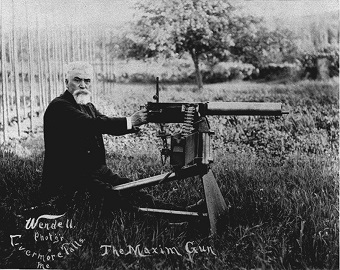
Guns


hiram_with_gun2

Las Cruces Sun News 08/09/2015, Page C05

Your opinions 

The Devil’s Paintbrush is still doing damage

The human weakness for mayhem and murder has been a consistent source for profit through the ages, a fact well known to the arms industry behind today’s National Rifle Association.

Armories of Germany, Britain, France, Belgium, Russia and the United States at the end of the 19th century produced versions of the “Maxim Gun,” referred to as the “Devil’s Paintbrush” due to its use in conflict since the original 1883 patent by its inventor, Hiram Maxim: “In 1882 I was in Vienna, where I met an American whom I had known in the States. He said, ‘Hang your chemistry and electricity! If you want to make a pile of money, invent something that will enable these Europeans to cut each others’ throats with greater facility.’” Ninety percent of those felled in the battlefields of WWI from bullet-related injuries died from Maxims and clones employed in that war. Similar numbers succumbed in WWII and subsequent wars from land and airlaunched ordnance fired at a rate of 600 rounds per minute and higher.

Sprayed ordnance at up to 1,200 rounds per minute is available from the muzzle of the Glock 18, a 2-pound gun that occupies the space within a lady’s handbag.

Trust the NRA, its network of craven politicians and infotainment jockeys to make such toys available to whomever wants one — presently available only to our increasingly militarized police forces — but stay tuned!

Imagine the result of a suspected attack inside a darkened theater answered by vigilantes in the audience with fire, the walls echoing from all directions and lit cell phone screens confused with muzzle flashes — enough body bags for the outcome?

Back to the NRA and its sponsors — Sir Basil Zaharoff, the most notorious arms dealer of all time, was known as the “Merchant of Death.” I’m sure he wouldn’t mind sharing the honor.

Dan Townsend, Las Cruces 

Categories: History, Science and Biography | Tags: , , , , | Leave a comment

Wisdom from Berlin


in English: "Anyone who wants to keep the world as it is does not want it to remain!"     Or, to put it another way,  our world is constantly changing--our survival requires that we recognize change and deal with it.

in English: “Anyone who wants to keep the world as it is does not want it to remain!”
Or, to put it another way, our world is constantly changing–our survival requires that we recognize change and deal with it.

Categories: History, Science and Biography | Leave a comment

BOMBASTER REVEALED


Notes on Rush Limbaugh

(Attribution: Brandon Paddock, Microsoft Engineer and colleague of Paul Gusmorino III)

The best story I’ve heard this week by far was told today over lunch.  Apparently, a co-worker of mine named George listens to the Rush Limbaugh show in his car, and yesterday heard him discussing Barack Obama’s comments about similarities between the recent housing crisis and the lead-up to the Great Depression (link goes to transcript).  I imagine the comments were referring to the obvious similarities between those who obtained ridiculous sub-prime loans and those in the 1920s who bought stock they couldn’t afford on margin.  However, Limbaugh decided that Obama’s comments were the result of a crazy “liberal education” – and even remarks how “lucky” he is that he didn’t graduate from college, thus allowing him to escape the perils of actual knowledge.

To prove his point, Rush says he did some Google searches for “Great Depression” and then proceeds to attack each of the results as liberal propaganda.  Because we all know that college professors teach straight off of Google results pages.  So my friend is listening and hears something rather striking… the name of one of our mutual colleagues – Paul Alexander Gusmorino (“The Third!” – I love the way Limbaugh says that).

Limbaugh found among the top results an essay written by Paul, entitled “The Main Causes of the Great Depression,” (link goes to essay).  He quotes Paul’s essay and refutes each of its claims, dissecting them as if they were part of a Harvard professor’s lecture on the subject.  He doesn’t pull any punches either.  “Mr. Gusmorino, you better check Karl Marx and see if you plagiarized him in putting this piece together.”

Ouch.  Those words would be harsh if they really were for a Harvard lecturer.  But that’s not who wrote this essay.  It was my friend who works as a Program Manager at Microsoft.

When he was in 10th grade!

                                                    COMMENT FROM A CHILDHOOD ACQUAINTANCE OF RUSH LIMBAUGH

Rush has always been an blithering idiot. I grew up a few miles south of Cape G, the blowhards boyhood home, and was in the same Boy Scout Council district as the fat butt. He was always the butt of lots of jokes and abuse because he was a know it all obese wussy who was always gonna have his grandfather’s law firm sue the teasers. He grew into a real nut.

Gusmorino, Paul A., III. “Main Causes of the Great Depression.” Gusmorino World (May 13, 1996). Online. Internet: http://www.gusmorino.com/pag3/greatdepression/index.html. TODAY’S DATE.

The federal government also contributed to the growing gap between the rich and middle-class. Calvin Coolidge’s administration (and the conservative-controlled government) favored business, and as a result the wealthy who invested in these businesses. An example of legislation to this purpose is the Revenue Act of 1926, signed by President Coolidge on February 26, 1926, which reduced federal income and inheritance taxes dramatically11. Andrew Mellon, Coolidge’s Secretary of the Treasury, was the main force behind these and other tax cuts throughout the 1920’s. In effect, he was able to lower federal taxes such that a man with a million-dollar annual income had his federal taxes reduced from $600,000 to $200,00012. Even the Supreme Court played a role in expanding the gap between the socioeconomic classes. In the 1923 case Adkins v. Children’s Hospital, the Supreme Court ruled minimum-wage legislation unconstitutional13.

The large and growing disparity of wealth between the well-to-do and the middle-income citizens made the U.S. economy unstable. For an economy to function properly, total demand must equal total supply. In an economy with such disparate distribution of income it is not assured that demand will always equal supply. Essentially what happened in the 1920’s was that there was an oversupply of goods. It was not that the surplus products of industrialized society were not wanted, but rather that those whose needs were not satiated could not afford more, whereas the wealthy were satiated by spending only a small portion of their income. A 1932 article in Current History articulates the problems of this maldistribution of wealth:

“We still pray to be given each day our daily bread. Yet there is too much bread, too much wheat and corn, meat and oil and almost every other commodity required by man for his subsistence and material happiness. We are not able to purchase the abundance that modern methods of agriculture, mining and manufacturing make available in such bountiful quantities”14.

Categories: History, Science and Biography | Leave a comment

Health Care mandate and King James I (of the Bible)


YANKEE CLIPPER, the SS CHALLENGE, 1858

7/15/17

Arguments were fierce during debate over the world’s first health care mandate in the British Parliament of 1624. Eventually, the Government’s bill, requiring an assessment on the wages of all sailors to pay for the care of sick and injured seamen, was passed over all objections and signed by the King.

King James I, beset by serious health challenges throughout his life, obviously had some empathy for those engaged in probably the most dangerous occupation of the age. Signing this bill, entitled “REVISED STATUTES (for the welfare of seamen)” was one of his last official acts, as he died in 1625.  Among his other distinctions was the convening of scholars in 1604 and the resultant KING JAMES BIBLE OF 1611.  He was the only British monarch who was a published author and a renowned linguist, fluent in 5 languages, conversant in several more.

The result of superior medical care for British sailors, not available to sailors of other countries, was that the British Navy became the most powerful in the world for the succeeding 300 years.

In 1791, George Washington signed a similar law which, since the new United States of America had no actual Navy at the time, (The “Continental Navy”, active in the Revolutionary War, had been disbanded and its ships sold–the US Navy was established by the Naval Act of 1794, also signed by President Washington) applied to merchant ships calling on US ports and was paid by ship owners.  Alexander Hamilton wrote of the importance of what he called a “nursery  {its meaning at the time was “attentive care”} of seamen” (in FEDERALIST PAPERS #11), to the future commercial success of our new nation, dependent, at the time, totally on marine commerce.

The better health of our sailors made the US merchant fleet, epitomized by the sleek “Yankee Clippers”, the best in the world for the next 150 years.

The resulting Marine Hospital Service became the Public Health Service which dealt with epidemics such as Cholera, Smallpox, Typhoid fever and malaria in the general population. The National Institutes of Health was added to pioneer research into polio, cancer, vaccine and drug development. It’s no accident that these  entities were part of the Treasury Department, (until 1953 when the Department of Health, Education and Welfare was created by President Eisenhower) charged with the health of our economy.

More recently, Kaiser Shipyards, desperate to attract workers needed to build “Liberty Ships” during World War II (the extraordinary production of which was vital to the Allied victory), created the “Kaiser Plan”, the model for managed care health plans for the succeeding 70 years. It was the model for the Massachusetts Health care plan under Governor Romney and “Obamacare”.  Today’s critics of  inclusive, public health care, mindlessly repeating the same discredited arguments heard first in 1624, appear to have learned nothing from history.

Categories: History, Science and Biography | Tags: , , , , | Leave a comment

DROPHEAD REVERIE (the reward for keeping a promise)


1936 Delahaye drophead (convertible) sedanette

Charlie K. slouched further into the lawn chair, his thermos to his right and the Delahaye drophead sedanette, 1936,  on his left.

It had been a long  day. The charity car show had drawn record crowds, as record rains had dampened spirits for weeks, and a day in the sun proved irresistible—even to the wives, who regarded car shows as trials to be endured.

By 3 o’clock, facing the task of gathering his sign listing the Delahaye’s statistics and awards and other gear for the long drive home-closing was at 4, Charlie’s eyelids grew heavy. A brief nap, considering that crowds had mostly gone, seemed appropriate.

A voice shattered his reverie. “My little girl would like to look at your car, would that be ok?” Looking up, Charlie saw a man, likely under 40, with a child of about  5  pulling him forward. Giving a start—the girl seemed familiar—except for the hair style, she reminded him of  Hilda!

Gloria, deceased 10 years ago, his wife for 29, and Charlie had a daughter, Hilda. During a dangerous operation to repair a faulty heart valve when she was 8 years old, she slipped into a coma and died. Gloria never really recovered from the loss, but Charlie, always busy and sought after, soldiered on, even as Gloria slipped away years later.

After all, he was the keeper of the Delahaye, as was his uncle Edward who bequeathed it to him. Not really “owners” as both men realized, since the real owner was Maurice Chevier, chief engineer for the Delahaye factory outside Paris, who planned to reclaim the car after the war.

Edward was the Paris correspondent for a British magazine, and rented a room in the house of the Chevier family, informally becoming a part of the family as war clouds hovered. He kept their children amused with his fractured French as the Delahaye, piloted by Maurice, sought out picnic spots and beckoning streams on holidays.

As news of the Panzers’ audacious flanking maneuver, rendering the Maginot line useless, reached Paris in 1940, panic reigned, not least in the Chevier household. You see, the Cheviers were Jewish.

Maurice got train tickets to Marseille, where sanctuary might be found, or an exit to somewhere—Algeria perhaps, might be achieved. He figured that gasoline, already rationed, would leave his family stranded like so many streaming out of Paris by car. So he assigned uncle Edward as leaseholder of the house, and signed the Delahaye over as well, the idea, over a handshake, that all would be restored after the war.

Uncle Edward had press credentials, and figured that he would be reasonably safe as it seemed that French forces began to stiffen for a brief time, before finally collapsing in a rout. Finally he too had to consider flight, but not until he had found enough gas and containers to risk a high speed trip to an embarkation point not already overwhelmed with refugees.

Getting 3 more escaping Brits and himself with enough room to operate the controls into the car, entwined among gas containers (no smoking, of course!) threading through road chaos, insane speeds, starless nights with lights off much of the time got the scruffy band  finally across the border into Spain.

A flurry of bribe negotiations, wheedling and bluffing eventually got Edward and the Delahaye, along with his companions, to the port of Folkestone. The overwhelming odor of stinking fish followed the car and its passengers all the way to the farm where it disappeared under wraps,  generously conferred by the barely seaworthy hulk which delivered them to safety.

Edward spent the war years editing manuals for the War Office—navigation for pilots, radio protocol and codes, camouflage techniques, first aid in the tropics, venereal disease prevention programs, how to read gunnery tables and maps, etc.

    Now and again he would slip over to the refugee office to pore over lists of persons known to have escaped occupied France, hoping to find M. Chevier, his wife Berenice or their children, Nathaniel and Nanette. Nothing, nada.

    Retrieved from beneath layers of tarpaulin years later, Edward aired up the tires, found a battery and paid the farm family for storing his treasure, attracting bystanders all the way to London—still stinking of fish, but the top was down, drizzling all the way.

So to Charlie K., today’s servant of the Delahaye, tinkering, polishing, exhibiting, holding various offices of the car club, arranging trophies, busy as usual.

Her father, Ted, as he introduced himself, explained that his daughter’s name was Christina. She could speak, he explained, but rarely did. Oddly, up to now she seemed able to make her needs known to her parents but they were concerned that she would have difficulty in school on this account. They have engaged professional help to overcome Christina’s speech reticence but so far to no avail. He also mentioned Christina’s odd interest in car shows, to which she was determined to go, and drag her father up and down every row, taking in every detail of the vehicles on exhibit.

At that point, Charlie thought it would be interesting to show his prize to the little girl, deciding to open the driver’s door rather than, as he customarily did to show adults, open the bonnet to expose the exquisitely crafted motor. At that point, she pushed past him, mounting the running board and holding her arms up as though asking to be lifted into the seat behind the wheel. Her father was startled, and came forward to remove Christina from the car, but Charlie explained that the seats were covered with African water buffalo hide and could handle all the punishment little feet could administer without blemish. At that, without thinking to ask her father’s permission, he picked her up and placed her, standing on the seat, her small hands firmly gripping the mahogany rim of the steering wheel.

Both, startled by the child’s determination, tried to make sense of the scene, as Christina seemed transfixed by all the shiny levers and dials facing her, as though reliving a prior memory or event. Her right hand released its grip on the wheel and took hold of a chrome lever within its circumference. “What’s this?”, she suddenly asked, addressing herself to Charlie.

Charlie answered, his eyes darting to Ted for assurance, “it’s the spark control, Christina”. “What’s a spark?” Christina asked. Reeling back through decades of memories to how he would have replied to Hilda at that age, Charlie replied:” a spark is a beautiful thing, but the wrong kind can hurt you. In this case, sparks are what make the motor run”.

While trying to process whether a 5 year old could have any idea what he was talking about, Christina spoke again, as her left hand reached for a chrome lever to the left of the first: “What’s this?” she asked.

Charlie answered: “That’s the hand throttle, Christina—it makes the motor go fast or slow. When you grow up and can reach it, there is a pedal on the floor which does the same thing.”

Ted spoke up, clearly surprised by his daughter’s sudden gift of speech, and to a complete stranger, besides: “I can’t believe this. It’s almost as though she recognizes you, or the car, or something.”

Christina’s hands returned to the rim of the wheel, gently rocking it and herself to the right and the left, her eyes fixed on something she seemed to see ahead, as though intent on a journey.  After watching her lost in her task for a few minutes, her father gently lifted her into his arms, telling Charlie that she was obviously getting tired, and that they needed to get home.

Charlie said: “The grounds are supposed to close at 4pm, so if you can put Christina on the cushion behind the seat while you help me put my signs and chair in the boot, I’ll drop you off on my way home.”

Before they left the grounds, Charlie took out his notebook to record Ted’s address and phone number, the idea being that, should a future car show be scheduled such that Charlie would be passing by on the way, he could take Ted and Christina to the show, and find someone to take them home when they were tired. As he was recording the data, he found himself asking:” does Christina have a middle name?”

“Yes she does. It’s Nanette”. Charlie was stunned. “Are you all right Charlie?”

Charlie, composing himself, said:”I was surprised—Nanette is a beautiful name—it seemed familiar, not sure why”.  Charlie decided not to explain the details to Ted at this time—maybe later.

As the Delahaye neared Ted and Christina’s neighborhood, Ted announced that they needed to be let out at the corner since, as he explained, the street was being repaired. Christina lifted her arms, just before she and her father walked away, inviting Charlie to lift her up,  at which she grabbed his neck and kissed him on the cheek.

A few miles down the road, Charlie was overcome. “Busy Charlie” pulled over, turned the engine off, and sobbed for a few minutes. He’d never done that before.  Composing himself, he felt lighter, almost giddy. When he got home, he remembered nothing after leaving Christina and her father at the corner—as though the Delahaye had an autopilot.

Time passed, Charlie’s task list ticked off like clockwork as usual. Scheduled car shows included one which would take Charlie by Ted and Christina’s neighborhood. Looking forward to meeting them again, Charlie called the number he’d recorded in his book. The message he got when he called the number was:”Please check the number—the number you have called is unassigned. Goodbye”.

Consulting his sheaf of maps, the street and number Charlie recorded in his book turned out to have been, before the “Blitz” of 1940-41 a residential block, but since its obliteration was rebuilt as a power substation.

Beep-beep-beep-beep-beep—-“what happened!”  “He’s flatlined”.  “Take his mask off and check—the monitor might be lying to us! I’m calling the supervisor!”

“I’ll take out the paddles!” “Hold it! Take a look at his chart—he has a ‘do not resuscitate’ order!”  “Are you sure!” “Yes, when I was on this floor a week ago I had a talk with Charlie, he was very lucid at that point. He asked me to take down the order from his chart and record it in my notes—making sure that the supervisor’s files had a copy.”

“He’s gone, the monitor wasn’t lying.” “He looks so peaceful—like he had a beautiful dream.”

Categories: History, Science and Biography | Leave a comment

Blog at WordPress.com.