Posts Tagged With: news

AS THE US IS EDGING TOWARD DICTATORSHIP—


The Father of Chinese Authoritarianism Has a Message for America

Xiao Gongqin thought that, in moments of flux, a strongman could build a bridge to democracy. Now he’s not so sure.

By Chang Che

December 21, 2024 (from the New Yorker Magazine)

A large mural depicting current and former Chinese leaders clockwise from top Mao Zedong Deng Xiaoping Hu Jintao Xi...

A large mural depicting current and former Chinese leaders: clockwise from top, Mao Zedong, Deng Xiaoping, Hu Jintao, Xi Jinping, and Jiang Zemin.Photograph by Mark Schiefelbein / AP

When Russian and Chinese élites talk about history, they often mean “History”—the grand Hegelian march toward progress. Since the end of the Cold War, the East has lived with the undignified thesis, popularized by Francis Fukuyama’s 1989 essay “The End of History?,” that democracy had defeated the authoritarian alternatives of the twentieth century. That idea has not aged well. According to a European survey of more than two hundred countries, 2022 was the first time in two decades that closed autocracies outnumbered liberal democracies in the world. Americans have become unreliable underwriters of the international order. Russia’s Vladimir Putin has incited Europe’s largest conflict since the Second World War and China’s Xi Jinping is remaking global institutions in his own image, bereft of democratic values. When Xi visited the Kremlin in March, 2023, a little over a year after Russia invaded Ukraine, he told Putin that the world was changing in ways “we haven’t seen in a hundred years.” “Let’s drive those changes together,” he said. Putin, hands outstretched, nodded. “I agree.”

Donald Trump’s victory this November turned what some dismissed as an electoral fluke, in 2016, into an enduring political reality. “We have won,” Aleksandr Dugin, the Russian ideologue known to some as “Putin’s philosopher,” proclaimed on X. “Globalists have lost their final combat. The future is finally open. I am really happy.” Ren Yi, a blogger and grandson of a former Chinese Communist leader, wrote that Trump’s win, along with his chumminess with Elon Musk, has created something of a “techno-authoritarian-conservative” alliance that resembled the authoritarian cultures of East Asia. “The ‘beacon’ of the free world, the United States, will lead various countries into illiberal democracy,” Ren predicted. “There is no end to history, only the end of the Fukuyama-ists.”

News & Politics

The latest from Washington and beyond, covering current events, the economy, and more, from our columnists and correspondents.Sign up

By signing up, you agree to our user agreement (including class action waiver and arbitration provisions), and acknowledge our privacy policy.

The morning after the U.S. election, I got a message from a seventy-eight-year-old historian in Shanghai named Xiao Gongqin. “I have predicted on several private occasions that Trump would win,” he wrote. Trump, he reasoned, was a necessary corrective against a “woke left” that “had truly gone overboard in recent years.” This level of antipathy toward American progressives is not uncommon among Chinese liberals, who, since 2016, have flocked toward Trump, in part to repudiate a Democratic Party whose emphasis on political correctness—real or imagined—reminds them of China’s past disasters in socialist governance. But Xiao is not a liberal, and his well-known anti-democratic influence on Chinese politics made him an instructive voice on America’s current predicament.

Xiao is the architect of a theory of strongman politics known as “neo-authoritarianism.” In the nineteen-eighties, reformers with varying predilections for democracy and capitalism consolidated power in Communist states. Mikhail Gorbachev restructured the Soviet Union’s planned economy and loosened censorship. In China, Deng Xiaoping ushered in an era known as “reform and opening up,” though the reforms went only so far; he also evinced a limited tolerance for dissent, believing full democracy untenable. In this, he was supported by a group of Chinese thinkers led by Xiao and a prodigious Shanghai academic named Wang Huning. The word “authoritarian” is a rote pejorative in the West, synonymous with tyranny, but in the China of the late twentieth century Xiao and his allies managed to reframe it as a rational, pragmatic, East Asian-specific strategy for modernization. Drawing on a range of sources—Chinese history; Samuel Huntington’s theory of “modernizing authoritarianism”; the Asian “dragons” of Singapore and South Korea, which had grown rapidly under authoritarian rulers—these intellectuals pushed, and supplied the moral ballast, for China to postpone the end of history.

Wang entered government in 1995 and shot through its ranks. He is now one of Xi Jinping’s closest advisers, the preëminent craftsman of Xi’s authoritarian ideology. Xiao, who coined the term “neo-authoritarianism” at a symposium in 1988, continued his advocacy as a professor in Shanghai, until he retired a decade ago. His argument that democracy was a “rootless politics,” alien to Chinese culture, remains part of a dominant strain of the country’s thought. Whether Xiao had influenced the Party’s direction or merely justified it is hard to say. But, in 1988, Deng was briefed on “neo-authoritarianism” by another Chinese leader, who described it as a system where a “political strongman stabilizes the situation and develops the economy.” Deng reportedly responded, “That is exactly what I stand for”; his only qualm was that it could use a rebrand. Later, as China’s economy took off, the world would accept more diplomatic names—“state capitalism” or, more vaguely, “the China model.”

As a writer covering Chinese culture and politics, I’ve watched with a sense of foreboding as America has begun to manifest the same authoritarian compulsions that have long dominated Chinese life. There is a cosmic irony in the way that the twenty-first century has played out: the West, hoping its adversaries would become more like it, has inextricably become more like them. Slowly, ideas that Xiao and his allies had propagated decades ago—the stabilizing force of the strongman and a reverence for cultural traditions—seem to have arrived in the control center of the world’s most powerful liberal democracy.

After Trump’s recent victory, I decided to pay Xiao a visit. I wanted to understand the scholar who had helped salvage the strongman from the dustbin of history, and to know what he made of the figure’s present, and likely future, proliferation. What I found, to my surprise, was a man quietly wrestling with the consequences of his ideas. Xiao has deeply conservative instincts—he counts Edmund Burke and Michael Oakeshott among his influences—but he was, and is, an incrementalist who dreams of China becoming a “constitutional democracy.” His was a theory of enlightened rule, wherein a dictatorship would vanquish the “radicals,” steward an economic miracle, and then, ideally, relinquish power to the people. He had ready-made examples in places such as Taiwan, whose leader Chiang Ching-Kuo dismantled his own autocracy before his death, in 1988. Xiao has not disavowed authoritarianism, and he even seemed to support America’s New Right. But as the immediate prospects for democracy have all but vanished from China, his politics have shifted from reaction to reflection. Authoritarianism, Xiao told me, “has its own problems.”

When Xi Jinping came to power, in 2012, he used his newfound authority to launch an anti-corruption drive, which Xiao endorsed. Since then, though, Xi has abolished Presidential term limits, decimated civil society, and intensified clampdowns on free expression. As a mainland Chinese scholar, Xiao was careful not to betray his views about the regime. He instead spoke to what he now sees as an unsolvable “dilemma” in his theory. A democrat risks welcoming dangerous ideas into a culture—ideas that, legitimate or not, could hasten a nation’s demise. Xiao turned to authoritarianism partly because he believed that China was careening in that direction. And yet “a neo-authoritarian leader must be wise,” Xiao told me, with a hint of exasperation. “And he may not be.” Once you pin your hopes on a justice-delivering strongman, in other words, he may take the righteous path, or he may not. The only certainty is that he has control.

On an overcast Monday evening, I arrived at a low-rise apartment tower in Shanghai, where Xiao lives with his wife. He is a sprightly man, with salt-and-pepper hair and wispy bangs that he brushes to one side. Every day, for twenty years, he has kept to an intense exercise routine—a hundred and fifty squats and more than three hundred volleys of a squash or tennis ball outside. During that time, he has been hard at work on a hefty three-volume history of China from antiquity to Deng’s “reform and opening up.” (He hopes to complete it by 2030.) Xiao has an obsession with classical music. He often leads guests into a spartan living room, where he shows off an oversized speaker system on which he spent tens of thousands of dollars. (“My entire life savings,” he told me.) On my visit, we listened to the German violinist Anne-Sophie Mutter’s rendition of the “Carmen Fantasy,” at a volume suited to the hard of hearing.

In the days after the U.S. election, Xiao wrote an essay on his blog in which he opined about the result’s geopolitical ramifications. He feared that Trump’s isolationist bluster would lead some Chinese to underestimate U.S. commitments to Taiwan, raising the “probability of direct conflict between the U.S. and China.” During our meeting, however, he also expounded on how the countries were similar. China’s neo-authoritarianism in the eighties, he told me, shared a common enemy with today’s Republican Party: the “romanticism” espoused by the “radical liberals.”

Video From The New YorkerAlpha Kings: Gen Z and the World of Financial Domination

Xiao used the term romanticism to describe the belief, inspired by the Enlightenment, that humanity can design ideal societies through reason. He criticized this view for disregarding history and experience—or, to riff on an old adage, for “making the perfect the enemy of the feasible.” Xiao, who was born in 1946 and grew up under Maoism, witnessed the worst excesses of this kind of armchair statecraft. When Mao launched the Cultural Revolution, in 1966, Xiao had recently graduated high school and was working in a factory. He hadn’t been able to enter university, likely for harboring “bourgeois” sympathies—including his passion for Western philosophy—and he allied himself with the Red Guards as a leader of a “rebel worker faction” at his machinery plant. But, as the revolution wore on, he himself was denounced as a “revisionist,” and he spent the next several years consigned to gruelling work at the factory.

Shortly after Mao died, in 1976, the reckoning began. Crowds gathered around a Democracy Wall near Beijing’s Tiananmen Square to post demands for freedom and accountability. Intellectuals called for a “New Enlightenment,” and an iconoclastic 1988 documentary, “River Elegy,” compared Chinese civilization to a muddied Yellow River that was in need of a “good scrubbing.” In the frenzy to repudiate the past, Xiao saw history repeating itself. The Cultural Revolution had cemented his faith in a liberal modernity, but it also, paradoxically, instilled a visceral fear of that modernity’s real-life accelerants. In the spirit of William F. Buckley, Jr., the architect of modern American conservatism, Xiao stood “athwart history yelling Stop.”

The seeds of “neo-authoritarianism” came to Xiao around 1983, when he was researching republican China, the country’s first major attempt at democracy. The experiment followed the overthrow of China’s last imperial dynasty, in 1911, and was seen by many of Xiao’s coevals as a fount of inspiration. But what Xiao found was complete and utter chaos. “The National Assembly couldn’t do anything except mess things up,” Xiao told me. “The parties would just go at each other with total disregard for the nation’s interests.” China, Xiao concluded, lacked the “software system” for democracy: a civil society, a rule of law, a culture of political bargaining and compromise. “I do not mean to say that I am fundamentally opposed to Western democracy,” Xiao told me. “I personally feel very envious of the United States and the West.” But, he went on, moving the system over is implausible because China “lacks so many of the conditions.” What China needed was something like a final emperor, the breaker of the despotic chain who would summon modernity by fiat. Xiao reverse-engineered democracy back to the strongman: “In order to have democracy, there must be civil society,” he told me. A civil society requires economic prosperity; economic prosperity requires political stability; and political stability “requires a strongman.”

In 1988, Xiao introduced his theory at an academic symposium, and “neo-authoritarianism” officially entered the public discourse. The idea was reviled by liberal intellectuals, who accused Xiao of rationalizing the status quo—or, worse, tilting China back toward the system that it had just escaped. But his theory seemed to mirror the temperament of Deng, who, for all his reformist tendencies, was a ruthless apparatchik. Throughout his reign, the man hailed as a pragmatic liberalizer jailed Democracy Wall activists and denounced unwelcome foreign ideas as “spiritual pollution.” In the spring of 1989, students gathered in Tiananmen Square to protest for greater political freedoms. Intellectuals led by the literary critic Liu Xiaobo joined a hunger strike in solidarity. Deng imposed martial law and approved the final order to clear the square.

Protester and soldiers.

Xiao told me that Liu and the demonstrators held “considerable responsibility” for the carnage on June 4th that year. The hunger strikers, it seemed, had contracted the same romantic virus that plagued the turn-of-century reformers, the Red Guards, and Gorbachev. “Neo-authoritarianism’s No. 1 enemy,” Xiao told me, “is the radical liberals.” Only once they were “marginalized,” he continued, could Chinese society stabilize and experiment with political freedoms. (Liu Xiaobo died of untreated liver cancer in 2017, after spending nearly a decade in prison.)

If reformers like Liu had, in Xiao’s view, pushed China beyond its immediate capacities, American progressives were now doing the same to the United States. For Xiao, the Democratic Party, élite universities, and Western corporate boards were the new epicenters of romanticism. Open borders ignored the real difficulties of cultural assimilation—it was, as he put it, like “mixing Type B blood with a Type A body.” Transgender identity was just pseudoscience: “The belief that everyone can decide their gender—it disregards human experience,” Xiao told me. (Xiao did not seem to be familiar with “radicalism” on the American right, from white nationalism to QAnon.) The implication was clear: in 1989, the man who repelled the radicals was Deng Xiaoping. In 2024, it was Donald Trump.

Perhaps one reason why authoritarianism has returned to America is that the country’s fundamental political questions are beginning to resemble those of the East. For most of American history, politics revolved around how to limit government. But, in the Communist world, the question was often about how to rebuild it—and save it from bad actors. The stakes felt higher. There are many probable causes of our eastward drift: the failures of globalization, the betrayals of technological progress, cultural anomie, the provocateurs who profit from the sense that the world is about to burn. Whatever the origin, America’s inner conflict now feels comparable to the pivotal decade when Xiao and his liberal adversaries fought over China’s future.

Following what many Americans considered the most consequential election of a lifetime, Elon Musk has vowed to “delete” a bloated government. Trump promises to eradicate an army of deep-state conspirators, whom he calls “the enemy within.” Democratic norms and the rule of law are mere windshield ornaments on the road to American redemption. In its emphasis on results, this approach is familiar to Chinese authoritarians. “The people didn’t want romanticism, they wanted performance,” Xiao told me when I asked him why he thought Trump had won. The Democrats didn’t perform, he added: they didn’t secure the border, and they didn’t improve the economy.

For all of Xiao’s attention to the psyche of “radical liberals,” I was most struck by his own. In the Liu Xiaobos of the eighties, Xiao had glimpsed a romanticism redolent of the Red Guards. In this light, an advocate for peaceful democratic change, who kept vigil in Tiananmen Square to protect students from oncoming tanks, had been similar to violent revolutionaries. Xiao, of course, had been a revolutionary himself—and who better to recognize a radical than a recovering radical? The current generation of Communist Party leaders is not so different in their perspective. “The Politburo is a Red Guard Politburo,” Geremie Barmé, a prominent Australian sinologist, told me. China, he continued, “lives with a completely unresolved, profound historical trauma . . . and is now led by people who are all the product of trauma. All of this is why it is so repressive.”

One is not born but becomes an authoritarian. Carl Schmitt, the twentieth century’s giant of illiberal thought, drew his theories from his personal experience living in the Weimar Republic. Xiao was inspired by Yan Fu, the reformist intellectual and translator of Adam Smith who, after living through China’s own republican experiment, decided that his people were “not capable of self-government.” And, in the U.S., one finds examples like Peter Thiel, the billionaire venture capitalist who declared, in a 2009 essay, that “I no longer believe that freedom and democracy are compatible.” Thiel traced his anti-democratic conversion to earlier defeats: his “trench warfare” against progressive students in college; the post-financial-crisis marginalization of libertarian dogma. Over the years, Thiel’s shift toward the authoritarian right has coincided with the growing acceptance of his ideas in the mainstream. He is now one of the biggest funders of the conservative nationalist movement, a mentor to Vice-President-elect J. D. Vance, and a supporter of “neo-reactionary” figures like Curtis Yarvin, who admires the state-capitalist societies of Singapore and Deng Xiaoping’s China.

Thiel and Xiao are vastly different thinkers, but this only makes their commonalities more striking. In believing that democracy was either premature or past its prime, they turned to the strongman as an antidote. “The problem with Xiao,” Joseph Fewsmith, a professor of Chinese politics at Boston University, told me, “is that he tackles the question of how countries get from autocracy to democracy, but he never explored how not to get stuck. Which is what happened.” When I asked Xiao what a democracy in China might look like, he said that he hadn’t really thought about it. The proponent of a so-called “soft landing” for democracy did not, ultimately, spend much time designing a parachute.

For most of his life, Xiao has claimed that the central danger to Chinese society was not the dictator but his liberal opponents. Whether Xiao was right we will never know. We cannot peer into the universe where Liu and his reformers won, where they are alive and well, rather than silenced or dead. Ours is the world of strongmen, where decisions increasingly turn on the whims of a vanishing few. In China, the risk of Xiao’s theory has come to pass—the strongman changed tack. At his trial for “subversion of state power,” in 2009, Liu Xiaobo prepared a statement of warning to his political opponents. It remains just as relevant today as it was then. “An enemy mentality will poison the spirit of a nation,” Liu wrote. It will “destroy a society’s tolerance and humanity, and hinder a country’s advance toward freedom and democracy.” ♦

Chang Che, formerly the Asia technology correspondent for the New York Times, has contributed to The New Yorker since 2022.

Categories: History, Science and Biography | Tags: , , , , | Leave a comment

 IMPERIUMS MADE SIMPLE (Dan Townsend, New Mexico, 2024)


im·pe·ri·um

 (ĭm-pîr′ē-əm)

n. pl. im·pe·ri·a (-pîr′ē-ə)

1. Absolute rule; supreme power.

     (Empires, wherever they existed, had certain common characteristics):

  1. Emperors, whether conspicuously insane and angry/paranoid (Caligula, Nero, Ivan “the terrible”) or, in some cases, relatively amiable and approachable, were consumed by the need to perpetuate, defend and expand the boundaries of the Empire.
  1. In order to accomplish this mandate, Empires required outsize expensive standing armies and navies, fueled by priority demands on the treasury of the country, and an endless supply of male citizens of acceptable levels of mental and physical health obliged to be available from the age of 18 to 55.
  1. Patrilineal succession was the usual way for Emperors to keep power within the family, with exceptions within the inner circle involving poisons and assassinations altering course to competing patrilineal lines or even Empresses—Elizabeth and Catherine of Russia—Elizabeths I and II, Victoria of England. Citizens of the Empire had no say whatever in the selection of their leaders at any level.

                             HOW “IMPERIUM” IN THE US, 2024, TOOK ROOT

Friedrich Trump, trained as a barber, left his family home in Kallstadt, Germany in 1885, obtained a steerage ticket and joined the 1.8 million Germans who emigrated to the US, settling initially in New York City pursuing the barber trade. His motive for leaving Germany had to do with the requirement of Imperial Germany that male citizens of sound mind and body commit to 2 years of compulsory military service.

Life in the chaos and overcrowding resulting from huge numbers of immigrants settling in NYC did not agree with Frederick, so after 6 years he managed to join the long trek to the west coast and the opportunities presented by desperate gold rush participants.

First in Seattle and later in the chaos of the Klondike Gold Rush, Friedrich (later anglicized to Frederick) engaged in various business ventures such as restaurants and brothels-both in high demand where money flowed like water and “anything goes” was the norm.

As the “gold fever” died off along with the lure of profits from gambling, prostitution and extortionate prices for supplies for gold seekers, Frederick gathered up his wealth and planned to live the rest of his life not as a struggling barber but a member of the property owning “gentry” of his home town (Kallstadt, Bavaria) in Germany.

For a time, Frederick, now with wife, property and standing in his home town, looked ahead to launching a family and a comfortable life going forward.

The Bavarian Palatinate authorities, however, would not let him. They claimed he had left Germany as an illegal emigrant, evading taxes and the compulsory two-year military service. Frederick pleaded that he and Elisabeth were “loyal Germans and stand behind the high Kaiser and the mighty German Reich”. It was all to no avail.

Before the bureaucracy could mobilize its police powers to carry out the penalties due an “illegal alien”, Frederick liquidated what he could and, with his new bride and what he could carry boarded another ship to the US with, at the time, only cursory medical checks and paperwork at Ellis Island for west European immigrants with provable assets.

Frederick Trump and his bride arrived in NYC at the peak of a real estate frenzy extending into the cities outer boroughs. So instead of going further west, Frederick’s assets went into apartments and commercial properties in the city. Eventually, a son was born, Frederick Christ Trump. All was well until Frederick Senior died of the Spanish Flu in 1918, leaving his wife and son, 15 years old. Frederic C. and his mother managed to keep the family business going until Junior was old enough to take over full management responsibilities.

(Looking ahead to Donald J. Trump’s 2015 campaign for President, largely based on immigration fears. It’s worth noting that the Trump family was, upon the US entry into World War I, threatened along with many other immigrants from Germany who were referred to as “enemy aliens” to such an extent that some were murdered and assaults on the street were common. As a result, Frederick Trump’s family began to claim that they hailed from Sweden instead.)

It was only from the 1980s that Donald Trump started to stand by his German roots.

Donald’s father Fred continued to invest heavily in New York real estate, laying the foundations for today’s business empire.

He eventually had a management team with which he could enjoy the fruits of wealth, including a visit to Scotland during which he met Mary, a maid, then employed at the Andrew Carnegie estate in Scotland. Courtship and marriage took place, after which, eventually, 4 children were born, the last of whom in 1946 was Donald John Trump.

Over time Frederick C.’s management team activities got the attention of the Manhattan District Attorney for various shady practices and links with criminal organizations. Clearly however, Junior’s skill at marshalling permits, materials and contractors for the construction of new buildings got the attention of the War Department which was faced with the need to speedily get housing built for workers at defense plants all over the country during World War II, so a deal was struck to relax Trump’s legal issues while he was engaged in constructing worker housing.

Not to mention the princely sums paid Frederick C. during the worker’s housing construction. It’s been remarked upon that this government project was the foundation of the Trump Organization’s rapid acquisition of power and wealth in Queens Borough, New York City.

Junior’s eldest son Frederick Christ Trump Jr. had been groomed by his father to succeed him in managing the Trump Organization, but was unhappy with the practices and associations with organized crime his father employed and resisted having anything to do with them. Aviation was his “independence” card, as he trained, and pursued a career as a pilot with Trans World Airlines. 

Unfortunately the unrelenting pressure his father applied to abandon his aviation career and take the reins of the Trump Organization took its toll, causing Frederick Junior to eventually become an alcoholic and forfeit his pilot certifications, causing his early death at 42. This left Donald J. as the only male heir left as Frederick Sr. descended into early onset Alzheimer’s disease. Donald J. made a great show of concern for his father, while at the same time being mentored by daddy’s Mafia lawyer, Roy Cohn. 

When Donald J. took the reins of the Trump Organization officially, one of his first acts was to try to deprive the family of his elder brother of their share of the inheritance by, among other things, cutting his nephew, suffering from a variety of health issues,  out of the corporate health plan to which the family was entitled. The psychologist Mary Trump, Donald J.’s niece and sister of the nephew mentioned, was often quoted during the 2024  campaign as trying to alert the public of the danger of allowing Donald J. another chance at the Presidency. Unfortunately her warnings were not heeded by the voters.

The irony here is that Donald J.’s grandfather fled Imperial Germany, only to wind up with a grandson who, according to all indications seeks to create an Imperial regime on the smoking ruins of Constitutional Republic we have, up to now enjoyed. 

    Addendum


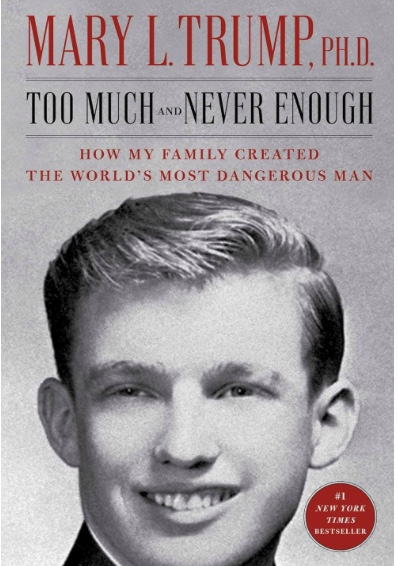
Dr. Mary Trump published a book, ominously titled, “Too Much and Never Enough: How My Family Created the World’s Most Dangerous Man.”

Most readers won’t need any more clues about her subject – her uncle, President Trump. But those who do could consult the cover, which features a photo of a young Trump before he became the figure who now lumbers upon the world stage and lurks in so many nightmares.

Three and a half years into the Trump era, endless words have been spent illustrating the chaotic and cruel personality that can, to cite just one example, schedule a huge ego-gratifying rally in the middle of a deadly Covid pandemic caused by a viciously contagious virus.

According to her publisher, Mary Trump will bring her special perspective – insider, psychologist, writer – to bear on incidents and information never before revealed.

Trump isn’t aging well

Having devoted years to the study of the man and the Trump clan, I can say that the bits teased so far suggest that Mary Trump has the goods. To begin with, she’s the daughter of the President’s eldest sibling, Fred Trump Jr., who may have been the original victim of Donald Trump’s bullying.

As publisher Simon and Schuster put it: “She recounts in unsparing detail everything from her uncle Donald’s place in the family spotlight and Ivana’s penchant for regifting, to her grandmother’s frequent injuries and illnesses and the appalling way Donald, Fred Trump’s favorite son, dismissed and derided him when he began to succumb to Alzheimer’s.”

Warm and easygoing, Frederick Junior was, by all accounts, ill-suited to play the role of cutthroat real estate baron, which was what his father expected of him. Happy to step in, Donald did all he could to prove that he was the more deserving son.

When Fred Jr. finally ceded first position among the heirs to the family business, he became an airline pilot. Donald mocked his profession. “What’s the difference between what you do,” he would ask, “and driving a bus?”

After Fred Jr. died at age 42 from complications of alcoholism, Donald turned his death into an object lesson that reflected well on himself. Donald pointedly abstained from tobacco and alcohol because of his brother’s struggle, saying, “I watched him. And I learned from him.”

The cruelty didn’t stop with Fred Jr.’s death in 1981. Later, when the paterfamilias Fred Trump Sr. died, heirs learned that his will distributed his estate among his children and their offspring “other than my son Fred C. Trump Jr.” The children of Fred Jr. sued, noting that an earlier will, written prior to Fred Sr. being diagnosed with dementia, had granted them proper shares.

Soon after the suit was filed, Donald changed a health insurance policy, taking away coverage for a disabled infant born to Fred’s own son, Fred III. (A second telling anecdote from author Harry Hurt III, who has written about the Trumps, describes Donald briefly considering evicting his brother and sisters from their rent-free homes in a Trump building unless they paid cash for the property.)

When asked in 2000 whether withdrawing the child’s insurance was cold-hearted, the man who claimed to be a billionaire said, “I can’t help that. It’s cold when someone sues my father.”

The suit was settled and the baby was again insured, but 16 years later, when he was running for president, Donald Trump seemingly had no regrets. Asked about the incident, he said, “I was angry because they sued.”

For those who know the family lore, the circle is completed by a little anecdote published in Hurt’s 1993 book “Lost Tycoon.” Hurt reports overhearing Fred Trump Sr. talking about his son Donald and his wife Mary flying off together. “I hope their plane crashes,” said Fred, adding that then “all my problems will be solved.”

Reports on the upcoming book suggest that the author will share juicy stories she learned from the President’s sister, Maryanne Barry. It wouldn’t be the first time that Barry, perhaps inadvertently, revealed something true about her brother. Speaking with writer Gwenda Blair in 1990, Barry shared a story about when Donald was a young man and turned a game of catch with Barry’s seven year-old son into a cruel contest.

“Donald kept throwing it faster and faster, harder and harder, until I hear this crack and the ball hit David’s head. Donald had to beat the seven year-old.”

This cold-hearted nature followed him into his political career. As president, Donald Trump has treated the children of asylum-seeking immigrants with great cruelty, separating them from their parents and locking them in cages. During our current pandemic, with over 116,000 dead in the US and more succumbing every hour, he has been so cavalier as to advocate dangerous unproven cures.

The biographer quoted below is Michael D’Antonio, a former journalist for Newsday and the author of The Truth About Trump. “In my own experience as a Trump biographer I have answered questions about the origins of the President’s weird ways by citing both genetics and his upbringing. This nature-and-nurture answer is a bit of a cop-out, but it is the best I have been able to muster after studying the man and his family.”

Because she has lived close to the source and possesses real expertise in mental health, Mary Trump’s opinion matters greatly to those seeking answers. I can’t wait to read her book.

Trump’s comments are in line with his vicious verbal attacks on Mexicans and other immigrant groups in the United States. But they betray his own family background. His grandfather, Friedrich Trump, a German, lived a migrant life in the US on the edge of illegality and rejection. During the World War I, he belonged to an immigrant group which was sweepingly labelled the “enemy within” or – in his grandson’s parlance – a Trojan horse.

The great wave

Friedrich Trump was swept to the United States in one of the biggest waves of mass migration in history. During the 1880s and early 1890s, 1.8m Germans emigrated to the US.

Wartime spy fever

World War I was not a happy time for German-Americans. They were summarily labelled as “alien enemies” whose true allegiance lay with the Fatherland. Nativist spokesmen agitated against “hyphenated Americans” as potential spies and saboteurs. Use of the German language was seen with suspicion. In contrast to many of their compatriots, the Trumps did not need to anglicise their surname as it worked perfectly in English.

The most notorious case of public violence was the lynching of German immigrant Robert Prager in Illinois. He was tarred and feathered, forced by an agitated crowd to kiss the American flag and sing patriotic songs, and finally hanged from a tree in front of 200 onlookers.

Frederick Trump evaded the fate of Prager, but not the other deadly weapon which swept the world once the war was nearing its end. In 1918 and 1919, Spanish influenza killed between 20m and 50m people worldwide. On a summer’s day in 1918, Frederick returned home from a stroll through New York with his son Fred (Donald’s father), went to bed feeling sick, and passed away the next day.

Paranoid nation

The dangerous mix of paranoia and xenophobia directed against German-Americans during World War I had profound and long-lasting effects. The Alien Enemy Bureau was established in the early days of the war with a brief to identify and arrest disloyal foreigners. It was headed by J. Edgar Hoover, then a young civil servant in the Justice Department. Here he picked up the tools he would use later as all-powerful director of the FBI.

In 1940, the notorious House Un-American Affairs Committee published The Trojan Horse in America, a compendium of domestic organisations believed to work for foreign powers. Chapter titles included “Mussolini’s Trojan Horse in America” and “A Trojan Horse of German War Veterans”.

All this was reason enough for the business-minded Trumps to deny their German heritage, claiming they hailed from Sweden instead. Donald’s father Fred invested heavily in New York real estate, laying the foundations for today’s business empire. It was only from the 1980s that Donald Trump started to stand by his German roots.

Trump’s own grandfather was an illegal emigrant whose income stream included alcohol and prostitution at a time when these were legally contested. He was an unwanted returnee to Germany, and then a potential “enemy alien” within the United States who had declared his loyalty to the German Kaiser – but ultimately made an immense economic contribution spanning generations.

Today, his grandson lambastes Mexicans as criminals, intends to erect a wall to keep them out, and warns of Syrian refugees as Trojan horses. If Donald Trump wins his party’s nomination, historians will have many a field day digging out the contradictions between his anti-immigrant rhetoric and his family background.

Categories: History, Science and Biography | Tags: , , , , | Leave a comment

Health Care mandate and King James I (of the Bible)


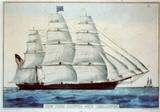
YANKEE CLIPPER, the SS CHALLENGE, 1858

7/15/17

Arguments were fierce during debate over the world’s first health care mandate in the British Parliament of 1624. Eventually, the Government’s bill, requiring an assessment on the wages of all sailors to pay for the care of sick and injured seamen, was passed over all objections and signed by the King.

King James I, beset by serious health challenges throughout his life, obviously had some empathy for those engaged in probably the most dangerous occupation of the age. Signing this bill, entitled “REVISED STATUTES (for the welfare of seamen)” was one of his last official acts, as he died in 1625.  Among his other distinctions was the convening of scholars in 1604 and the resultant KING JAMES BIBLE OF 1611.  He was the only British monarch who was a published author and a renowned linguist, fluent in 5 languages, conversant in several more.

The result of superior medical care for British sailors, not available to sailors of other countries, was that the British Navy became the most powerful in the world for the succeeding 300 years.

In 1791, George Washington signed a similar law which, since the new United States of America had no actual Navy at the time, (The “Continental Navy”, active in the Revolutionary War, had been disbanded and its ships sold–the US Navy was established by the Naval Act of 1794, also signed by President Washington) applied to merchant ships calling on US ports and was paid by ship owners.  Alexander Hamilton wrote of the importance of what he called a “nursery  {its meaning at the time was “attentive care”} of seamen” (in FEDERALIST PAPERS #11), to the future commercial success of our new nation, dependent, at the time, totally on marine commerce.

The better health of our sailors made the US merchant fleet, epitomized by the sleek “Yankee Clippers”, the best in the world for the next 150 years.

The resulting Marine Hospital Service became the Public Health Service which dealt with epidemics such as Cholera, Smallpox, Typhoid fever and malaria in the general population. The National Institutes of Health was added to pioneer research into polio, cancer, vaccine and drug development. It’s no accident that these  entities were part of the Treasury Department, (until 1953 when the Department of Health, Education and Welfare was created by President Eisenhower) charged with the health of our economy.

More recently, Kaiser Shipyards, desperate to attract workers needed to build “Liberty Ships” during World War II (the extraordinary production of which was vital to the Allied victory), created the “Kaiser Plan”, the model for managed care health plans for the succeeding 70 years. It was the model for the Massachusetts Health care plan under Governor Romney and “Obamacare”.  Today’s critics of  inclusive, public health care, mindlessly repeating the same discredited arguments heard first in 1624, appear to have learned nothing from history.

Categories: History, Science and Biography | Tags: , , , , | Leave a comment

Blog at WordPress.com.