The US standard railroad gauge (distance between the rails) is 4 feet, 8.5 inches. That’s an exceedingly odd number. Why was that gauge used?
Well, because that’s the way they built them in England, and English engineers designed the first US railroads. Why did the English build them like that?
Because the first rail lines were built by the same people who built the wagon tramways, and that’s the gauge they used. So, why did ‘they’ use that gauge then?
Because the people who built the tramways used the same jigs and tools that they had used for building wagons, which used that same wheel spacing. Why did the wagons have that particular odd wheel spacing?
Well, if they tried to use any other spacing, the wagon wheels would break more often on some of the old, long distance roads in England . You see, that’s the spacing of the wheel ruts. So who built those old rutted roads?
Imperial Rome built the first long distance roads in Europe (including England ) for their legions. Those roads have been used ever since.
And what about the ruts in the roads?
Roman war chariots formed the initial ruts, which everyone else had to match or run the risk of destroying their wagon wheels. Since the chariots were made for Imperial Rome , they were all alike in the matter of wheel spacing. Therefore the United States standard railroad gauge of 4 feet, 8.5 inches is derived from the original specifications for an Imperial Roman war chariot. Bureaucracies live forever.
So the next time you are handed a specification/procedure/process and wonder ‘What horse’s ass came up with this?’, you may be exactly right. Imperial Roman army chariots were made just wide enough to accommodate the rear ends of two war horses. (Two horses’ asses.)

Now, the twist to the story:
When you see a Space Shuttle sitting on its launch pad, there are two big booster rockets attached to the sides of the main fuel tank. These are solid rocket boosters, or SRBs. The SRBs are made by Thiokol at their factory in Utah . The engineers who designed the SRBs would have preferred to make them a bit fatter, but the SRBs had to be shipped by train from the factory to the launch site. The railroad line from the factory happens to run through a tunnel in the mountains, and the SRBs had to fit through that tunnel. The tunnel is slightly wider than the railroad track, and the railroad track, as you now know, is about as wide as two horses’ behinds.
So, a major Space Shuttle design feature, of what is arguably the world’s most advanced transportation system, was determined over two thousand years ago by the width of a horse’s ass.
And you thought being a horse’s ass wasn’t important? Ancient horse’s asses control almost everything.
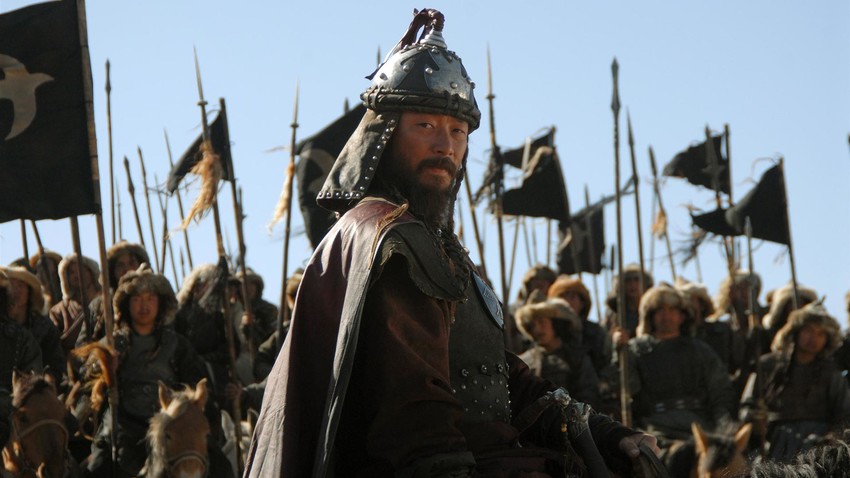
A still from “The Mongol,” 2007Sergey Bodrov Sn./STV production, 2007
1197
It is wrong to think that Mongol-Tatars invaded Russia as a single state, because the state actually formed as a response to the invasion, to resist and overthrow it. It was Peter the Great who formally ended Russia’s tributes to the Khans.
Knyaz’ Yaroslav II of Vladimir was poisoned by Güyük Khan’s wife. At the age of 67, Knyaz’ Mikhail of Chernigov was executed in the capital of the Golden Horde (Mongol khaganate) for refusing to worship Mongol idols. Knyaz’ Mikhail of Tver had his heart ripped out in the same capital, the chronicle says. The Russian population was forced to pay substantial tributes, and Russian princes were only allowed to rule their duchies by the permission of the Khan of the Golden Horde. That’s how it was under the Mongol rule, or, as we call it in Russia, the Tatar-Mongol Igo (Yoke).
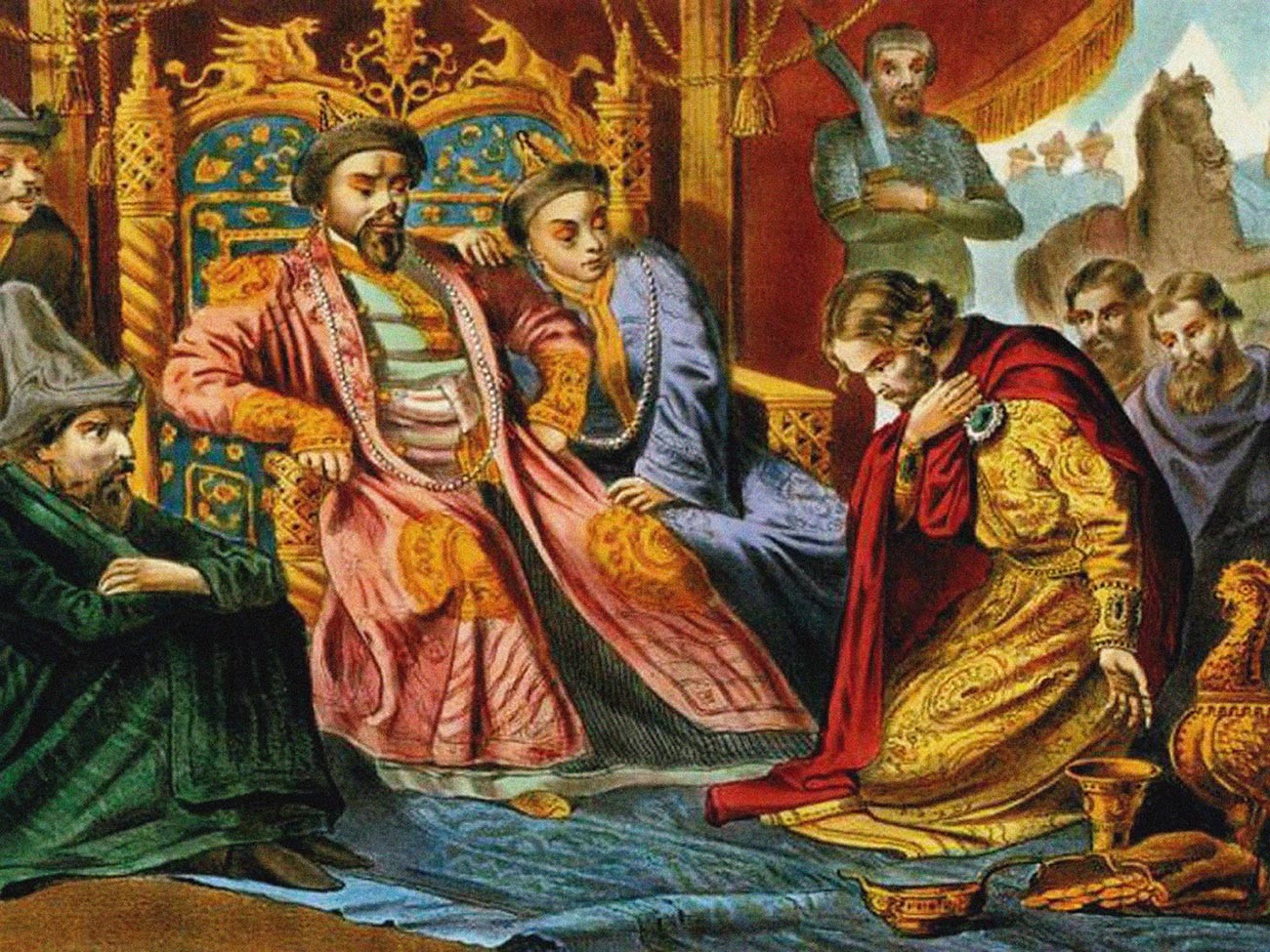
Prince Alexander Nevsky begging Batu Khan for mercy for Russia, End of the 19th century. Found in the collection of Russian State Library, MoscowGetty Images
It’s hard to believe that events such as these were instrumental in the formation of the Russian state. But it was opposition to these actions that united the Russian princes – unfortunately, not with friendship, but under the iron fist of the strongest of them. “Moscow owes its greatness to the Khans,” wrote the great Russian historian Nikolay Karamzin (1766-1826).
At the time of the Mongol invasion of Rus’, the Mongols were advanced both in the military and in the systems of governance. Only unity could help the Russians to overthrow Mongol rule. How did it begin in the first place?
1. What prompted the Mongol Invasion?
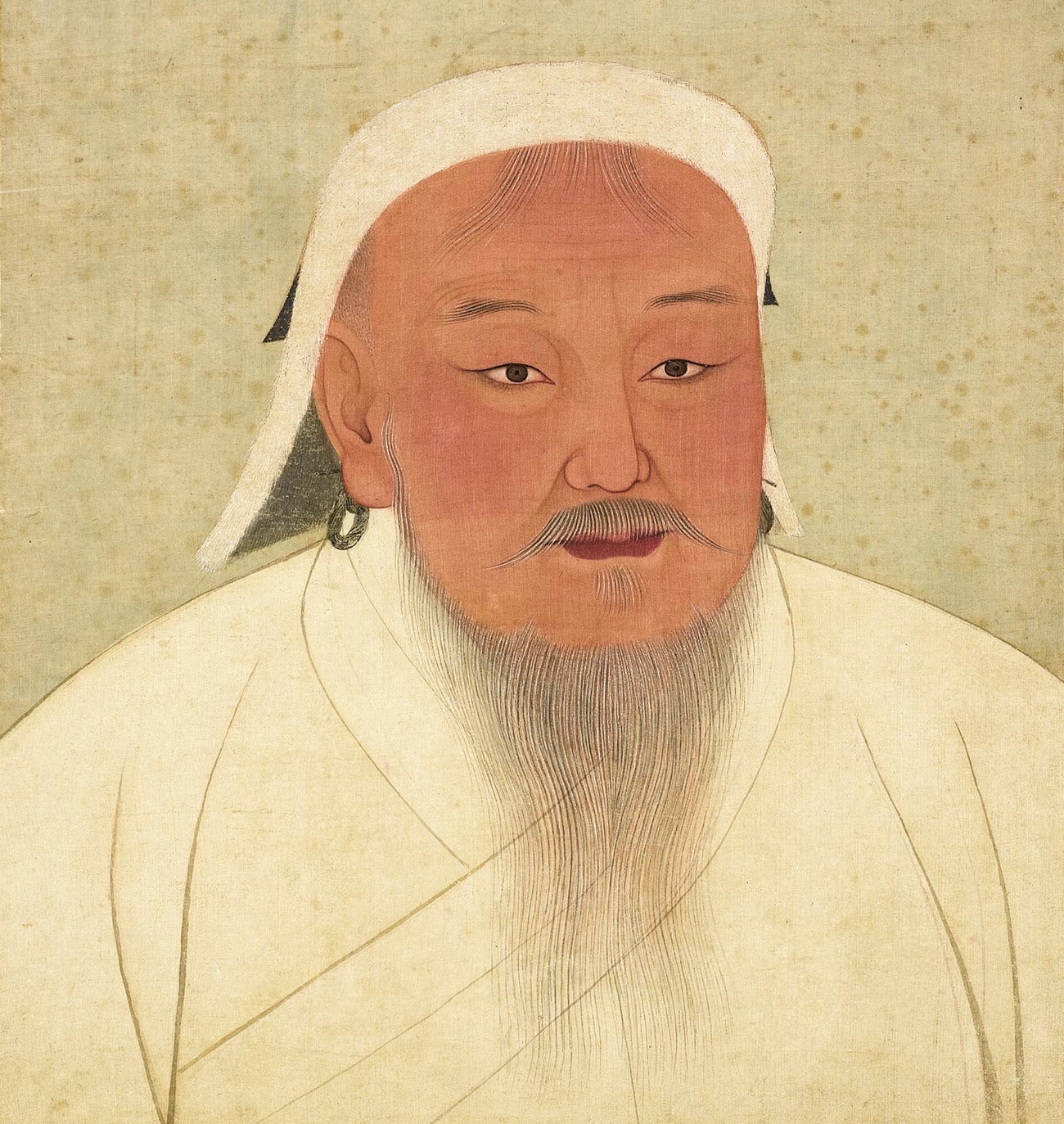
Genghis KhanPublic domain
It all started when Genghis Khan (1155-1227), the founder of the Mongol Empire, sent his son Jochi (1182-1227) to conquer the lands of what is now Siberia, Central Russia, and Eastern Europe. Giant armies of Mongol warriors (clearly over 100,000, an enormous number in the 13th century) easily defeated the weak and ill-numbered forces of the Russian princes, who were at war with each other before the invasion.
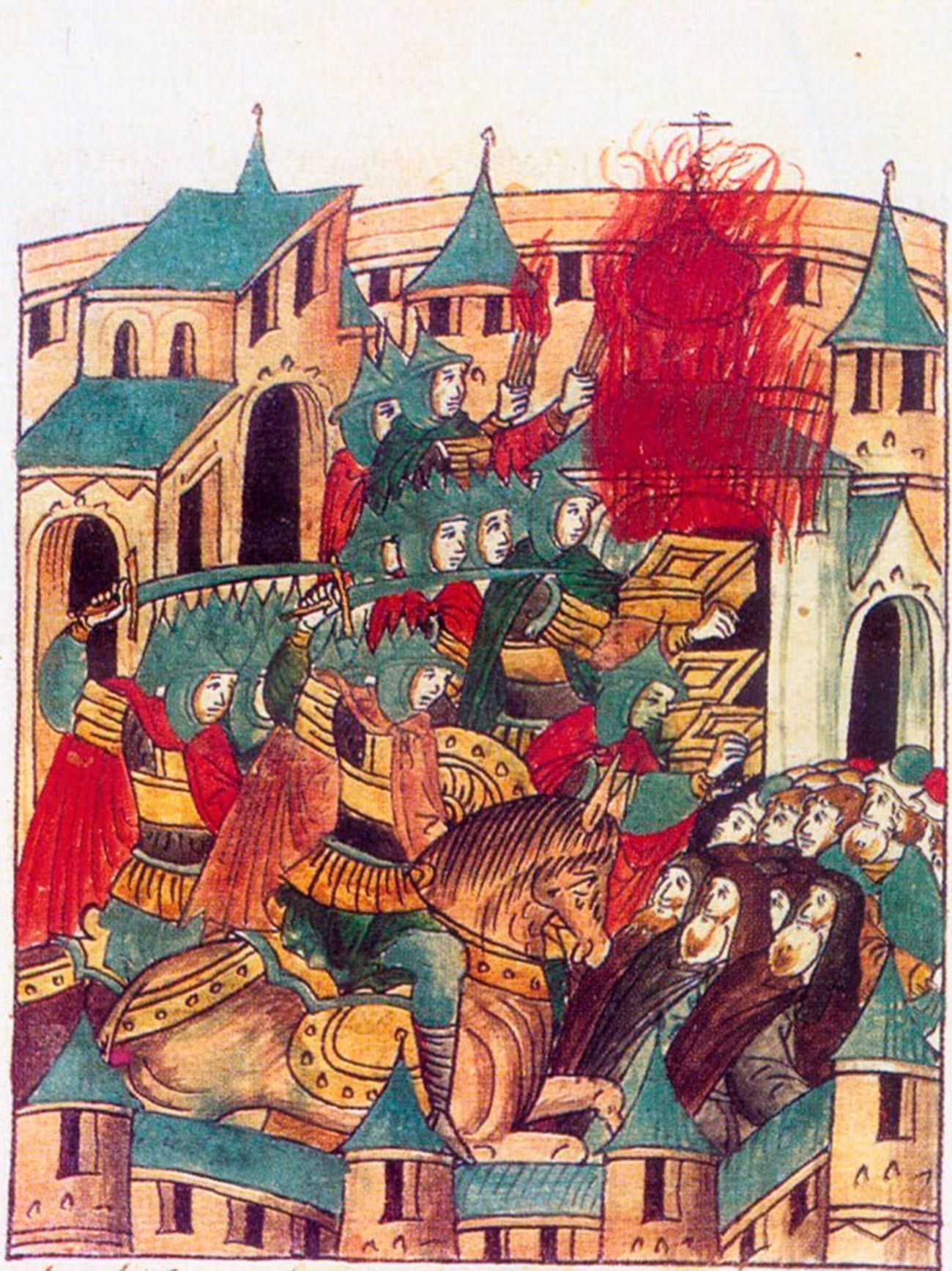
In 1237, the Mongols, led by Batu Khan, invaded Rus’. They took, ravaged and burned Ryazan’, Kolomna, Moscow, Vladimir, Tver – all the main Russian cities. The invasion continued until 1242 and was a terrible blow for the Russian lands – it took almost 100 years to fully recover from the damage the Mongol army did. Also, the lands and cities of the South – Kiev, Chernigov, Halych were burned to the ground. The North-Eastern lands, most notably Tver, Moscow, Vladimir, and Suzdal became the main cities after the invasion.
However, the Mongols didn’t want to conquer the land fully – they just wanted stable tributes. And they knew how to get what they wanted.
2. How did Mongol rule work?
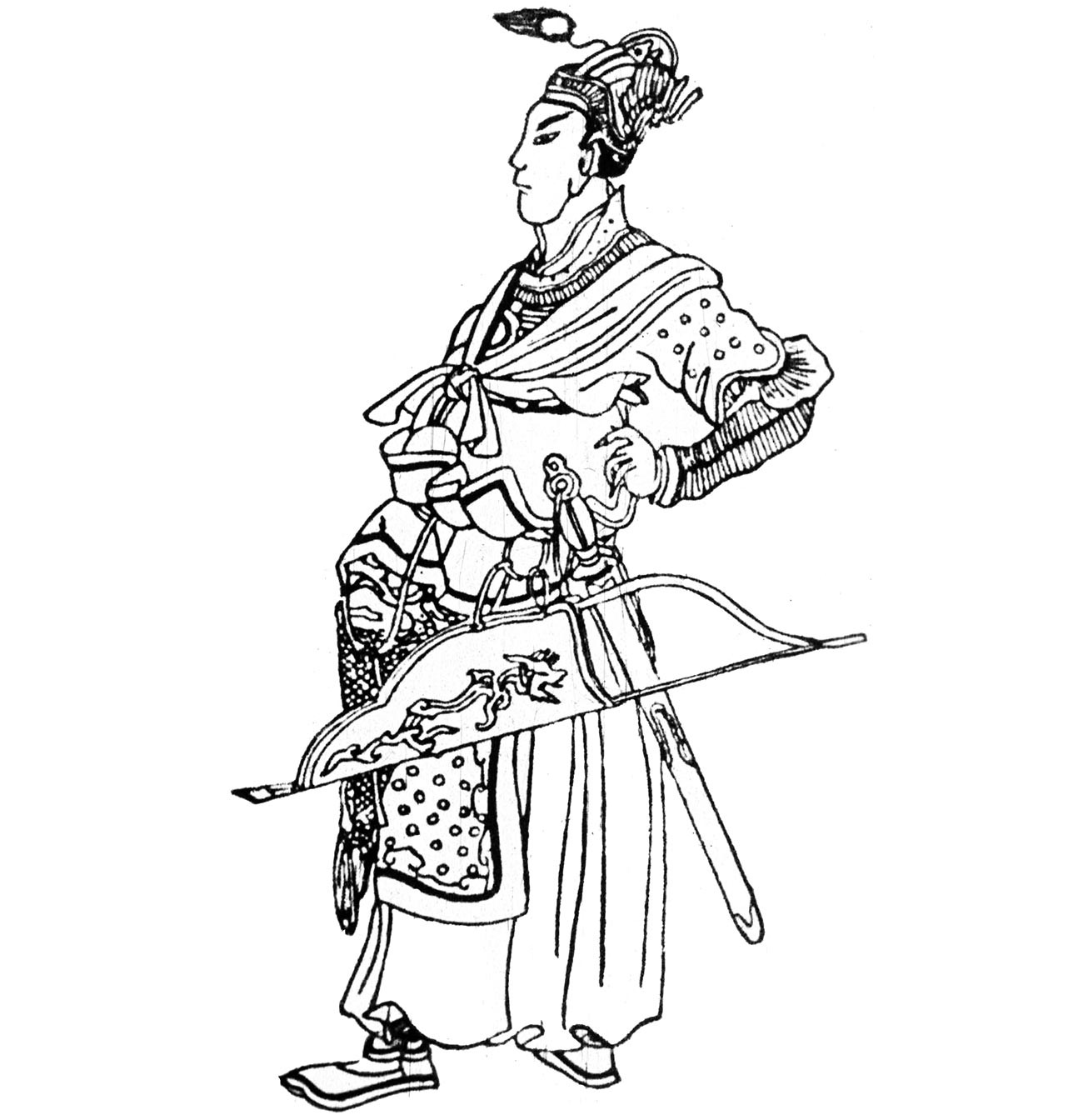
Batu Khan as seen on a Middle Ages Chinese etchingPublic domain
In 1243, Yaroslav II of Vladimir (1191-1246) was the first Russian prince to receive permission to rule – he was summoned to Batu Khan, swore his allegiance to him and was named the “biggest knyaz’ of all Russians.”
The ceremony of swearing allegiance to Mongols was very similar to the French ceremony of homage, where the liege kneeled on one knee at the feet of his seated sovereign. But in the Horde’s capital Saray, Russian princes were sometimes forced to walk on their knees to the Khan’s throne and overall treated like inferiors. It was this same Yaroslav II, by the way, who received the first jarlik and later was poisoned.
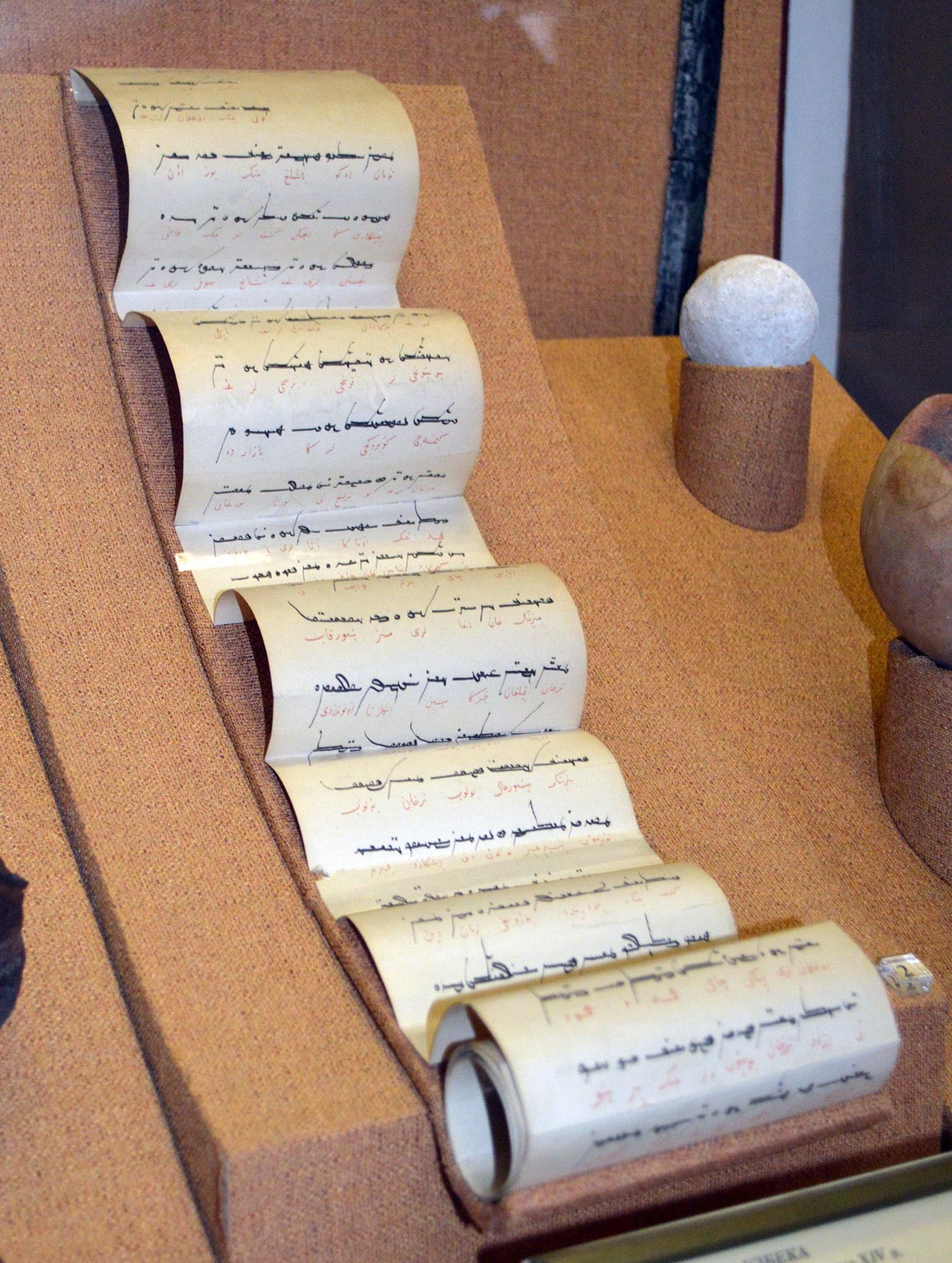
Jarlik (a shout-out, an announcement in the ancient Mongol language) was how Mongols called diplomatic credentials – protective charters they wrote and handed over to the Russian princes and priests. The important part of the Mongols’ policy was that they protected the Russian Orthodox churches, never ravaged them, and kept the clergy safe. For protection, the church was obliged to preach allegiance to the Mongol Tatars to their parishioners.
A typical Mongol jarlik dating back to 1397Лапоть (CC0 1.0)
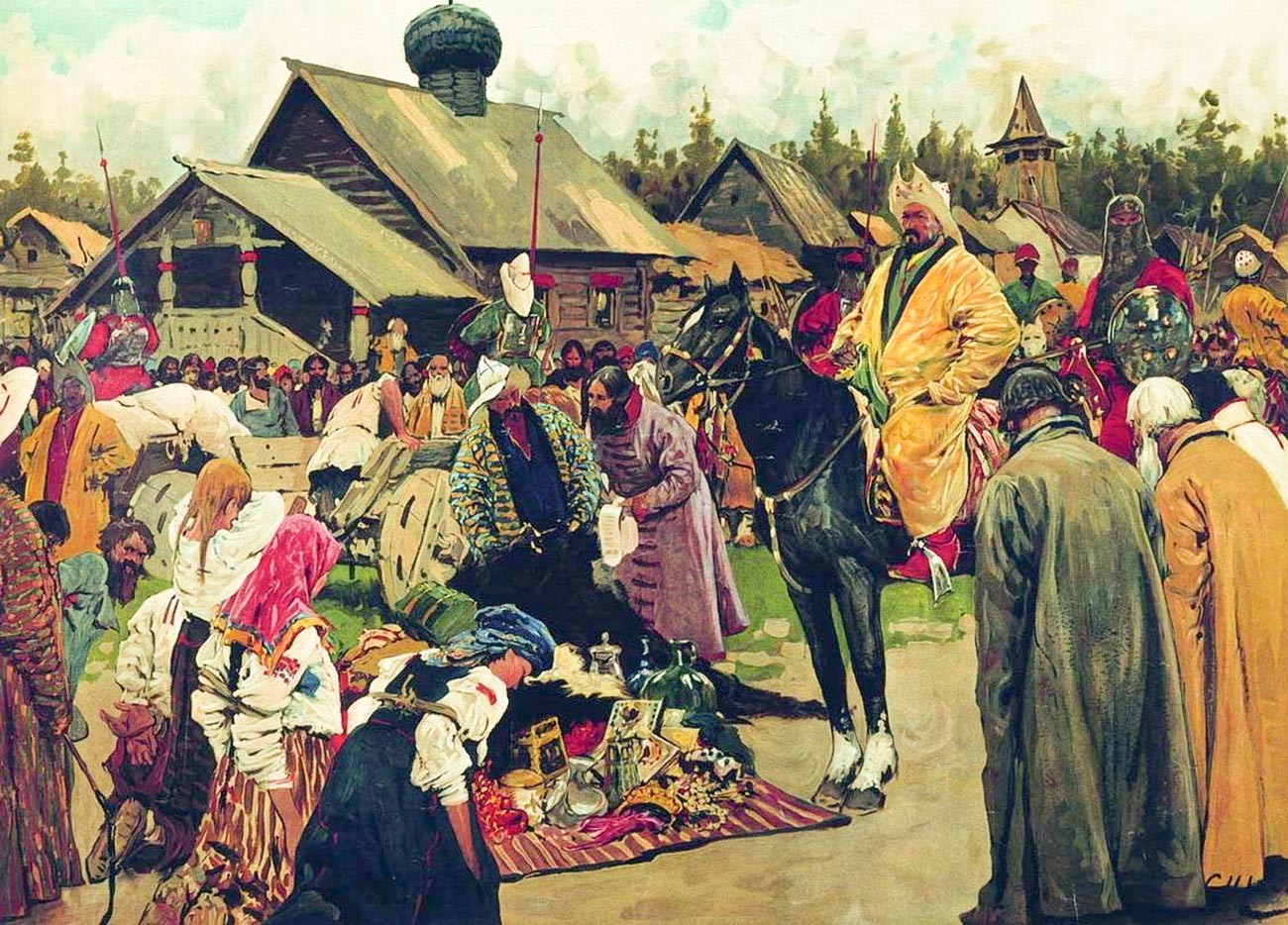
The tributes were controlled and collected at first by the baskaks, the Mongol taxmen, who lived in Russian cities with their suite and security guards. To collect the tributes, the Mongols performed a census of the population of the subdued duchies. The tributes went to the Mongol Empire, and after 1266, when the Tatar-Mongol state of Golden Horde divided itself from the Mongols, tributes went to the Golden Horde’s capital Saray. Later, after multiple local revolts and following the Russian princes’ pleas, the tribute collection was handed over to the princes themselves. Otherwise, the Russians were left to live their life.
3. How did the Russians USE the Mongols to their benefit?
“The Baskaks”Sergey Ivanov
There was never any constant military presence of the Mongols, but if the Russians revolted against their rule, they could send armies. However, the cunning and politically sophisticated Mongol khans manipulated Russians, incited hatred and wars among them to better control the weak, divided states. Soon, the princes learned this tactic and started applying it against the Mongols.
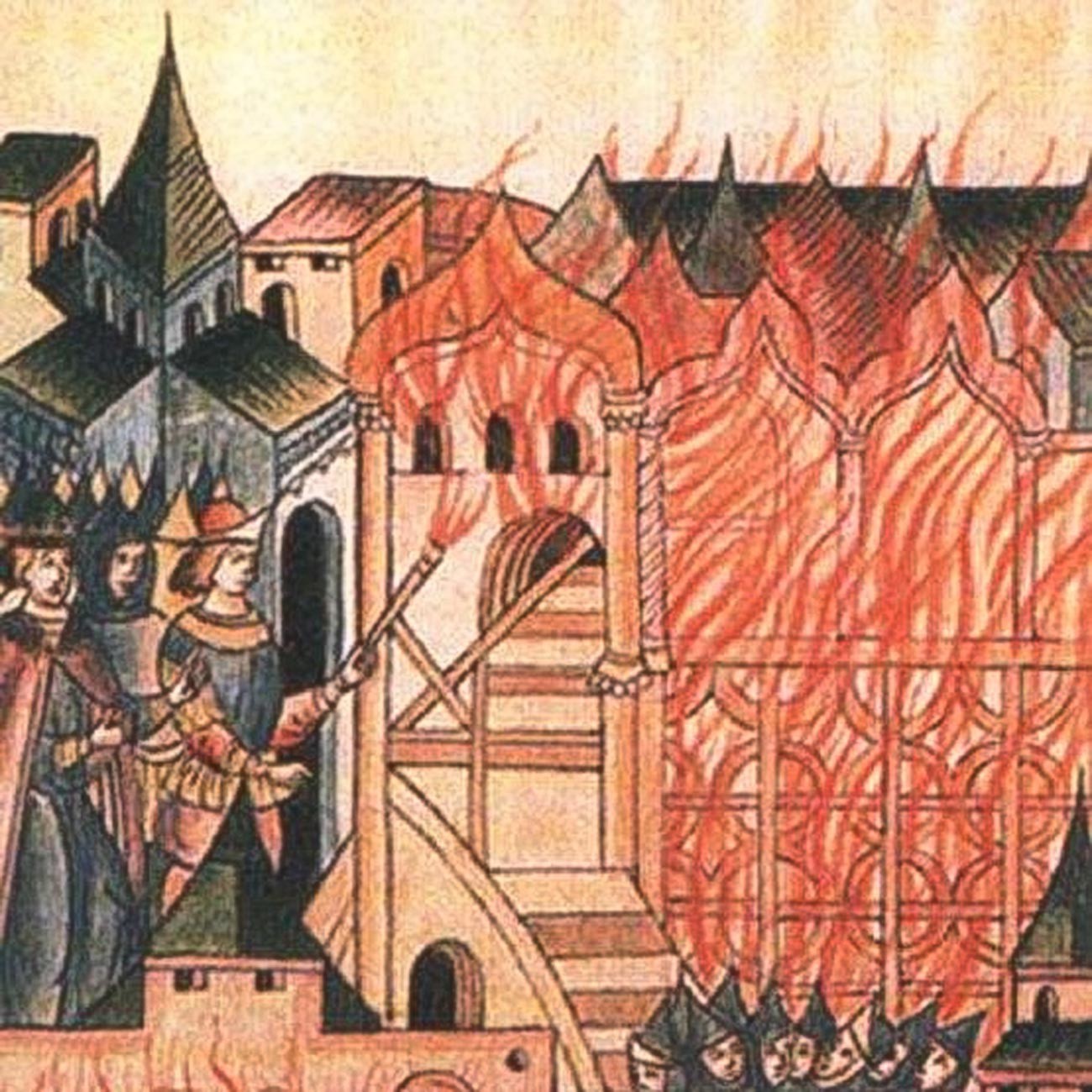
For a century, there were innumerable military campaigns between Mongols and Russians. In 1328, Tver duchy revolted against the Mongols, killing the Uzbek Khan’s cousin. Tver was burned and destroyed by the Horde, and Moscow and Suzdal princes helped the Mongols. Why? How could they?
In a war between the duchies, the Moscow princes understood that somebody has to take the lead against the Mongols by subduing others to his rule. After Tver’s demise, Ivan I “Kalita” of Moscow became the first prince to collect the tributes from the Russian lands instead of the baskaks – that’s what he got for helping the Mongols to murder his compatriots – and at the same time, his enemies. However, this helped bring the famous “40-year peace” when Mongols didn’t attack the lands of Moscow (but ravaged other duchies). Meanwhile, Moscow used the defeats of other princes for their own means.
The sacking of Suzdal by Batu Khan in February 1238. Mongol Invasion of Russia. A miniature from the sixteenth-century chroniclePublic domain
Russians also quickly learned from the Mongols to use written contracts, sign acts, enact laws; Russians used the system of yams – road stations, employed first by Genghis Khan for multiple purposes: shelter for travelers, places to hold spare horses for army messengers, and so on. This system was installed in the Russian lands by the Mongols for their purposes but eventually started being used by Russians for their own good – to connect their lands.
4. How did the Mongol rule end?
The Tver uprising of 1328 as seen in a Russian chronicle of the 16th centuryPublic domain
What Moscow princes learned from the ruthless Mongols was that you either kill your enemy or disable him so he can’t take revenge. Simultaneously with the strengthening of Moscow princes, the Golden Horde fell into a political crisis. In 1378, Dmitry of Moscow, known as Donskoy (1350-1389) for the first time in a long while, crushed one of the Horde’s armies.
In 1380, Dmitry Donskoy, who had earlier stopped paying tributes to the Horde, defeated the 60,000-110,000-strong army of Khan Mamay in the Battle of Kulikovo, a great moment of high spirits for all the Russian lands. However, in 1382, Moscow was burned by Tokhtamysh, a Khan of another part of the dismantled Horde.
For the next hundred years or so, Russian lands on and off paid tributes to different Khans of the Horde, but in 1472, Ivan the Great of Moscow (1440-1505) refused again to pay tributes to the Tatar Mongols. This time, the Great Duchy of Moscow was really great. Ivan and his father Vasily II the Blind had collected lands and princes and subdued them to Moscow.
Ahmed bin Küchük, Khan of the Golden Horde, tried to wage war against Ivan, but after the famous standoff at the Ugra river in 1480, he returned home. This battle marked the end of the Mongol rule and control – but not the tributes. Russia continued sending money and valuable goods to different parts of the Horde just to make peace with militant Tatars. This was called “pominki” (appr. ‘memorables’) in Russian.
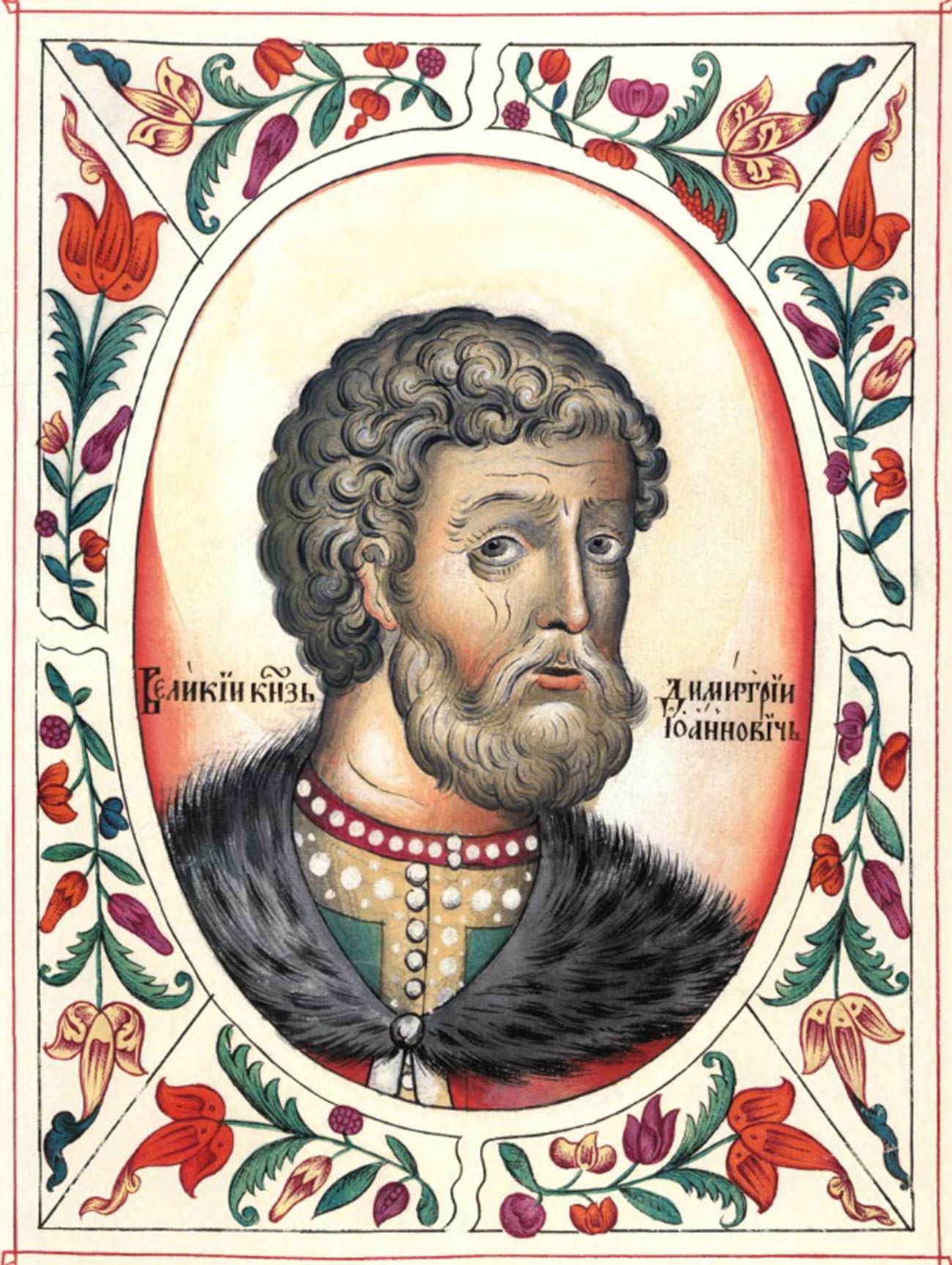
Dmitry Donskoy, an image from a Russian chroniclePublic domain
Russia paid pominki to different former Horde dynasties until 1685. Formally, the tributes were banned by Peter the Great only in 1700, according to the Treaty of Constantinople between the Russian Tsardom and the Ottoman Empire. The Khan of Crimea, one of the last of the Khans at the time, and the Ottoman Empire’s vassal, was also the last to whom Russia paid. The treaty said:
“…Because the State of Moscow is autonomous and free – the tribute that annually was given to the Crimean Khans until now, henceforward shall not be given from His Holy Greatness of the Tsar of Moscow, nor from his descendants…”
It is very symbolic that Peter, the last great tsar of Moscow and the future first Emperor of Russia, signed this treaty in 1700, the first year that began in Russia not from the 1st of September, like in ancient Russia, but from January 1st – just like in Europe.
Interesting, but after applying Occam’s Razor (the simplest explanation is very probably the correct one) I’m inclined to stick wth my OWN theory, that Russia and many of its people are as they are thanks to conquest by the Mongols. The Mongol invaders treated their enemies with abolutely no mercy, and the penalty for defiance was extermination. The wisest course of action when it even LOOKED like you might be attacked was…. Immediate surrender. And the Mongols, curously, didn’t even bother to leave behind a garrison in their conquests, which remained free to administer themselves. BUT, as a conquered posession, the man task of that admniistration was to gather “tribute” to send to the Khanate. Fail to deliver, and… they’d be back – and you would be dead. So would your family, your friends, your neighbours, your livestock and your pets… So you DIDN’T provoke them. And faced with collective punishment, you didn’t allow anyone else to do so. And the level of “tribute” demanded left the starving people in absolute poverty. Not very different from being a prisoner in Auschwitz. Except Russia’s experience of being prisoners in their OWN COUNTRY lasted for generations. No surprise that it influenced the culture at a VERY basic level. And what makes that “character change” plausible is what happened when the Mongol Empire imploded… Which is basically… NOTHING. Generations of children who had been carefully taught by their parents how to avoid getting the whole family killed had in turn taught THEIR children, who taught their children lessons on how to behave in a totally warped reality. It had become their “Normal”.And the laws that they passed in their newly freed country reflected that. “Just keep on doing what you’ve been doing, and your parents did, and their parents and grandparents…” The rationale for the behaviour was lost. You no longer behaved like that BECAUSE “otherwise the Mongols will come back and kill us all”, but because NOW it had just become the NORMAL way to behave. And for things to become as warped a THAT takes many generations.. ALL of the peculiarities listed above are explained by that MUCH simpler cause. When a tiger, or a lion is kept in caged captivity or long enough, pacing the limits of their cage… when the physical bars are taken away, the tiger may continue to pace the limits of a cage that exist only in its mind. Same basic idea. A Russian named Trofim Lysenko managed to convince the leaders (under Stalin) that it is possible, through controling the environment, to bring about permanent genetic changes. Complete BS of course.That’s NOT how genetics works!!
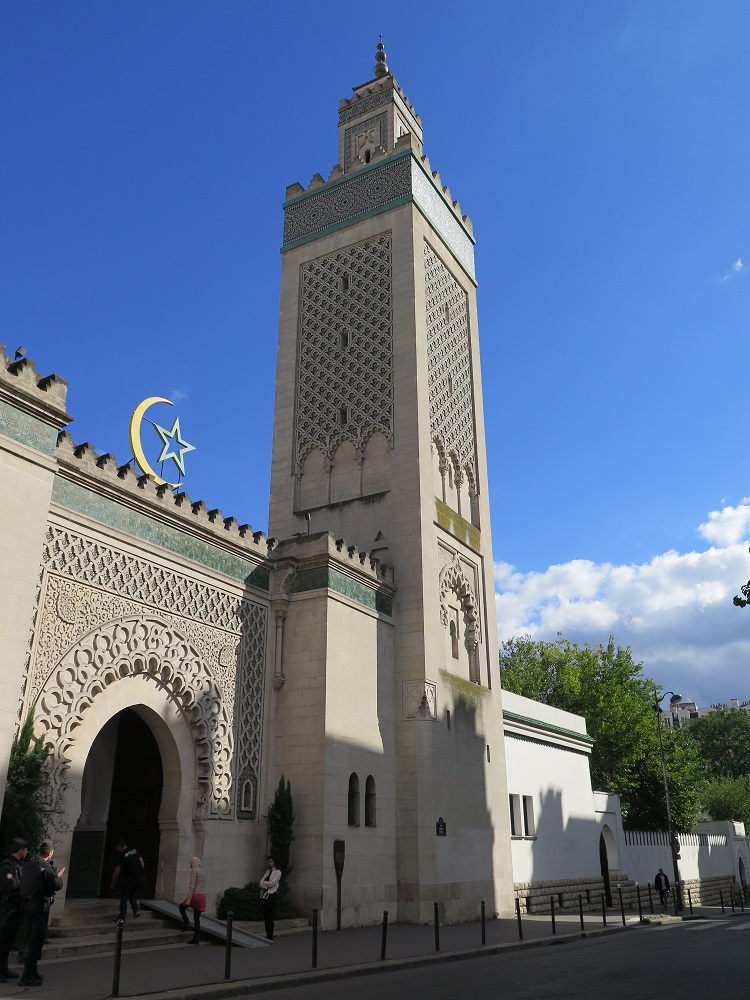
The Grand Mosque of Paris was built between 1922 and 1926 to symbolize the eternal friendship between France and Islam. It was also meant to express gratitude to the half-million Muslims of the French Empire’s North African colonies who had fought against the Germans in World War I. A hundred thousand Muslims died for France; without their sacrifice, it is said, the victory of Verdun would not have happened. The Mosque was particularly meant to honor the fallen Muslim tirailleurs (sharpshooters) from Algeria.
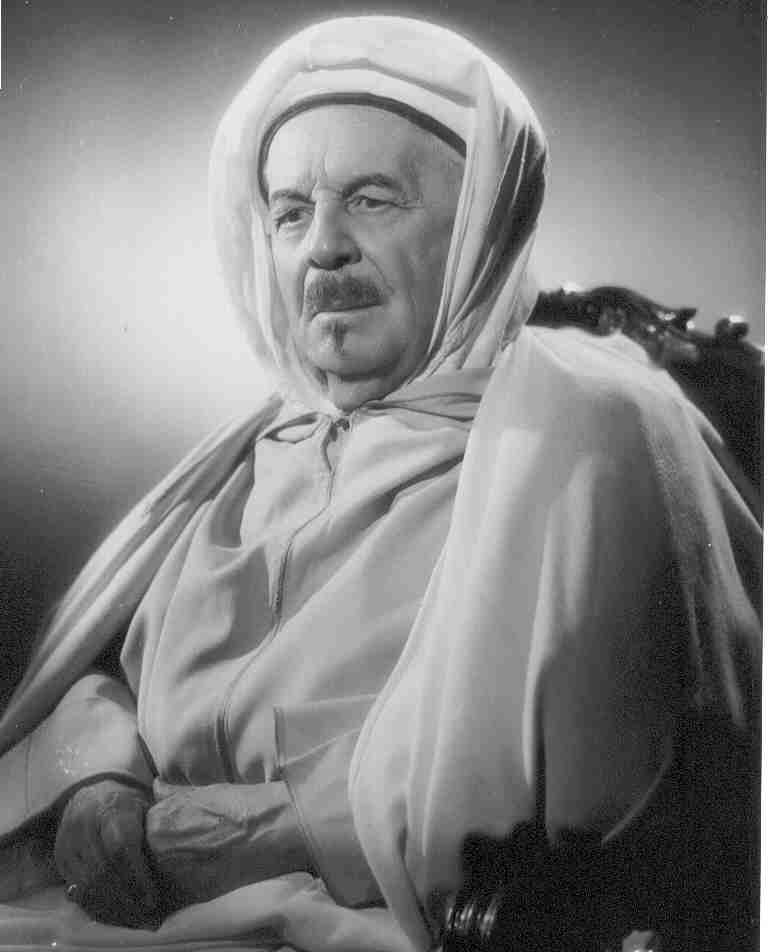
Si Kaddour Benghabrit. Image is in the public domain via
After the war many Algerians relocated to France, working in factories and on construction jobs mostly, sending money home to their families. Known as Kabyles—Berbers from Kabylia, the treacherous Atlas Mountains and impoverished villages of Algeria that Albert Camus wrote about — the Kabyles became the dominant Muslim population in Paris. Many lived in slum housing in Belleville in northeastern Paris, forming bonds with their other immigrant neighbors and coworkers: Chinese and Vietnamese, Tunisians, Moroccans, Jews from North Africa, Russia, eastern Europe.
When the Nazis invaded in 1940 and began rounding up Jews for deportation, many Kabyles joined the French Resistance. (It is also true that like Christians, many Arabs in North Africa and Paris collaborated with the anti-Semitic Vichy and German authorities.)
Benghabrit saves Jews from the Gestapo
The successes of the Kabyle Resistance were intimately connected with the clandestine antifascist operations in daily progress in the cellars of the Grand Mosque where the Kabyles worshipped. Thanks to the heroism of the Mosque’s rector, Si Kaddour Benghabrit (1868–1954), the Kabyles were free to bring their Jewish friends and coworkers to the Mosque for safe haven.
The first prayer offered at the Paris Mosque in 1926, in the presence of the president of France, was given by this rector who was also the Mosque’s founder. Benghabrit, born in Algeria, a cultured diplomat in Paris and North Africa who wrote books, enjoyed Parisian salon culture, and loved music became the most important Muslim in Paris and the most influential Arab in Europe. Benghabrit has now become a figure of historical interest and some acclaim because of his actions during the Holocaust.
When the Nazis and the Vichy government began arresting and deporting the Jews of Paris, Benghabrit committed himself and his congregation to making the Grand Mosque a sanctuary for endangered Jews. He devised a threefold rescue operation: first, he offered European and Algerian Jews shelter in the same apartments inhabited by Muslim families; second, he gave them fake identity certificates, to prove they were Muslims, not Jews; finally, he initiated the use of the cellars and tunnels beneath the Mosque as escape routes.
The Jews-in-hiding crawled and dug their way through the sewers and tunnels (souterrains) under the Mosque to the banks of the Seine where empty wine barges and boats operated by Kabyles were waiting to smuggle them out of Occupied Paris. Benghabrit was arrested and interrogated by the Gestapo a number of times as rumors of the Mosque’s resistance inevitably got out. A higher German command, however, ordered him released each time: The Germans could not risk Algerian riots in North Africa or Paris if the Reich was to hold North Africa against the allies. It was important that the Muslims on both fronts stayed submissive.
Salim Halali, a Berber Jew from Algeria, popular singer of North African songs and friend of Benghabrit, sought and found safety in the Mosque. The rector not only made him a Certificate of Conversion to show—falsely—that Salim’s grandfather had converted to Islam; he also had an unmarked tombstone in the Muslim cemetery in Bobigny inscribed with the family name of Halali’s grandfather.
After the Nazis checked it out, they left Halali alone. He lived out the war in the Mosque, passing as a Muslim when the Nazis, responding to rumors of a Mosque underground, barged in regularly on a search-and- deport mission. (Benghabrit had a warning bell hidden in the floor under his desk that alerted everyone of another Nazi raid in progress.) After the Liberation, Halali went on to become the most popular “oriental” singer in Europe. He and Benghabrit remained good friends.
Albert Assouline, a North African Jew who with a Muslim friend escaped from a POW camp in Germany, surfaced in Paris without identity papers. The Mosque welcomed him and his friend. While hiding out in the basement, Assouline saw many other Jews in hiding: the children lived in the upstairs apartments with Muslim families, the adults in the basement. Because North African Jews and Muslims looked alike, had similar surnames, were circumcised, and spoke Arabic, the Jews, with their fake Muslim identity certificates, were able to pass as Muslim when the Gestapo came searching for evidence of a Jewish sanctuary movement. After the war, Assouline gave testimony that he witnessed 1,600 Jews passing through the basements and sub-basements of the Mosque and descending into the dark labyrinthine tunnels, eventually making it out onto the boats waiting at the Halles aux Vins on the Seine to carry them to safety in the Maghreb and Spain. In addition to Jewish refugees, the Kabyle boatmen also carried messages between the French Resistance in Paris and the Free French Army in Algeria.
The Grand Mosque of Paris: Place du Puits de l’Ermite. Image is taken from the book The Streets of Paris
Some sources dispute Assouline’s estimate, claiming that at most five hundred Jews were given a home and then safe passage by Benghabrit and the Mosque. One Israeli scholar dismisses the story as exaggerated from start to finish. There is not much data available to provide the actual numbers of Jews rescued by the Mosque. But what there is—old newspapers, scholarly research,* and personal testimonies from Jews who after the war told of hiding for its duration in the Mosque’s basements—supports the details of this hidden history.
Benghabrit was given the Grand Croix de la Légion d’Honneur after the war. But Eva Wiesel has noted in The New York Times that getting Yad Vashem in Israel to grant the honorific of “Righteous Among Nations” to a Muslim, even the Oskar Schindler–like Benghabrit, is and will remain very difficult. This heroic unsung leader of the Paris Mosque Resistance died in 1954 in the early stages of the war of Algerian independence.
He is buried in the Mosque, facing in the direction of Mecca, as are all Muslims.
SUSAN CAHILL has published several travel books on France, Italy, and Ireland, including Hidden Gardens of Paris and The Streets of Paris. She is the editor of the bestselling Women and Fiction series and author of the novel Earth Angels. She spends a few months in Paris every year.
The current crisis between Russia and Ukraine is a reckoning that has been 30 years in the making. It is about much more than Ukraine and its possible NATO membership. It is about the future of the European order crafted after the Soviet Union’s collapse. During the 1990s, the United States and its allies designed a Euro-Atlantic security architecture in which Russia had no clear commitment or stake, and since Russian President Vladimir Putin came to power, Russia has been challenging that system. Putin has routinely complained that the global order ignores Russia’s security concerns, and he has demanded that the West recognize Moscow’s right to a sphere of privileged interests in the post-Soviet space. He has staged incursions into neighboring states, such as Georgia, that have moved out of Russia’s orbit in order to prevent them from fully reorienting.
Putin has now taken this approach one step further. He is threatening a far more comprehensive invasion of Ukraine than the annexation of Crimea and the intervention in the Donbas that Russia carried out in 2014, an invasion that would undermine the current order and potentially reassert Russia’s preeminence in what he insists is its “rightful” place on the European continent and in world affairs. He sees this as a good time to act. In his view, the United States is weak, divided, and less able to pursue a coherent foreign policy. His decades in office have made him more cynical about the United States’ staying power. Putin is now dealing with his fifth U.S. president, and he has come to see Washington as an unreliable interlocutor. The new German government is still finding its political feet, Europe on the whole is focused on its domestic challenges, and the tight energy market gives Russia more leverage over the continent. The Kremlin believes that it can bank on Beijing’s support, just as China supported Russia after the West tried to isolate it in 2014.
Putin may still decide not to invade. But whether he does or not, the Russian president’s behavior is being driven by an interlocking set of foreign policy principles that suggest Moscow will be disruptive in the years to come. Call it “the Putin doctrine.” The core element of this doctrine is getting the West to treat Russia as if it were the Soviet Union, a power to be respected and feared, with special rights in its neighborhood and a voice in every serious international matter. The doctrine holds that only a few states should have this kind of authority, along with complete sovereignty, and that others must bow to their wishes. It entails defending incumbent authoritarian regimes and undermining democracies. And the doctrine is tied together by Putin’s overarching aim: reversing the consequences of the Soviet collapse, splitting the transatlantic alliance, and renegotiating the geographic settlement that ended the Cold War.
Stay informed.
In-depth analysis delivered weekly.Sign Up
BLAST FROM THE PAST
Russia, according to Putin, has an absolute right to a seat at the table on all major international decisions. The West should recognize that Russia belongs to the global board of directors. After what Putin portrays as the humiliation of the 1990s, when a greatly weakened Russia was forced to accede to an agenda set by the United States and its European allies, he has largely achieved this goal. Even though Moscow was ejected from the G-8 after its annexation of Crimea, its veto on the United Nations Security Council and role as an energy, nuclear, and geographic superpower ensure that the rest of the world must take its views into account. Russia successfully rebuilt its military after the 2008 war with Georgia, and it is now the preeminent regional military power, with the capability to project power globally. Moscow’s ability to threaten its neighbors enables it to force the West to the negotiating table, as has been so evident in the past few weeks.
As far as Putin is concerned, the use of force is perfectly appropriate if Russia believes that its security is threatened: Russia’s interests are as legitimate as those of the West, and Putin asserts that the United States and Europe have been disregarding them. For the most part, the United States and Europe have rejected the Kremlin’s narrative of grievance, which centers most notably on the breakup of the Soviet Union and especially the separation of Ukraine from Russia. When Putin described the Soviet collapse as a “great geopolitical catastrophe of the twentieth century,” he was lamenting the fact that 25 million Russians found themselves outside of Russia, and he particularly criticized the fact that 12 million Russians found themselves in the new Ukrainian state. As he wrote in a 5,000-word treatise published last summer and titled “On the Historical Unity of Russians and Ukrainians,” in 1991, “people found themselves abroad overnight, taken away, this time indeed, from their historical motherland.” His essay has recently been distributed to Russian troops.
In an essay last year, Putin wrote that Ukraine was being turned into “a springboard against Russia.”
This narrative of loss to the West is tied in to a particular obsession of Putin’s: the idea that NATO, not content to merely admit or aid post-Soviet states, might threaten Russia itself. The Kremlin insists that this preoccupation is based on real concerns. Russia, after all, has been repeatedly invaded from the West. In the twentieth century, it was invaded by anti-Bolshevik allied forces, including some from the United States, during its civil war from 1917 to 1922. Germany invaded twice, leading to the loss of 26 million Soviet citizens in World War II. Putin has explicitly linked this history to Russia’s current concerns about NATO infrastructure nearing Russia’s borders and Moscow’s resulting demands for security guarantees.
Today, however, Russia is a nuclear superpower brandishing new, hypersonic missiles. No country—least of all its smaller, weaker neighbors—has any intention of invading Russia. Indeed, the country’s neighbors to its west have a different narrative and stress their vulnerability over the centuries to invasion from Russia. The United States would also never attack, although Putin has accused it of seeking to “cut a juicy piece of our pie.” Nevertheless, the historical self-perception of Russia’s vulnerability resonates with the country’s population. Government-controlled media are filled with claims that Ukraine could be a launching pad for NATO aggression. Indeed, in his essay last year, Putin wrote that Ukraine was being turned into “a springboard against Russia.”
Putin also believes that Russia has an absolute right to a sphere of privileged interests in the post-Soviet space. This means its former Soviet neighbors should not join any alliances that are deemed hostile to Moscow, particularly NATO or the European Union. Putin has made this demand clear in the two treaties proposed by the Kremlin on December 17, which require that Ukraine and other post-Soviet countries—as well as Sweden and Finland—commit to permanent neutrality and eschew seeking NATO membership. NATO would also have to retreat to its 1997 military posture, before its first enlargement, by removing all troops and equipment in central and eastern Europe. (This would reduce NATO’s military presence to what it was when the Soviet Union disintegrated.) Russia would also have veto power over the foreign policy choices of its non-NATO neighbors. This would ensure that pro-Russian governments are in power in countries bordering Russia—including, foremost, Ukraine.
DIVIDE AND CONQUER
So far, no Western government has been prepared to accept these extraordinary demands. The United States and Europe widely embrace the premise that nations are free to determine both their domestic systems and their foreign policy affiliations. From 1945 to 1989, the Soviet Union denied self-determination to central and eastern Europe and exercised control over both the domestic and foreign policies of Warsaw Pact members through local communist parties, the secret police, and the Red Army. When a country strayed too far from the Soviet model—Hungary in 1956 and Czechoslovakia in 1968—its leaders were ousted by force. The Warsaw Pact was an alliance that had a unique track record: it invaded only its own members.
The modern Kremlin’s interpretation of sovereignty has notable parallels to that of the Soviet Union. It holds, to paraphrase George Orwell, that some states are more sovereign than others. Putin has said that only a few great powers—Russia, China, India, and the United States—enjoy absolute sovereignty, free to choose which alliances they join or reject. Smaller countries such as Ukraine or Georgia are not fully sovereign and must respect Russia’s strictures, just as Central America and South America, according to Putin, must heed their large northern neighbor. Russia also does not seek allies in the Western sense of the word but instead looks for mutually beneficial instrumental and transactional partnerships with countries, such as China, that do not restrict Russia’s freedom to act or pass judgment on its internal politics.
Such authoritarian partnerships are an element of the Putin doctrine. The president presents Russia as a supporter of the status quo, an advocate of conservative values, and an international player that respects established leaders, especially autocrats. As recent events in Belarus and Kazakhstan have shown, Russia is the go-to power to support embattled authoritarian rulers. It has defended autocrats both in its neighborhood and far beyond—including in Cuba, Libya, Syria, and Venezuela. The West, according to the Kremlin, instead supports chaos and regime change, as happened during the 2003 Iraq war and the Arab Spring in 2011.
The Warsaw Pact was an alliance that had a unique track record: it invaded only its own members.
But in its own “sphere of privileged interests,” Russia can act as a revisionist power when it considers its interests threatened or when it wants to advance its interests, as the annexation of Crimea and the invasions of Georgia and Ukraine demonstrated. Russia’s drive to be acknowledged as a leader and backer of strongmen regimes has been increasingly successful in recent years as Kremlin-backed mercenary groups have acted on behalf of Russia in many parts of the world, as is the case in Ukraine.
Moscow’s revisionist interference also isn’t limited to what it considers its privileged domain. Putin believes Russia’s interests are best served by a fractured transatlantic alliance. Accordingly, he has supported anti-American and Euroskeptic groups in Europe; backed populist movements of the left and right on both sides of the Atlantic; engaged in election interference; and generally worked to exacerbate discord within Western societies. One of his major goals is to get the United States to withdraw from Europe. U.S. President Donald Trump was contemptuous of the NATO alliance and dismissive of some of the United States’ key European allies—notably then German Chancellor Angela Merkel—and spoke openly of pulling the United States out of the organization. The administration of U.S. President Joe Biden has assiduously sought to repair the alliance, and indeed Putin’s manufactured crisis over Ukraine has reinforced alliance unity. But there is enough doubt within Europe about the durability of U.S. commitment after 2024 that Russia has found some success reinforcing skepticism, particularly through social media.
Weakening the transatlantic alliance could pave the way for Putin to realize his ultimate aim: jettisoning the post–Cold War, liberal, rules-based international order promoted by Europe, Japan, and the United States in favor of one more amenable to Russia. For Moscow, this new system might resemble the nineteenth-century concert of powers. It could also turn into a new incarnation of the Yalta system, where Russia, the United States, and now China divide the world into tripolar spheres of influence. Moscow’s growing rapprochement with Beijing has indeed reinforced Russia’s call for a post-West order. Both Russia and China demand a new system in which they exercise more influence in a multipolar world.
The nineteenth- and twentieth-century systems both recognized certain rules of the game. After all, during the Cold War, the United States and the Soviet Union mostly respected each other’s spheres of influence. The two most dangerous crises of that era—Soviet Premier Nikita Khrushchev’s 1958 Berlin ultimatum and the 1962 Cuban missile crisis—were defused before military conflict broke out. But if the present is any indication, it looks as if Putin’s post-West “order” would be a disordered Hobbesian world with few rules of the game. In pursuit of his new system, Putin’s modus operandi is to keep the West off balance, guessing about his true intentions, and then surprising it when he acts.
THE RUSSIAN RESET
Given Putin’s ultimate goal, and given his belief that now is the time to force the West to respond to his ultimatums, can Russia be deterred from launching another military incursion into Ukraine? No one knows what Putin will ultimately decide. But his conviction that the West has ignored what he deems Russia’s legitimate interests for three decades continues to drive his actions. He is determined to reassert Russia’s right to limit the sovereign choices of its neighbors and its former Warsaw Pact allies and to force the West to accept these limits—be that by diplomacy or military force.
That doesn’t mean the West is powerless. The United States should continue to pursue diplomacy with Russia and seek to craft a modus vivendi that is acceptable to both sides without compromising the sovereignty of its allies and partners. At the same time, it should keep coordinating with the Europeans to respond and impose costs on Russia. But it is clear that even if Europe avoids war, there is no going back to the situation as it was before Russia began massing its troops in March 2021. The ultimate result of this crisis could be the third reorganization of Euro-Atlantic security since the late 1940s. The first came with the consolidation of the Yalta system into two rival blocs in Europe after World War II. The second emerged from 1989 to 1991, with the collapse of the communist bloc and then the Soviet Union itself, followed by the West’s subsequent drive to create a Europe “whole and free.” Putin now directly challenges that order with his moves against Ukraine.
As the United States and its allies await Russia’s next move and try to deter an invasion with diplomacy and the threat of heavy sanctions, they need to understand Putin’s motives and what they portend. The current crisis is ultimately about Russia redrawing the post–Cold War map and seeking to reassert its influence over half of Europe, based on the claim that it is guaranteeing its own security. It may be possible to avert a military conflict this time. But as long as Putin remains in power, so will his doctrine.
Subscribe to Foreign Affairs to get unlimited access.
Paywall-free reading of new articles and a century of archives
Unlock access to iOS/Android apps to save editions for offline reading
Six issues a year in print, online, and audio editions
German Kurt Henke had lived part of his childhood in Norway. On February 16th 1945, 10 days after his arrival in Denmark, he started passing information to the local Danish resistance group, who called him “The Norwegian”. He succcesfully prevented the Gestapo in destroying a resistance weapons depot and workshop and arresting the resistance members. Being able to speak German and Norwegian/Danish, he worked as an enterpreter between the Wehrmacht and the towns people. Post-war he was allowed to stay in Denmark, and he worked for the Danish Brigade’s occupation forces in Germany. He married a German refugee woman in Denmark and settled in Germany, but he still visited Denmark to go fishing with his old friends.
Thanks to our Norwegian brothers who gave Kurt Henke a good upbringing!
Granted, Denmark was not the most dangerous “frontline”, but if he had been found passing warnings to the resistance, he would have have been a dead man.
Sabotaged railway that Kurt Henke was to protect (unknown date).
The following contains disturbing details about the German refugees that died in Denmark post-WWII:
German soldier who in 1945 was stationed in Skanderborg, where he helped the Danish resistance movement.
Kurt Henke was an interpreter for the German Security Police in Skanderborg and Århus. With his life in extreme danger he passed on the information he as an interpreter received, to the resistance movement via an intermediary and thereby saved several resistance fighters from arrest. Furthermore, he prevented the Gestapo from carrying out reprisals against Brigadir Nielsen’s mechanic’s workshop, Banegårdsvej 23 in Skanderborg, where the resistance movement had stored weapons.
Kurt Henke was born in 1914 in Berlin. In the years 1924 to 1939 he was in family care in Norway with several long stays, where he went to school in Tromsø.
I dec. In 1939, he was called up for service at Siemens, which manufactured parts for airplanes. In late 1943, he was drafted into the army and deployed to Poland.
Later he was transferred to Ers as a member of Und Ausbildungsbataillon O 292 (effort and training battalion) in Rostock. The letter O referred to that it consisted of people with ear disorders from deafness to total deafness in one ear.
On February 6, 1945, the battalion, which consisted of 550 men, was relocated to Skanderborg. The task was to secure the railway line Skanderborg – Hørning, Skanderborg – Hylke against sabotage.
The soldiers were accommodated at Skanderborg Kommuneskole, Hylke Forsamlingshus, Vrold Forsamlingshus, Forsamlingshotellet and Håndværkerforeningen.
When Kurt Henke spoke both German and Norwegian / Danish, he got the job as an interpreter in the dialogue between the armed forces and the population and the city management.
The “Norwegian”, as he was called, gradually developed a good relationship with many people in Skanderborg, and based on his pacifist attitude to life, he opposed the occupying power. He contacted the local Danish resistance movement as early as 16 February 1945, and he was associated with it until it was abolished on 15 July 1945.
At the capitulation (the term for Germany’s surrender), Kurt Henke was given permission to stay in the city at the request of the city leader of the resistance movement, Munch Carlsen, and the air defense chief. The Danish air defense chief offered him the place as an office assistant at the refugee camp “Sølund”, where he was to act as an intermediary between the air defense chief and the German refugees.
Later, Kurt Henke got a job as an interpreter at the Danish Brigade in Germany, where he worked until 1948.
Excerpts from Gefreiter Kurt Henke’s memoirs:
The strange thing was that after the capitulation, we had a whole lot of children here at Sølund who died. It was because of the milk. The doctor said to the mothers: “You must not give the children the milk”. They got a daily ration of half a liter, as far as I remember, and the mothers got a quarter of a liter. But the mothers were so crazy that they also gave the quarter liter to the child.
But the doctor said that the only way to save the children was that they did not get any fats, because they were not used to it. The nutrition they had received as Germany’s forces collapsed might have consisted of dry bread and perhaps some coffee substitute, but no fats. I myself was completely sick of the milk. I first started drinking milk again a few years ago. But then the refugees came. It was also a problem.
It was a fucking job, it was, because I was the one who had to requisition schools, youth centers and everything around here in the city, receive refugees at the train station. There was a whole train, probably from Copenhagen, with a couple of hundred refugees. And then I say to the general “Where should I send them, all those people”? And then he said: “Henke, difficulties are too much to overcome!” (Difficulties exist to be overcome). “Well, what should I do?” “Yes,” he said, “make a big pit, throw everything in there!” (“Yes,” he said, “dig a big hole and throw them all in there!”).
It was also a kind of solution. But then I got hold of the different schools, but it was difficult. We used the gym at the private school down here. We got bunk beds, I dont know where we picked them up. There were three beds on top of each other, and it had to be taken into account, an old lady could not be put in the upper bed. It was nonsense. I was actually a nanny for all of them. I organized a library and some musical instruments.
They got sick in the head if they just had to sit at school and “pick their nose” all day! With the money I got from the German Consulate in Aarhus, I drove around to different cities and bought coffins.
Because we had a whole lot of dead here at school, children, and out on Sølund later. No matter what size! I had to be happy with every single coffin I could get until the mayor said: “Now you have to stop buying coffins, because we also need someone ourselves”. So we had to save on the coffins.
So we did it in the way that I put the corpses in the coffin – there were many children – and then we drove them to Aarhus. Then we put the coffins in place, and the family – mostly the mother and maybe siblings were there – but then they were not buried after the ceremony while the relatives were there. We said they would be buried later.
The reason was that when the family was gone, we opened the coffin, you see, and just poured them into the ground, for we were going to use the box for someone else. Eventually we had to bury them in cement bags and that sort of thing. There was a mother who lost two children in 24 hours.
I only had a single coffin that was too small. The parents were going to Aarhus. We had to transport the children out to the morgue in the cots on a trailer. But because of the rough roads the bottom fell out of the beds and the children lay there crosswise. There was lots of old coke dust in the barn where the children lived and the kids were full of it.
They looked absolutely awful. I could not allow the parents to look at the children, I was so startled. I had to unplug the car, and then I said to the driver, “Drive! The parents must not get out of the carriage ”. And he gave it gas and drove away, and I stood alone with that cart. Then I had to clean the kids, and what was I supposed to do? I had to take a water hose and rinse them off, clean it out of their eyes. It looked so ugly you understand.
And then it is also a different feeling if you see an adult human being lying there as dead than you see a child. It’s so cruel. The last one I buried, it went pretty solemnly until I was about to wrap the little one. I do not remember if it was a girl or a boy, but ….. he was at least 20 cm taller than the coffin. So the only option was to pull his legs up so high he could be there. It was the last one I buried.
But then I have also experienced some fun things at Sølund. We also had a wedding. One day a woman came and said: “Tell me, Henke, is it possible that we can get married here in Skanderborg?” I did not know. I went to the mayor and said, “Is it possible for German refugees to get married here?” “Yes, why not?” He said. The groom was a hairdresser. “Did they have papers?” “Yes,” they had. And then they got married here at City Hall. The mayor is coming, he was a nice guy, he was gracious, he was a human being. Strict on the one hand, absolutely sovereign and strict, but he was a human being. Then he gets into his car after they had been married and returned with a large layer cake.
And then you can say: A layer cake, it’s nothing! But then one must understand that people who have not seen layer cake for 5-6 years, whipped cream, a cake that tastes great. At home, (in rationed wartime Germany) they were given 20 grams of butter or margarine. Here they get a whole layer cake! It is like the dear God coming from heaven. And the people of the resistance movement – they were completely unique.
They made sure that the soldiers from the occupying forces (German soldiers imprisoned in Denmark or left behind when Germany surrendered) got their food every day from Skanderborg – all the way down to the border! We drove two trucks with bread and sausage and horse ham. Of course it was not first quality, that is clear, but they got food at least. We picked up people who had bad legs and could not walk anymore, and drove them to the next station … It was strange conditions, but that was it …, why should we shoot at each other? It’s no use. Why should we be unfriends? The ordinary German soldier would be a thousand times better off at home as a prewar civilian than a day in Skanderborg. It is true. You can not blame the ordinary soldier …
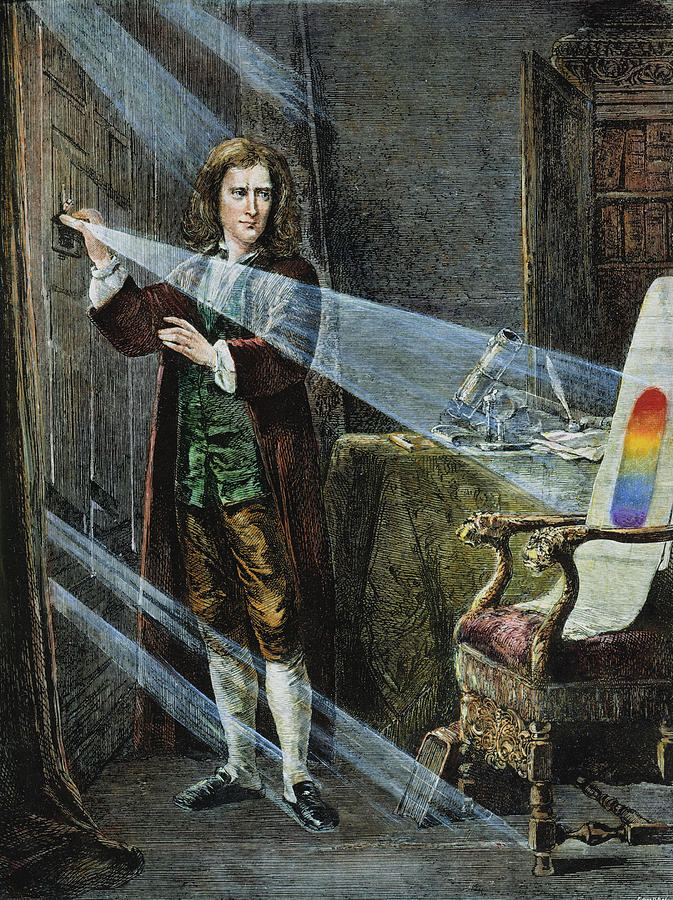
17th century science at Isaac Newton’s “laboratory”. An innovative use of a keyhole, don’ t you think?
Isaac Newton, Professor at Trinity College, London, fled London to escape the twin catastrophies of a recurrent Bubonic Plague outbreak and the later “Fire of London”. Both of which occurred during a 2 year period, 1665-66, during which a third of London’s population died.
To occupy himself during his self-imposed “lockdown”, he compiled his reflections on gravity and related physical phenomena, in a classic work entitled: PRINCIPIA, the foundation of modern physics.
Gravity and light were key parts of his research interests and speculations. It was two centuries and a fraction later that Albert Einstein proposed that both light and gravity were “wave” phenomena and that both were “bent” as they moved through space. Light had been observed to bend and break up into primary colors and wavelengths long before, but gravity was, and is, a continuing mystery in many aspects, even to Einstein.
(Update on gravity reflection: Do Mirrors for Gravitational Waves Exist?; https://arxiv.org/abs/0903.0661, a report from Cornell University, U.S.A.)
Suppose, during the Covid 19 imposed lockdown, we could focus on phenomena such as gravity, and engage in thought experiments which sometimes lead to breakthroughs in science and understanding of our world.
Like most of us, I’m afraid that human nature during this 2020 pandemic and related political opportunism and disfunction have clouded our minds to the point that distraction would be helpful.
Here Goes:
Suppose that, instead of the usual energy hogging metal boxes we move ourselves around in, we used gravity to gently lift our metal boxes off the surface just enough to eliminate the need for wheels or tracks.
Many of you will recognize that this describes an already studied method of doing this, known as “magnetic levitation”. However, this technology requires enormous amounts of electrical energy and infrastructure to implement and operate, so seems to have receded into the archive of brilliant but impractical schemes. Battery-electric vehicles and gyroscopic power systems have their own well-known obstacles to overcome, and neither can function without specific infrastructure and abundant fixed energy suppliers.
All that would be needed for gravity fueled levitation is a means, attached to the “metal box, something like car with no wheels or engine” which needed to be moved around, to reflect the energy already existing between the box and the earth–up to now securing the box to the earth–back to the earth such that the box is lifted sufficiently to enable frictionless movement.
Too advanced for its time, the Aerocar was the model for cars 20+ years later, a creation of Germany’s most innovative aviation pioneer
The beauty of harnessing gravity via reflection/deflection is that, exactly as the gravity field between heavy masses and light ones automatically adjusts to whatever the “metal box” earlier mentioned weighs, sufficient spacing to achieve frictionless travel would depend on how it was focussed rather than a need for external power input. Remember Newton’s determination that, absent air resistance, light bodies fall at the same speed as heavy ones.
Of course, any human inside the box would have in mind a destination, rather than some random amusement ride which could turn into something truly terrifying.
Frictionless movement over a level surface could be enabled by nothing more than, say, the cooling fan or turbine used to displace heat from onboard air conditioning for passengers, for example. Of course, some sort of battery or power source would be needed, since vehicle AC compressors typically require 3 to 5 horsepower to operate. Some type of vane or rudder system would be needed to provide directional control as well.
Braking and wind effects on a frictionless land vehicle would be significant engineering challenges once the forward motion systems are sorted out, but if we were able to harness gravity to lift such a vehicle, perhaps we could use the same force to maintain direction despite wind effects and control momentum (braking).
Most urban travel, except for cities like Pittsburg and San Francisco, is typically on fairly level ground. Hills would obviously be a challenge for frictionless vehicles, so summoning up imaginative solutions for that problem would be additional brain teasers.
My speculation on the “ascent” (hill) challenge is to imagine that harnessed gravity to lift “metal boxes” to enable frictionless movement could possibly be finessed to enable ascent of such a frictionless body, since ascent is a similar challenge to gravity with an added horizontal component.
Have you forgotten about pandemics and politics yet?
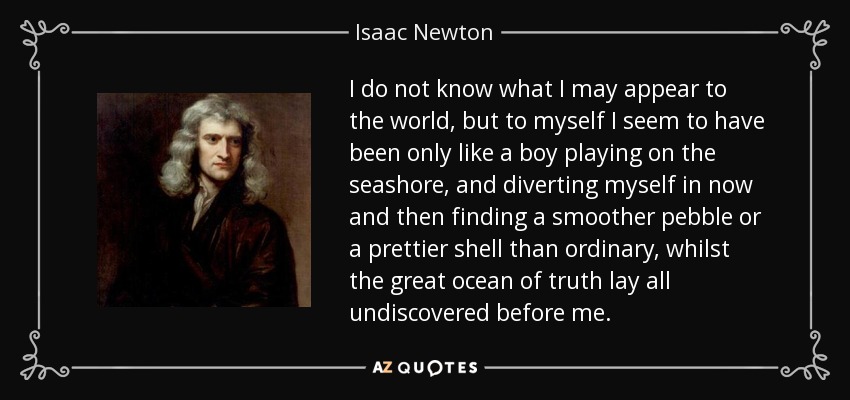
How about a final word from Professor Newton:
Curiosity may have killed the cat, but it underpins all that’s worth knowing, especially science
Russian President Vladimir Putin arrives to take his place with French President Emmanuel Macron, Brigitte Macron, German Chancellor Angela Merkel, President Donald Trump, and first lady Melania Trump at the Arc de Triomphe in Paris, France.
Republicans were once proud of claiming that Ronald Reagan won the Cold War. “Mr. Gorbachev, Tear down this wall” was the moment often cited as the key point of challenge in a war that threatened more than once to end life on the planet as it waxed and waned from 1946 to 1991. When the wall came down in 1989 and the USSR unraveled until it collapsed in 1991, Republicans stood as the party that took the firmest defense of America’s interests abroad. That stance of confronting any and all threats, both real and imagined, to the US backed global order continued throughout the Bush I and Bush II regimes. Republicans, including Trump, frequently attacked the Clinton and Obama administrations for their supposedly weak defense of American interests abroad.
But when the Russians attacked us in the citadel of our democracy, our elections, Republicans actively cooperated with Russia to cover up and deny that attack, and even took money from organizations such as the NRA that appear to have been turned into laundromats for Russian money. Meanwhile, Republican Supreme Court nominees in the Citizens United decision threw the door open to dark money and ensured that this dark money would be untraceable. In effect the Republican majority on the Supreme Court turned the Constitution, with its protections of fundamental rights and democratic processes, into a suicide pact in which dark money from whatever sources could be used to turn us against ourselves.
Now, Republicans defend a president who seems determined to aid former spy, current Russian dictator Vladmir Putin, to reverse that Cold War victory. Moscow Mitch may be an epithet, but it accurately reflects the core of compromise and accommodation that now characterizes what was once described as the party of Ronald Reagan, the man who won the Cold War. Now, Republicans stand firmly behind, and beside, and in front in defending Trump, a man who appears determined to leave the United States without allies, without alliances, and surrounded on all sides by enemies determined to redraw the maps of the post WWII/post Cold War world.
This is not an imagined fear. It is all too real, and very far along in its progress. Yet no Democratic debate yet has really probed this threat to our freedoms and even our existence as a nation. This must be recified in the coming debate. Make no mistake about it, as Bill Taylor’s 15 pages of opening testimony attests, NATO and the European Alliance are in deep peril. Russia has already and continues to use force to redraw the post Cold War European map. American allies in Ukraine and Syria are dying as a result of Trump’s treachery. Russia has the center of the NATO line already weakened. With Turkey’s connaivance, Russia has now weakened the southern flank. And Trump is doing all he can to wreck America’s Pacific alliances and the China Card Reagan played that was crucial in ending the Cold War.
I spent the final years of the Cold War between the USSR and USA living and working in Hong Kong, which was then described as the window on China and a hotbed of agents of all sides on the prowl for intel. Reagan was in his final two years as President. As China reformed and opened up during the 1980s, the peril and isolation of the USSR grew. This was readily discernible from Hong Kong, where I continued to live until late 2015, teaching in a department of government and international studies. When the West, in no uncertain terms, punished China for the mid-1989 Tiananmen Square massacre with sanctions and with effectively siphoning off many of the most promising Chinese students abroad, Soviet leaders knew that their shaky economy could not withstand a similar response. And this played a role in the hesitancy they exhibited as demonstrations grew throughout the Soviet bloc and eventually spread to the USSR “republics” themselves.
The unity of the West, led by the United States, and buttressed by our ringing affirmations of democracy and freedom in defensive alliances such as the UN and NATO, as well as in agencies of economic cooperation and freedom such as the World Bank and WTO (then the GATT), constrained and then collapsed the dictatorships that ruled the majority of humanity during the Cold War. The Ukraine, as a result, broke free.
Russia has never accepted Ukraine’s independence and it appears it still covets its lost global influence. Putin appears determined to resurrect Russian global power and simultaneously destroy America’s.
This Cold War victory is thus in very real danger of being reversed. If Putin can break up the EU and NATO, the United States loses access and assistance from what is currently the largest economic bloc on the planet. Technically, the US and EU together command about 40% of the global economy. With the Asian alliance with Japan and our strong relations with China, well over half the global economy was strongly influenced by the United States as of 2016. But America alone is about 16-18% of the global economy, and shrinking. In purchasing power parity terms, China is already larger economically than the US according to the World Bank. A Russia-China bloc would have immense global influence without a US-EU-Japan and other allies block to counter it. If the US is weakend enough, you can be certain China will move to secure its hold over the entire South China Sea and over Taiwan. Japan, alone, would have no choice but to secure its vital trade routes through the South China Sea by alliance with China instead of the US. Other Pacific allies such as Australia and NZ, much of South America and Central Asia would shift orbit from the US to China.
Without our global alliances, the United States would be isolated in a world very much increasingly imperiled by global threats such as climate change and the rampant spread of nuclear weaponry. Even a “small” nuclear war between Pakistan and India would, as recent studies show, kill hundreds of millions globally. The Bulletin of Atomic Scientists recently noted the world is in as much or even more danger of nuclear war now than during the Cold War.
The global threats are growing. Our alliances and influence are weakening. This is a recipe for disaster, both to the US and our planet.
In attacking our democratic system and rule of law, Putin is attacking the very core of the global security and trade system that reflects and protects those values. There is no question Trump shares that hatred of democracy and rule of law with his master, Putin. With Trump disrupting and neglecting the UN, NATO, and the WTO—attacking all those agencies that globalized American democratic and legal values and systems, he proves himself a positive, present danger to the American Republic. His actions are wholly traitorous.
Yes, all these agencies need to better reflect our democratic values and better protect us as human beings, but they cannot be made better if they are destroyed. We cannot advance the global cooperation needed to address climate change and nuclear weapons without them. We cannot defend ourselves, our climate, our values, or our trade and hence prosperity alone. But Trump and Republicans today appear determined to strip us defenseless and to render us impotent.
Trump must be impeached and removed from office. And all those who defend this traitor must similarly be investigated for any criminality that may be found and/or voted from office. That includes Moscow Mitch, who may actually be a witting agent of Beijing, not Moscow, or perhaps of both. Assuredly, he is no patriot. Further, the “good behavior” of US Supreme Court justices who opened the door for Russian intervention and the destruction of our democracy must be fully, carefully investigated by Congress. If questionable associations (Deutschebank and a particular former justice come to mind) led to the majority forming this disastrous decision, the decision itself must be reconsidered. And if the “majority” do not reverse the decision, steps must be taken to impeach and remove justices who insist on forcing the United States to commit suicide. It cannot be considered “good behavior” to actively assist those who aim to destroy the nation.
As was said long ago, Now is the time for all good men and women to come to the aid of their country. We are clearly under attack from foes both foreign and domestic. Remember your oaths. Read the many diaries laying out how to assist in the coming election, and do your part, and do your part now in supporting our Congressional representatives who are standing up for us and our nation against those who want nothing less than to become rich by assisting the dismantling of this country.
Multiple actors in the United States, Russia, and Ukraine have been promoting the idea of investigating Ukraine’s alleged election meddling, as well as the inquiry about the Bidens. The calls for such measures have been promoted especially by Ukrainian lawmakers known for their pro-Russian views, including Yuri Boyko, the co-chairman of Ukraine’s biggest pro-Russian party.
“Russia’s influence over its largest European neighbor can be restored only by undermining the American involvement.”
According to the English-language Ukrainian newspaperKyiv Post, three other Ukrainian lawmakers—Oleg Voloshyn, Valentyn Nalyvaichenko, and Andriy Derkach—are also “doing Trump’s dirty work” to try to prompt the investigations he demanded from the Ukrainian president.
The Kyiv Post pointed out the lawmakers’ links to the oligarch Dmytro Firtash, discredited former Prosecutor General Yuriy Lutsenko, and President Trump’s former campaign chief Paul Manafort.
Voloshyn, who calls Manafort his friend, authored a flattering opinion piece about him in December 2017. At the time, Robert Mueller’s prosecutors argued that Manafort violated a gag order by heavily editing Voloshyn’s op-ed that attempted to whitewash Manafort’s work in Ukraine.
The politically motivated investigations of the Bidens and Ukraine’s alleged interference in the U.S. elections would play right into President Vladimir Putin’s hands by jeopardizing bipartisan U.S. support for Kyiv. The Kremlin, which seized and annexed the Crimean Peninsula in 2014, sees Ukraine as the highly coveted jewel of the post-Soviet region. But Russia’s influence over its largest European neighbor can be restored only by undermining the American involvement. Putin personally pitched in to paint a negative picture of Ukraine, when President Trump inexplicably sought his “guidance” on how to deal with President Volodymyr Zelensky.
The Kremlin has strived continually to drive a wedge between the United States and Ukraine in order to get the country back firmly into Russia’s sphere of influence. Russian state media repeatedly urge the Ukrainian government to go along with Trump’s demands, no matter how humiliating, or else lose any hope of continued U.S. support.
The host of Russian news talk show 60 Minutes, Evgeny Popov, warned: “If Trump gets re-elected, and you don’t investigate Biden… [Ukraine] won’t get anything from America. Not a thing.” The co-host of 60 Minutes, Olga Skabeeva, scoffed: “With respect to mutual American-Ukrainian love, as we know, nothing lasts forever,” adding, “Trump could spit on Ukraine.”
The leader of a pro-Russian group of Ukrainians, Yuriy Kot, picked up that refrain: “Trump could spit on Ukraine!” Kot added that if Trump is re-elected, Ukraine can expect “four more years of hell from the United States of America. You don’t even understand the horror that is coming your way.” Skabeeva summed up: “For Ukraine, this is a catastrophe… Americans are directly telling you they’re sick of you. Nobody needs you.”
“Trump could spit on Ukraine.”
— Olga Skabeeva, co-hose of Russia’s “60 Minutes”
Such demoralizing drivel from Russian state media is, of course, designed to push the fledgling democracy away from the U.S. and back into Russia’s orbit.
Trump, for his part, has been in the “blame Ukraine” camp for years as a way to diminish or discredit the consensus of the U.S. intelligence community and many of its Western allies that, as Fiona Hill pointed out, Putin had waged a systematic effort to undermine U.S. democracy, with support for Trump a part of that strategy.
Putin and Trump reportedly have discussed allegations of Ukrainian interference in U.S. elections. In a 2017 Oval Office meeting, Trump told Russian Foreign Minister Sergei Lavrov and Russian Ambassador Sergey Kislyak that he was unconcerned about Moscow’s election interference. At the G20 in June of this year, Trump grinned and playfully wagged his finger as he told Putin: “Don’t meddle in the election.”
One month later, during Trump’s now infamous July 25 call with Ukraine’s Zelensky, Trump urged him to investigate Ukraine’s alleged meddling in the U.S. elections—and the lesson drawn from all this by Putin? Appearing at the economic forum Russia Calling, he smirked: “Thank God no one is accusing us of interfering in the U.S. elections anymore. Now they’re accusing Ukraine.”
But here’s the fact of the matter. Russia’s unprecedented interference in the 2016 U.S. presidential election has been described, with reason, as “the most successful influence campaign in history, one that will be studied globally for decades,” and it is far from over.
Instead of counteracting Russia’s malign influence, American foreign policy under Trump is seemingly being guided by it and leaders of the Republican Party are doing their best to aid and abet that program.
The wave of Kremlin disinformation started with faceless workers at the St. Petersburg “troll factory” banging away at their keyboards, striving to reach everyday not-very-well-informed Americans who would in turn misinform others within their sphere of influence.
The operation surpassed Putin’s wildest dreams when ripples of disinformation surged into a tsunami as Candidate Trump and then President Trump started openly to recite Russia’s fictive talking points. The range of dissemination was then magnified by Trump’s Republican supporters, along with his 67 million Twitter followers, and media outlets hanging on to every word uttered by the leader of the mightiest country in the world.
Russia Can’t Get Enough of Impeachment Hearings
‘TRUMP UNCHAINED’
Julia Davis
In sum, there’s no question the presidency of Donald J. Trump has proved to be enormously beneficial for the Kremlin, and supporters of the Russian president are openly rooting for Trump’s re-election.
Russian state television channel Rossiya-1 has dispatched its reporter Denis Davydov to broadcast directly from the impeachment hearings and, probably this should not be a surprise, Russian state-media coverage sounded eerily like much of Fox News, echoing the disingenuous claims by Trump supporters that there was no pressure against Ukraine and no “quid pro quo.”
For the first time in modern history, in the era of Trump, Russian state television is more than happy to support the Republicans—and for a good reason.
What actually happened to Otto Richter and his wife? They were reported to have been seen in Cuba several years later. Good thing too, since Belgium later fell to Nazi Germany, its Jewish inhabitants paying the price.
According to the stock photograph repository Alamy, the picture was taken on 12 June 1936 and credited to the German newspaper Süddeutsche Zeitung and featured a man named Otto Richter and his wife protesting at Ellis Island. A 24 December 1937 report in Seattle’s The Jewish Transcript provides a full accounting of Richter’s remarkable story, which ended with his deportation to Belgium (as opposed to Nazi Germany) after significant pressure from U.S. based-advocacy groups:
In November, 1933, a young German seaman jumped ship In the harbor of Seattle. He was in the truest sense of the word a political refugee, seeking the right of asylum from a regime of tyranny and dictatorship. This young man’s name was Otto Richter; born in Bremen, Germany, he was a worker and an active anti-Nazi. On the night of the burning of the Reichstag, storm troopers apprehended him and, though he had not the slightest connection with that event, beat and tortured him. The next four and a half months he spent hiding from Hitler’s secret police. [He] managed to enlist as a seaman and sail on German boat which was to call at ports in the United States. During the voyage his identity became known and officers of the ship, after abusing him, threatened to turn him over to the police on their return to Nazi Germany. These were the circumstances underlying Richter’s attempted escape from Nazi tyranny to American freedom.
What has happened since? In July, 1934, during the San Francisco general strike, a vigilante raid was made on the Workers Center, and there Otto Richter was found engaged in what the Department of Labor evidently regarded as the heinous offense of helping to feed striking marine workers. He was seized and ordered deported to Nazi Germany on the technical charge that he had remained in the United States illegally. Since that time a long legal battle has been fought by the American Committee for Protection of Foreign Born to save him from deportation. And only the tremendous counterpressure of mass sentiment has secured for Otto Richter the dubious privilege of being deported to a country of his choice -— Belgium -— instead of to Hitler’s sadistocracy.
RUSSIANS have demanded the return of Alaska from the US in a fiery new memorial.Images of the stone engraving in the Crimean town of Yevpatoria have emergedin the region recently annexed from the Ukraine by Vladimir Putin.Russia has flexed its muscles in Crimea since seizing the region from neighbour Ukraine in 2014.
Carrying an image of Crimea and Alaska, an inscription on the marble slab reads: “We have returned Crimea, you are to return Alaska!”
Has Vladimir Putin set his sights on ALASKA after war-mongering Russians demanded the US state is returned to Moscow’s rule?
United States bought the icy state from Russia for just £6million back in 1876, or $7.2 million dollars. Though an enormous sum just after the Civil War, Russians in 2016 are quick to point out that our government paid with a “rubber check”, since the Senate of the day refused to back the check with actual money. This is the basis of the claim by many that the U.S. acquired Alaska through fraud.
Years passed until the Russian Ambassador summoned a number of Senators, including Daniel Webster, to a sumptuous dinner during which he provided Senators present with a “gift” of $10,000 (the equivalent of millions today) each. Soon afterward, the Senate backed the check mentioned above with actual funds.
BY DANNY COLLINS, staff writer for the London SUN newspaper
27th October 2016, 2:57 pm
It is just the latest in a series of coded warnings from newly-resurgent Moscow that it is eyeing up its former territory.
How Russia once ruled a North American empire all the way down to California
Russia first established colonies in North America back in 1733.
Eastern pioneers first established settlements in Alaska, Canada, and then later in California.
Russia also held two ports on the Pacific islands of Hawaii.
Voyages were first made across the narrows of the Bering Strait in the hunt for valuable sea otter pelts.
By the mid 19th-century, intrepid explorers had established Fort Ross in California, for the purpose of growing food for its Alaskan colony.
But Moscow was forced to abandon its American adventure by 1867, citing the high cost of war with Britain–at the time considering annexing (by force) Russian territory adjoining its own North American lands, now known as Canada. An additional problem was that the sea otter harvest had resulted in depleting the resource, very nearly rendering the species extinct.
The Russian and US mainland are separated by barely 55 miles across the Bering Strait.
Each country possesses one of the Diomede Islands, which are only two miles apart.
It means two of the world’s superpowers are barely a few thousand metres (yards, in English measure) apart at their closest point.
The USA’s largest state was later found to contain reserves of natural gas and oil.That fact has not gone unnoticed in Russia, which lies only 55 miles away from Alaska across the Bering Strait.
.On one of Vladimir Putin’s carefully monitored “call-in” programs, a caller asked whether he would like to see his country seize America’s 49th state. Yet Vlad brushed off the question, dismissing the region as a cold outpost of no interest to Moscow.
He replied: “My dear caller, why do you need Alaska?”
“Although we sold Alaska to the United States for a song, we are the northern country. “
“Seventy percent of our territory today is located in regions of the North and Far North.”
“Alaska is not in the Southern hemisphere. It is also cold there.”
“Let’s not be hot-tempered.”
RUSSIA’S CUDDLY MUSIC MAKERS–“LYUBE”
Lead singer of the band “ Lyube”, Nikolai Rastorguyev had sung about the need for Russia to reclaim its territories in Alaska. V. Putin is a fan of this musical group. “Mixed signals” are hallmarks of Putin’s style. Below is an example:
“Do Not Fool with Us, America!The Tsars were wrong! Russia and Alaska are two banks of the same river!”
“Give back our dear land, dear Alaska, give it back to us!”
“We should have reclaimed Alaska a long time ago!”
Only last year an inflammatory TV documentary was aired with the name “When Will Alaska become Ours?” No doubt the script was a production of the Putin homeland propaganda machine. Nothing gets on Russian TV without approval.
It seems clear that the incoming Trump Administration has already figured out how to make the country “great again”. Key to its strategy is the sale or “gift” of public assets to private interests, mainly “friends” of Trump and his pals.
Certainly whatever token amount can be worked out for this fire sale of the heritage of our country will temporarily boost revenues, but in the long term (too late, of course) we will learn the consequences of the election of 2016.
The other part of this festival of greed will be what are called “usage charges” for literally everything essential to life and sustenance, essentially the conversion of freely traveled highways to toll roads, escalating fees for privately owned frequency spectrum and both surface and subsurface water.
Actually we will see a replay of the scandals of the Harding Administration of the 1920s, such as the Teapot Dome bribery case involving the only Cabinet Officer (so far!) convicted of a crime in office, a character well known in New Mexico (and reviled by history!), Albert B. Fall.
Complicit in the Harding greed-fest was Republican lock on Congress, lasting from 1919 to 1930, during which the slide toward Depression and war was launched—another similarity to today.
Sadly, responsibility for this election result belongs with all the eligible voters who, by their indifference, failed to exercise their responsibilities by voting in the 2016 election (final total, 53.1% voted, 46.9 % stayed home). I hope they’re happy.
Recent Comments